
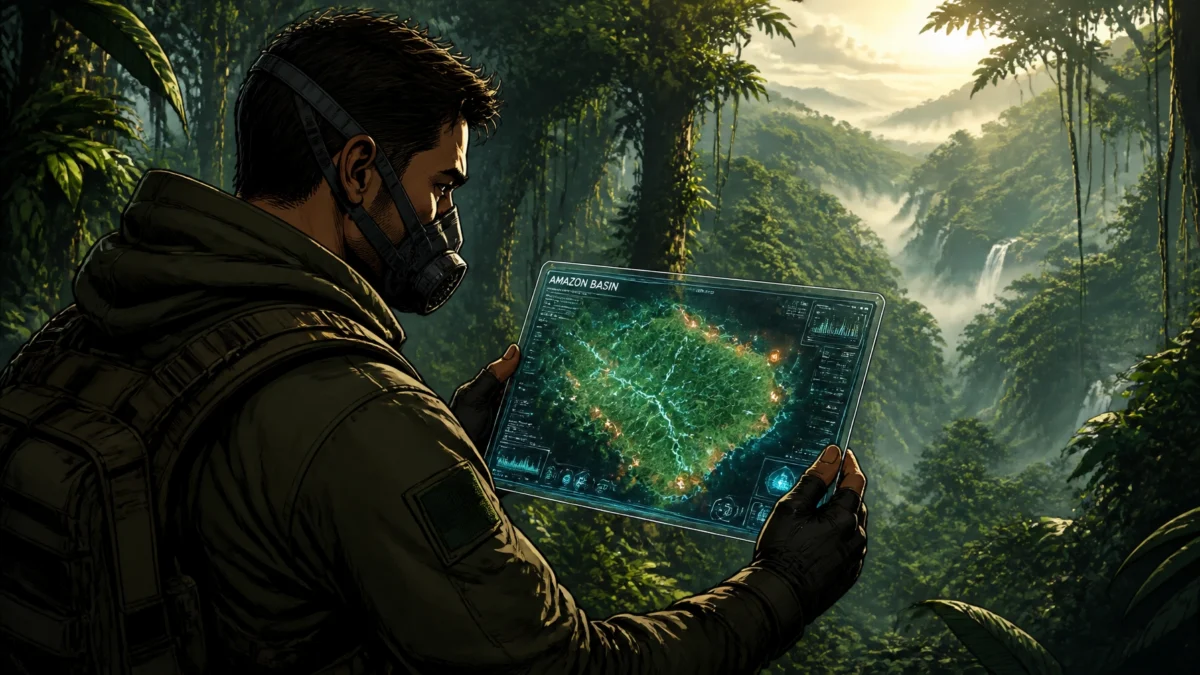
Welcome to 2026, friends! If you’ve been tearing through the pages of The Rainsavers series, you probably think Tom “Primal” Swift and his genius orangutan sidekick, Alpha, are living in a high-octane sci-fi fever dream. Superhuman strength? Ancient red mercury crystals? A rogue agent turning into a moon-base-dwelling monster? It’s a lot to process.
But here’s the wild part: while Tom is busy throwing punches at corporate goons, the real-world fight to save the Amazon is using tech that looks suspiciously like it was ripped straight out of Dr. Mubari’s lab.
As we navigate the mid-2020s, the "real" Rainsavers aren't wearing spandex (mostly because it’s too humid for that, let's be honest, major "oops" on the wardrobe front there), but they are using a "smart nervous system" of satellites, AI, and bioacoustics to keep the lungs of our planet breathing.
Let’s take a look at how the high-stakes tech of the series mirrors the actual conservation efforts happening right now in 2026.
1. Eyes in the Sky: Beyond the Sunbyte Drone
In Book One: Primal Awakening, we meet Sunbyte, the team’s tech specialist who uses cutting-edge drones to track Bossman’s deforestation crews. In the books, these drones are almost magical. In real-life 2026? We call them Planet Labs and Project Guacamaya.
Back in the day (like, 2022), we used to get satellite updates every month. If someone was illegally logging a patch of forest, we wouldn't know until the trees were already on a truck heading to a shipyard. Talk about being late to the party.
Today, researchers are using near-daily satellite imagery combined with AI models. This means forest loss is spotted in days, not months. Systems like Colombia’s official deforestation authority are now using AI to scan huge image sets and identify patterns of roads and mining pads before the heavy machinery even arrives. It’s basically Sunbyte’s tactical map but on a global scale.

2. The Ears of the Forest: Real-World Bioacoustics
Remember when Jungle Dart used those specialized sensors to hear Bossman’s movements miles away? That wasn't just cool writing, it’s a reality.
Organisations like Rainforest Connection (RFCx) have been installing solar-powered "ears" in the canopy. These devices record the forest 24/7. In 2026, AI models have become so sophisticated they can distinguish between the natural chirping of a macaw and the distant, muffled sound of a chainsaw or a gunshot.
When a threat is detected, an alert is sent directly to a ranger’s phone with a GPS location. It’s a "smart nervous system" for the forest. If only we could get them to translate Alpha’s grunts as accurately as they track illegal gold miners! (Alpha, if you're reading this, your recent "Field Notes" were… informative, if a bit heavy on the banana emojis.)

3. The Spirit Tree vs. Real-World Genomics
In Book Five: Curse of the Spirit Tree, the stakes get personal. The Spirit Tree isn’t just a plant; it’s a source of immense power and a symbol of the rainforest’s soul. Mortalis (the artist formerly known as Leonard West) wants to control it, and Primal has to decide if saving the tree is worth losing the forest.
In the real world, our "Spirit Trees" are the ancient, primary forests that hold the genetic blueprint for thousands of species. In 2026, we’ve moved into the era of Environmental DNA (eDNA).
Conservationists can now take a scoop of water from an Amazonian stream and, using portable sequencers, identify every animal that has visited that water in the last 48 hours. We’re cataloging the "Spirit Tree" of life at a molecular level to ensure that even if a species is pushed to the brink, we have the data to bring it back. It’s less "ancient magic" and more "advanced biology," but the feeling of awe is exactly the same.

4. Dealing with "Bossmen" (Policy and Enforcement)
Let’s talk about the villains. Bossman is the classic corporate shark, prioritizing quarterly earnings over the survival of the biosphere. He’s the guy we love to hate.
In 2026, the real "Bossmen" are facing a much tougher crowd. In Brazil, deforestation rates have hit an 11-year low. Why? Because the tech we talked about above, those satellite alerts, is now being handed directly to judges and prosecutors.
When an AI detects an illegal clearing, it’s not just a "sad fact" for a blog post; it’s legal evidence. This has led to massive crackdowns on illegal land grabbing (called grilagem) and unauthorized cattle ranching. The Rainsavers fight with their fists and high-tech gadgets, but real-world rangers are fighting with data, fines, and law enforcement. Both are equally badass in their own way.
5. Historical Echoes: The "German" Connection
One of the coolest parts of The Rainsavers lore is the discovery of abandoned German technology from the 1940s hidden deep in the jungle. While we haven't found any red mercury fusion reactors (yet), the Amazon is full of historical mysteries that are only now being revealed thanks to LiDAR tech.
LiDAR (Light Detection and Ranging) allows us to "see" through the dense canopy to the ground below. In recent years, archaeologists have discovered massive, ancient urban networks that were hidden for centuries. These aren't sinister laboratories, but they do show that the Amazon has always been a place of high-stakes human history and complex civilization.
Leaked Field Notes: The West Files
Speaking of "German" tech, we recently stumbled upon some… interesting scribbles. We’re pretty sure these belong to Leonard West. We shouldn't really be sharing these, but since when does a Rainsaver follow all the rules?

Note from Penny: West’s handwriting is surprisingly legible for a guy who eventually turns into a moon-monster. Also, is that a coffee stain or a bloodstain on the corner? Let's hope it's dark roast.
Why the Fiction Matters
You might wonder why we spend so much time writing about Tom Swift and his team when the real-world stakes are so high. The answer is simple: Stories move the needle.
When you read Book One: Primal Awakening, you aren't just reading an adventure story. You’re engaging with the idea that the environment is worth fighting for. You’re seeing the Amazon through the eyes of heroes who refuse to give up.
In the real 2026, we need that same energy. We need people who are as passionate about protecting the rainforest as Tom Swift is. We need people who are as smart as Alpha. And yes, we even need people who can keep their cool under pressure like Sunbyte.
The Rainsavers might be fictional, but the threat they face: the destruction of our natural world for short-term gain: is very real. The good news? We have the tech, the data, and the heroes to win this fight.
Ready to join the team?
Read Book One now and start your journey into the heart of the Amazon. The world is counting on us; and the series is only just getting started.
