
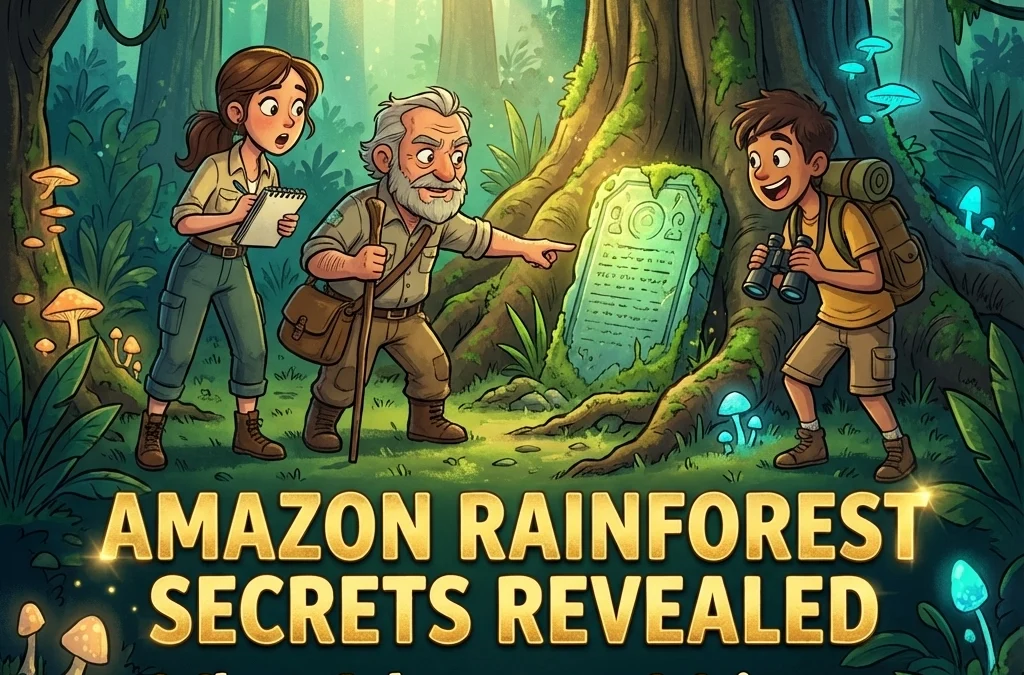

Most adventure writers play it safe. They stick to the same tired tropes: lost temples, generic indigenous guides, and villains who want to "destroy the rainforest for profit."
But here's what they're missing: the Amazon's real secrets are way wilder than anything Hollywood dreams up.
We're talking ancient mega-cities invisible from ground level, soil that renews itself through mysterious microbes, and boiling rivers that shouldn't exist. These aren't fantasy elements: they're documented discoveries that most adventure fiction completely ignores.
Why? Because the truth is harder to research than recycling the same old jungle clichés.
Hidden Cities That Rewrite History
Forget everything you think you know about "primitive" Amazon societies. LiDAR technology recently revealed massive ancient settlements hidden beneath the canopy: complete cities with road networks wider than modern highways, sophisticated canal systems, and organized neighborhoods dating back over 2,000 years.
These weren't small nomadic tribes. We're talking about advanced civilizations that completely reshaped the landscape through engineering skills that modern science is still trying to understand.

Most adventure writers still default to the "lost tribe living in huts" stereotype because it's easier than diving into archaeological journals. But imagine the storytelling possibilities: What if those ancient engineers left behind more than just roads? What if their descendants still guard secrets that could change everything?
In The Rainsavers series, we lean into this reality. Our characters don't stumble across generic "lost temples": they uncover evidence of sophisticated societies whose environmental knowledge puts modern science to shame. Because when you base your fiction on actual discoveries, the stakes feel real.
The Soil That Scientists Can't Replicate
Here's something that sounds like fantasy but isn't: indigenous Amazon communities created terra preta, a man-made super-soil that stays nutrient-rich for centuries and apparently renews itself.
Think about that for a second. Over 1,000 years ago, Amazon peoples mixed charcoal, food scraps, bones, and pottery into the ground, creating soil so superior that modern farmers still can't replicate it. The microbes in terra preta seem to maintain the soil's fertility through processes we don't fully understand.
Most eco-fiction treats indigenous knowledge as mystical wisdom that can't be explained. We prefer the approach where ancient innovation meets modern science: and sometimes the old ways prove superior.

This is exactly the kind of detail that makes or breaks environmental adventure fiction. When your characters discover something that bridges ancient wisdom and cutting-edge research, readers sense the authenticity. They know you've done the work.
Geological Impossibilities That Actually Exist
Want to know what's really hiding in the Amazon? A boiling river hot enough to cook dinner.
The Shanay-timpishka in central Peru reaches temperatures over 200°F despite being nowhere near active volcanoes. The heat sources from deep geothermal fissures, creating a phenomenon so rare that scientists are still studying how it works.
Then there's the massive coral reef system stretching 3,600 square miles at the Amazon River's mouth: thriving in dark, muddy water where coral shouldn't be able to survive. Discovered in 2016, it's already changing what marine biologists thought was possible.
Most adventure writers would turn these into supernatural locations guarded by ancient curses. But the real science is more compelling than any made-up mythology.

In our stories, geological anomalies become tactical advantages. When your team knows the real science behind "impossible" natural phenomena, they can use that knowledge strategically. Suddenly, the environment isn't just a backdrop: it's an active element in the plot.
The Tribes That Choose Isolation
Here's something most adventure fiction gets completely wrong: there are approximately 14 separate uncontacted tribes in the Amazon, numbering around 2,000 people total, and they're isolated by choice.
These aren't "primitive" societies that don't know the outside world exists. They're communities that have deliberately chosen isolation after centuries of conflict with European colonizers and modern exploitation. They know exactly what they're avoiding.
This flips the entire "first contact" adventure trope on its head. What if the isolated communities aren't waiting to be "discovered"? What if they're actively working to stay hidden: and they have very good reasons?
The Rainsavers universe respects this reality. Our characters don't stumble into "undiscovered" villages because they understand the Amazon's human geography. When they do encounter isolated communities, it's through careful negotiation and mutual respect, not accidental discovery.
Biodiversity That Defies Cataloging
Scientists estimate thousands of plant species in the Amazon remain completely unknown to science. Not "recently discovered", literally unknown. We're talking about entire ecosystems in remote regions that haven't been systematically studied.
And it's not just plants. Every expedition finds species that don't match anything in existing databases. The Amazon is essentially a living laboratory where evolution is still actively writing new chapters.

Most adventure stories treat this biodiversity as window dressing: colorful background details to make the jungle feel exotic. But what if undiscovered species held the key to solving modern environmental crises? What if the next breakthrough in sustainable technology was hiding in an unnamed tree?
This is where adventure fiction can get exciting without getting ridiculous. When your characters are racing to document species before climate change destroys their habitat, every discovery matters. The clock is ticking, but the stakes are based on real science.
Why Most Adventure Writers Avoid These Secrets
Here's the thing: incorporating real Amazon discoveries into fiction takes work. You can't just Google "jungle adventure ideas" and call it research. You have to dig into archaeological papers, botanical surveys, and geological reports.
Most writers stick with generic "lost civilization" plots because they're easier to write and don't require fact-checking. But readers can tell the difference between researched worldbuilding and recycled tropes.
When you base your environmental adventure on actual discoveries, every plot twist feels possible. Readers don't just suspend disbelief: they start wondering if this stuff could actually happen.
The Rainsavers Difference
This is exactly why The Rainsavers series digs deeper into Amazon realities than most environmental fiction. Our characters operate in a world where ancient engineering coexists with cutting-edge technology, where isolated communities make strategic choices about contact, and where every ecosystem holds potential breakthroughs.
We don't just use the Amazon as a dramatic backdrop. We treat it as a complex, living system where human and natural histories intersect in ways that most adventure fiction never explores.
Ready to experience adventure fiction that respects the Amazon's real secrets? Start with Book One of The Rainsavers series and discover how environmental adventure can be both scientifically grounded and absolutely thrilling.
Because the truth about the Amazon is way more interesting than most writers are willing to admit.
