
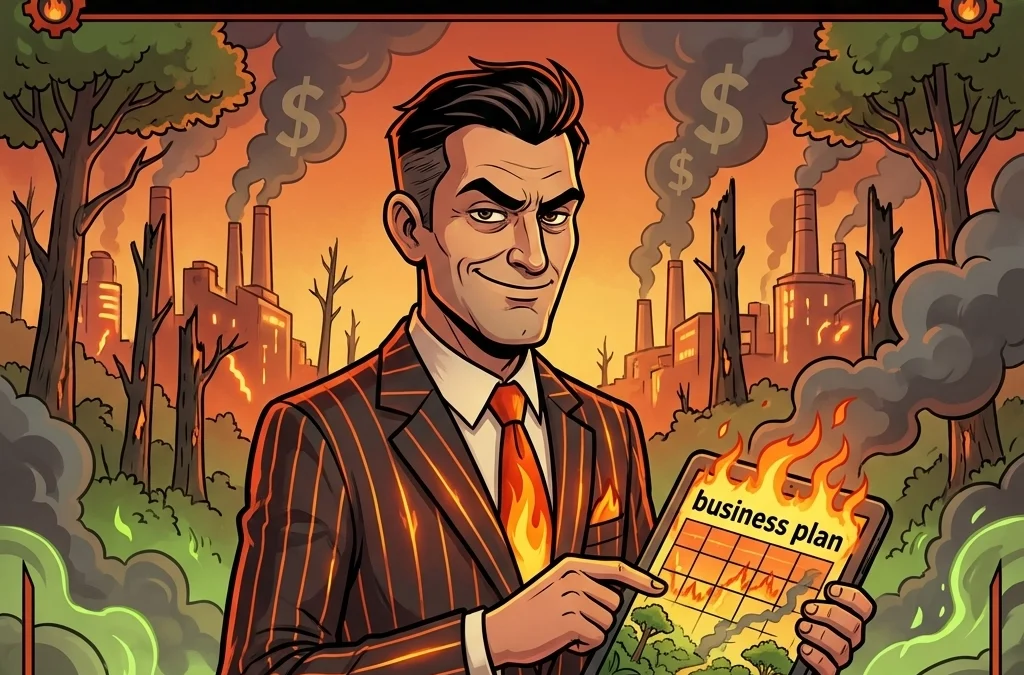
Every great adventure story needs a villain who makes your skin crawl. Not because they're scary or monstrous, but because they're real. They're the kind of person you might actually encounter in a boardroom, wearing a thousand-dollar suit and talking about "maximizing resources" while the world burns around them.
Meet Bossman, also known as Burner – the corporate antagonist who looks at the Amazon rainforest and sees nothing but dollar signs, quarterly reports, and untapped market potential.
The Man Behind the Business Plan
Bossman didn't start out evil. He started out ambitious. Fresh out of business school with an MBA from a prestigious university, he had all the buzzwords down: synergy, optimization, scalable solutions. But somewhere along the way, those buzzwords became his entire worldview. People became "human resources." Ancient forests became "timber assets." Indigenous communities became "market obstacles."

What makes Bossman particularly chilling as a villain isn't his mustache-twirling evil schemes – it's his complete inability to see the Amazon as anything other than a massive, untapped business opportunity. When he looks at a thousand-year-old tree, he doesn't see majesty or wonder. He sees board feet of lumber and the profit margin on premium hardwood flooring.
Corporate Colonialism in Action
Bossman's approach to the Amazon is methodical, clinical, and terrifyingly efficient. He's not some cackling cartoon villain with a doomsday device. He's worse – he's a real-world threat wrapped in legitimate business practices and legal loopholes.
His company, which operates under several shell corporations and subsidiary names, specializes in what he calls "resource optimization." That's corporate speak for "strip everything valuable and leave." His business plan for the Amazon reads like a horror story written in spreadsheet format:
Phase 1: Acquire land rights through questionable but technically legal means
Phase 2: Clear-cut "low-value" vegetation (aka: priceless biodiversity)
Phase 3: Extract valuable resources (timber, minerals, oil)
Phase 4: Convert cleared land to "productive" use (cattle ranching, palm oil plantations)
Phase 5: Move on to the next "opportunity zone"

The scariest part? It's all perfectly legal according to current regulations. Bossman doesn't break laws – he finds ways around them. He hires the best lawyers, lobbies the right politicians, and makes sure every environmental impact study somehow concludes that his projects will have "minimal ecological disruption."
The Psychology of Destruction
What makes Bossman such a compelling villain is that he genuinely believes he's the good guy. In his mind, he's bringing civilization and economic development to "underutilized" areas. When environmental groups protest his operations, he sees them as obstacles to progress. When indigenous communities resist his expansion, he views them as standing in the way of jobs and prosperity.
This isn't mustache-twirling villainy – it's the banality of evil in a three-piece suit.
Bossman has convinced himself that nature exists to serve humanity, not the other way around. He sees conservation as wasteful sentimentality. Biodiversity? That's just inefficient resource allocation. Climate change? That's someone else's problem to solve after he's maximized shareholder value.

His office is filled with "sustainable development" awards and photos of him shaking hands with local politicians. He sponsors youth soccer teams in the communities he's destroying and donates to charity galas in the same cities where he lobbies against environmental regulations. The cognitive dissonance would be fascinating if it weren't so destructive.
Methods and Madness
Bossman's toolkit for Amazon exploitation reads like a master class in modern corporate colonialism:
Greenwashing: Every project comes with environmental-sounding names like "Green Valley Development" or "Sustainable Timber Solutions." His marketing team is brilliant at making destruction sound like conservation.
Legal Warfare: A small army of lawyers ensures that every environmental protest gets tied up in courts for years. By the time legal challenges are resolved, the damage is done and it's "economically unfeasible" to reverse course.
Economic Pressure: He offers short-term jobs and immediate cash payments to communities, creating economic dependence that makes resistance difficult. Why fight the man who's putting food on your table, even if he's also poisoning your water supply?
Political Connections: Strategic campaign contributions and lobbying ensure that regulations stay favorable to his interests. He doesn't buy politicians – he invests in "business-friendly policy development."

Information Control: His PR department works overtime to discredit environmental studies, fund counter-research, and ensure that any negative coverage gets buried under positive economic impact reports.
Why He's the Perfect Antagonist
In the world of The Rainsavers, Bossman represents something more terrifying than any cartoon supervillain: the absolute worst of real-world capitalism unleashed on the natural world. He's not trying to destroy the planet – he's trying to make money. The destruction is just an externality that doesn't appear on his quarterly reports.
This makes him particularly dangerous because defeating him isn't just about stopping one bad guy. It's about confronting an entire system that prioritizes short-term profit over long-term survival. You can't just punch Bossman in the face and save the day (though that would be satisfying). You have to outsmart him at his own game while also protecting what he's trying to destroy.
For eco-adventure heroes like The Rainsavers, Bossman represents their greatest challenge: How do you stop someone who's technically operating within the law? How do you fight an enemy who has more resources, better lawyers, and government support?

The Bigger Picture
What makes Bossman truly chilling is how realistic he is. Every day, real-world Bossmans are making real-world business plans that treat irreplaceable ecosystems like quarterly earnings opportunities. They're not cartoon villains – they're executives, investors, and entrepreneurs who genuinely believe that economic growth justifies environmental destruction.
That's what makes stories like The Rainsavers so important. They show us that environmental protection isn't just about cute animals and pretty trees – it's about standing up to powerful interests that view the natural world as nothing more than an untapped market opportunity.
Bossman isn't just a character in an adventure story. He's a warning about what happens when we let business logic override basic environmental ethics. He's a reminder that the greatest threats to our planet often wear suits and carry briefcases, not capes and ray guns.
Ready to Meet the Heroes?
Want to see how the good guys plan to stop Bossman and his corporate colonialism? Ready to dive into adventure stories that tackle real environmental challenges with both thrills and hope?
Discover the full Rainsavers universe and meet the team of heroes fighting to save the Amazon – and the world – from villains who treat nature like a business plan.
Because in the battle for our planet's future, the most dangerous enemies might just be the ones who never see themselves as the bad guys.
