
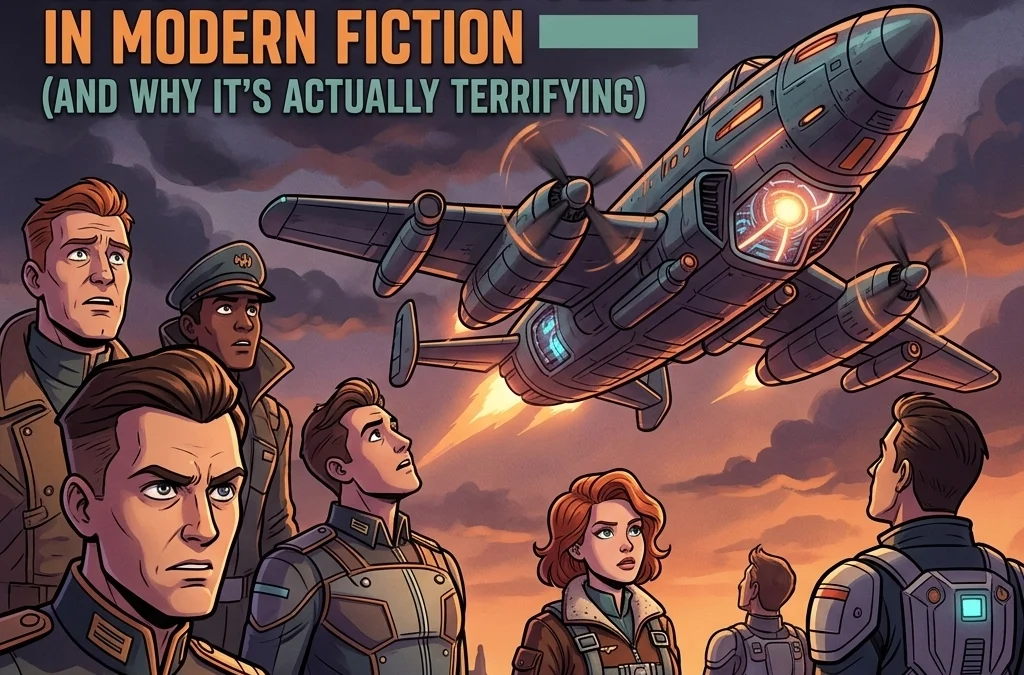
2026 check-in: if you’ve opened a thriller, watched a streaming sci-fi drop, or scrolled past a “secret bunker tech” thread lately, you’ve seen it: German WWII technology showing up everywhere in modern fiction.
Not in a “history class” way, more like a creepy engine writers keep bolting onto contemporary plots. Hidden labs. Prototype respirators. Rocket math. Wunderwaffen blueprints. The myth of a last-minute breakthrough… upgraded with modern materials, modern data, and modern delivery systems.
And that’s the terrifying part: it doesn’t feel made up. It feels… plausible enough to get under your skin.
A quick “case file” on why this trope won’t die (and why it works)
Think of German WWII tech in fiction as a three-part cocktail:
-
It’s real enough to anchor the story.
Nazi Germany did push major weapons development, including advanced rocketry (like the V-2) that foreshadowed modern ballistic missiles. That historical foundation gives writers a launching pad that doesn’t require much suspension of disbelief. -
It’s wrapped in a built-in myth.
Late-war propaganda leaned hard on Wunderwaffen (“wonder weapons”), the idea that one incredible breakthrough could flip a collapsing war. That desperation narrative is pure story fuel: hidden facilities, frantic scientists, moral rot, and “just one more test.” -
It’s instantly cinematic.
Bunkers. Mountain tunnels. Schematics. Hard-edged machinery. Masks. Labels in gothic type. If you’re writing modern fiction, this aesthetic reads like “danger with paperwork.”
So when modern storytellers want a villain’s tech to feel both grounded and nightmarish, WWII German R&D becomes a shortcut, because it already lives in the public imagination as “the stuff they almost pulled off.”
2026 makes it worse (because the “upgrade path” is obvious)
In 2026, audiences are fluent in how innovation actually spreads: research networks, supply chains, talent migration, and the uncomfortable reality that ethically dirty breakthroughs can still shape the future.
History backs that discomfort up. After WWII, large numbers of German scientists were recruited by the U.S. through Operation Paperclip, and pieces of that expertise flowed into postwar development. That doesn’t mean “everything cool came from Nazis” (nope), but it does mean this uncomfortable idea feels believable:
If knowledge survives regimes… what else survives?
Now combine that with modern accelerants, AI-driven modeling, cheap drones, biometric surveillance, black-market logistics, and suddenly “old designs” aren’t quaint artifacts. They’re seeds you can replant into a modern threat.
And in fiction, seeds love to grow teeth.
The real hook: WWII tech isn’t the villain, the obsession is
Here’s the trick modern fiction pulls (and why it hits harder than a simple “secret weapon” plot):
The scary thing isn’t the gadget. It’s the person who can’t let the past go.
That’s why the most effective stories don’t treat WWII tech like a museum prop. They treat it like a psychological magnet, a fixation that drags characters into repeating history, rationalizing cruelty, and turning “research” into a private religion.
Which brings us to Leonard West.
Leonard West: when “history nerd” becomes “history weapon”
Leonard West isn’t powered by lightning. He isn’t fueled by alien crystals. He doesn’t need a magic amulet.
His power source is simpler and far more believable:
He’s obsessed with the past, specifically the parts of the past that promised control.
West’s fixation isn’t the nostalgic kind. It’s not “wow, cool old stuff.” It’s the darker kind: the belief that the past contains unfinished work: and that he’s the guy qualified (destined, even) to finish it.
That obsession becomes a blueprint for how he builds his modern bioweapon: Black Rain.
Black Rain isn’t frightening because it’s “sci-fi.” It’s frightening because it follows a logic we recognize:
- find a framework people already fear,
- wrap it in technical authority,
- and deliver it through modern vectors that don’t care about borders.
In other words: West doesn’t just reference WWII-era tech mythology. He uses it as a storytelling camo net: a way to make his present-day threat feel inevitable.
Why a “high-tech respirator” look hits so hard right now
If you want one visual that sums up the whole vibe: this is it: the field respirator.
Not because it’s stylish (though fiction absolutely loves the silhouette), but because it implies something specific:
- the air is compromised
- the environment is hostile
- survival is conditional
- and the threat is invisible
A respirator isn’t a sword you can see coming. It’s a quiet admission that the world itself has turned against you.
That’s why modern fiction keeps leaning into it: especially when the plot involves contamination, spores, engineered pathogens, or bio-threat paranoia. In 2026, audiences don’t need much convincing that “the invisible thing” is the scariest thing.

Featured image ALT text suggestion (for the image above): Tactical expedition character wearing a high-tech field respirator, rain-slick gear, intense close-up, no logos, no recognizable superheroes
“Wonder weapons” were never just tech: they were a story people wanted to believe
One reason Wunderwaffen continues to haunt fiction is because it wasn’t merely a lab program: it was a narrative:
“We’re losing, but science will save us.”
That narrative is timeless. You can swap the setting, change the uniforms, modernize the hardware, and it still works: because it’s not about metal. It’s about denial dressed as innovation.
And that’s the part that gets recycled into modern villains like Leonard West:
- not “I have a cool device,”
- but “I have the one solution everyone else is too weak to use.”
That’s how obsession becomes permission.
Why it’s especially chilling when the threat is biological (hello, Black Rain)
A rocket is terrifying: but it’s also straightforward. There’s a launch, there’s a boom, there’s a crater.
A bioweapon doesn’t give you that clarity. It gives you:
- delays
- ambiguity
- denial
- misinformation
- panic
- and second-guessing your own senses
That ambiguity is perfect for modern fiction because it mirrors real-world anxiety: the fear that catastrophe can arrive quietly, through systems we depend on, and spread faster than our ability to agree on what’s happening.
Leonard West’s Black Rain leans into that dread. His obsession with the past isn’t window dressing: it becomes a method:
- study old “breakthrough” mythology,
- borrow the aura of forbidden research,
- then apply modern precision and distribution.
It’s not a history cosplay. It’s weaponized longing.
A skimmable checklist: why this trope keeps winning in modern fiction
If you’re wondering why readers keep clicking these stories, it’s usually because they deliver at least one of these:
-
Plausibility without homework
The historical foundation does the heavy lifting. -
Instant stakes
“This is the kind of tech that changes the world” is baked into the premise. -
Atmosphere for days
Bunkers, diagrams, masks, secret files: fiction comfort food, but in a scary way. -
Moral corrosion
It invites the big question: What would you do to win? And then it dares characters to answer. -
The obsession angle
Tech is interesting. Obsession is addictive. Together they’re gasoline.
And Leonard West? He’s basically the trope’s final form: the past as a power source.
What The Rainsavers does differently: the past isn’t trivia: it’s a trigger
At The Rainsavers, we love the “ancient mystery vs modern threat” vibe because it creates villains who feel smart and dangers that feel earned. But we’re not here to romanticize dark history or treat it like a toy box of aesthetics.
We’re interested in the uncomfortable question underneath:
What happens when someone uses history not to learn: but to justify?
Leonard West’s story is built around that tension: his obsession with the past doesn’t just inform his worldview; it powers Black Rain. That’s what makes him feel so grounded: and so unsettling.
If you want to dig deeper into the people tangled up in this world, you can explore more of our universe here: https://rainsavers.com.
And if you want the fast, direct version of what we do best:
See how we blend both
