Meta Description: Is Tom "Primal" Swift a hero or a vigilante? Explore the ethics of "jungle justice" in 2026 and why the system isn’t enough to save the Amazon.
Hey everyone, Steven G. Samuels here.
It’s May 2026, and if you’ve been keeping up with the news lately, you know the world feels like it’s moving at a hundred miles an hour: and most of that movement is toward a bit of a cliff. Here at The Rainsavers, we don't just write books; we try to capture the pulse of what it feels like to live in this strange, high-stakes era.
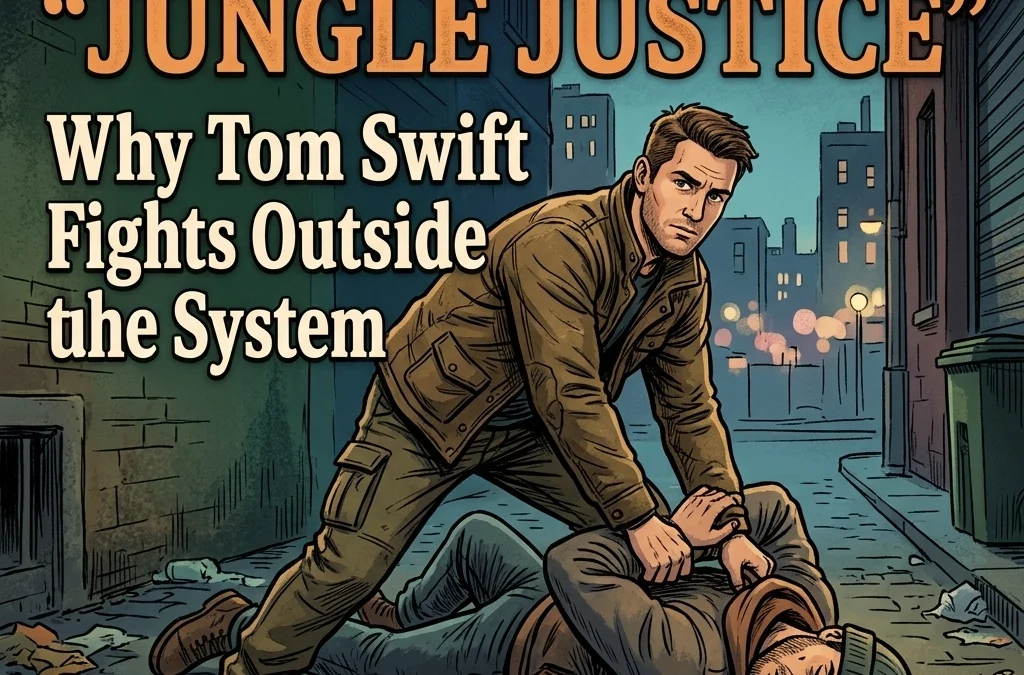
One of the biggest questions we get from readers about our lead hero, Tom "Primal" Swift, is pretty straightforward: “Steven, why can’t he just call the cops? Why does he have to be so… intense?”
It’s a fair question. In a world of laws, why does Tom choose "Jungle Justice"? Why does he operate entirely outside the system? Today, I want to dive into the moral complexity of his mission and why, in 2026, the "official" way of doing things might just be the most dangerous path of all.
The 2026 Reality: Why the System is Stalled
To understand Tom Swift, you have to understand the world he lives in. It’s not a dystopian wasteland: it looks a lot like our world, just turned up to eleven. By 2026, the Amazon is at a tipping point. We’ve seen the reports. The bureaucracy required to stop a single illegal logging operation can take months. There are permits to file, jurisdictions to argue over, and corporate lobbyists in high-rise offices who are paid very well to make sure nothing happens quickly.
In our series, we explore the idea that "the system" isn't necessarily broken; it’s just designed for a world that no longer exists. It’s designed for a world where we had time.
Tom Swift realizes that while a legal team is arguing over satellite imagery in a courtroom in Geneva, a thousand acres of ancient rainforest are being torched. For Tom, the ethics of waiting are worse than the ethics of acting.

ALT Text: A sleek, high-tech tactical drone hovering silently over a dense rainforest canopy, its sensors glowing blue against the emerald leaves.
What Exactly is "Jungle Justice"?
When we talk about "Jungle Justice" in the context of The Rainsavers, we aren’t talking about mindless violence or being a "tough guy" for the sake of it. For Tom, it’s about immediate accountability.
In the traditional legal system, the person who orders the destruction of a biosphere is rarely the one who feels the consequences. They’re protected by layers of corporate shells and legal immunity. "Jungle Justice" strips all of that away. It brings the conflict back to the dirt, the rain, and the immediate moment.
Tom operates on a simple principle: if you are actively destroying the life-support system of the planet, you have forfeited the right to hide behind a desk. He’s not interested in a three-year trial; he’s interested in stopping the bulldozer right now.
The "Primal" Philosophy
There’s a reason Tom earned the nickname "Primal." It isn’t just about his survival skills; it’s about his mindset. He believes that humanity has become too disconnected from the natural laws of the earth. We think our digital contracts and international treaties are the ultimate authority, but Tom knows that the ultimate authority is the ecosystem itself.
By operating outside government channels, Tom is able to act as a representative of the forest, not a representative of a flag. This gives him a moral clarity that people working for the government often lack. He doesn’t have to worry about "diplomatic incidents" or "trade relations." He only has to worry about the trees.
You can learn more about how this philosophy shapes the rest of the team on our characters page.
Why "Direct Action" is the Theme of 2026
In 2026, "Direct Action" has become a bit of a buzzword. But in our fiction, we treat it with the weight it deserves. Direct action is the choice to take personal responsibility for a problem rather than asking someone else to fix it.
Tom Swift represents that part of us that is tired of waiting for a "plan" that never comes. He is the embodiment of the idea that one person with the right gear, the right training, and a complete lack of fear can do more than a committee of a hundred.
This isn't just about punching bad guys. It's about high-tech field respirators, holographic mapping, and using the latest tech to outmaneuver those who would destroy the planet. It’s a tactical expedition where the stakes are literally life and death: for everyone.

ALT Text: Close-up of a high-tech field respirator sitting on a rustic wooden table next to a muddy tactical map.
The High Cost of the Lone Path
But let’s be real: fighting outside the system isn't all cool gadgets and heroic poses. It’s lonely. It’s dangerous. When you operate outside the law, you don’t have backup. You don’t have a pension. You don't have anyone to bail you out if things go south.
Tom’s mission often puts him at odds with the very people he’s trying to protect. He’s hunted by the authorities and targeted by corporate mercenaries. We wanted to show that "Jungle Justice" has a price. It’s a burden Tom carries because he believes no one else can: or will.
If you’re wondering if this kind of hero is still relevant today, you might want to check out our deep dive on why modern eco-heroes are saving fiction.
The Moral Complexity of the Mission
Is Tom Swift a "good" man? That’s for you to decide as you read. He does things that would get anyone else thrown in prison for life. He ignores borders. He destroys private property (specifically, property being used to destroy the environment).
We didn’t want to write a character who is a perfect Boy Scout. We wanted someone who feels the pressure of the world’s clock ticking. When you’re facing the end of the world, does "legal" still mean "moral"? That’s the core question of the series.

ALT Text: A silhouette of a man standing on a high ridge overlooking a vast, misty valley, the sun just beginning to rise over the horizon.
Why This Story Matters Now
We’re living through a time of massive transition. Whether it’s struggling with climate anxiety or just feeling like the world is out of control, we all want someone to step up.
The Rainsavers series is our way of exploring that desire. We take the high-octane adventure of a classic thriller and mash it together with the very real environmental threats we're facing in 2026. It’s tactical, it’s messy, and it’s deeply human.
Tom Swift isn't a superhero. He doesn't have powers. He has a tactical vest, a respirator, and a refusal to look away. He fights outside the system because he knows the system is too slow to save us.
Join the Expedition
If you’re looking for a story that doesn’t pull its punches: and a hero who isn’t afraid to get his hands dirty: you’re in the right place. Tom’s journey is just beginning, and the stakes are only going to get higher.
At https://rainsavers.com, we’re building a world where the adventure actually means something. We’re glad you’re here for the ride.

ALT Text: A collection of six adventure novels stacked on a mossy stone, with a compass resting on top of the books.
Discover the hero’s journey: Read Book One now.
Stay primal,
Steven G. Samuels
CEO, The Rainsavers
