
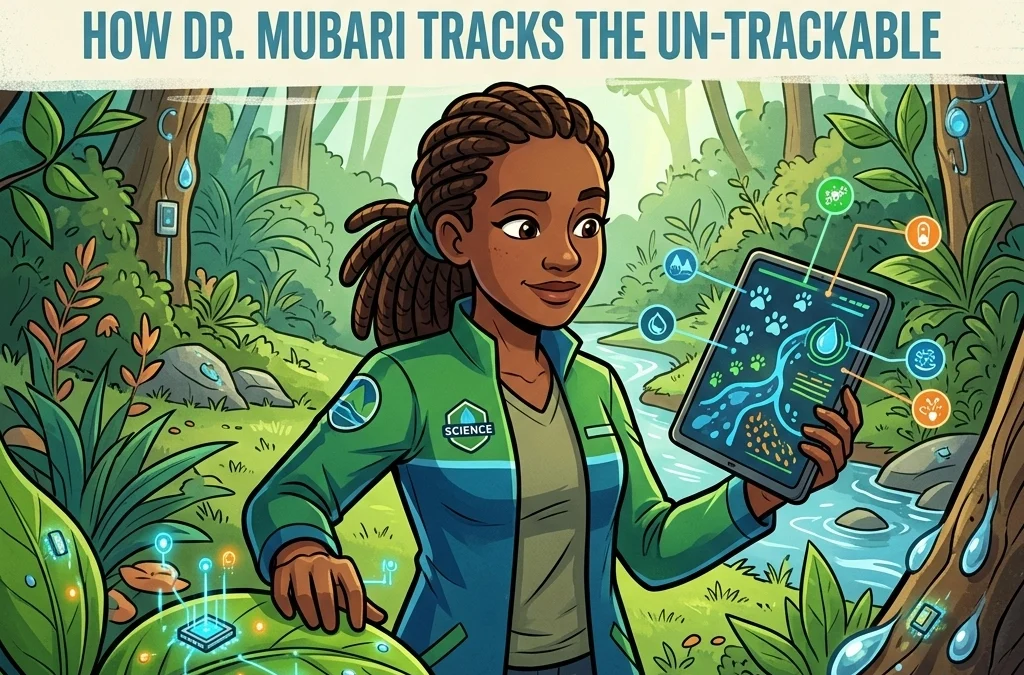
Meta Description: Dr. Mubari is changing the game in 2026. Learn how her cutting-edge nano-sensors track the elusive Leonard West through the densest rainforests on Earth. High-tech meets high-stakes adventure!
Hey everyone, Steven here. If you’ve been keeping up with The Rainsavers lately, you know that the jungle isn’t just a bunch of trees and humidity: it’s a high-tech battlefield. And leading the charge on the tech front is none other than our very own Dr. Mubari.
By now, it’s May 2026, and the world has seen some pretty wild leaps in technology. But what Mubari is doing in the heart of the Amazon and the Congo Basin is something straight out of a fever dream. She’s not just using cameras or drones; she’s turned the forest itself into a massive, living biological hard drive.
Today, I want to pull back the curtain on the tech that makes our favorite team so effective. We’re talking about nano-sensors, molecular tracking, and how you hunt down a man like Leonard West when he literally blends into the shadows.
The "Invisible Net": What Are Nano-Sensors?
When most people think of "tracking," they think of a blinking red dot on a map. But if you’re trying to find someone in a million square miles of canopy, a GPS tag is about as useful as a flashlight in a sunstorm. Leonard West is too smart for that. He knows how to jam frequencies and spoof signals.
That’s where Dr. Mubari’s "Invisible Net" comes in.
These nano-sensors aren’t metal boxes with wires. They are microscopic, synthetic biological mimics. Think of them like high-tech pollen. Dr. Mubari has engineered these sensors to behave like local spores. They travel on the wind, they stick to clothing, and they embed themselves in the moist bark of the Ceiba trees.

ALT: A digital rendering of microscopic, glowing orange nano-sensors floating through a dense green jungle canopy like bioluminescent dust.
Once they are deployed: usually via a high-altitude "dusting" from the team’s transport: they create a mesh network. Each sensor communicates with its neighbor using low-frequency bio-resonance. It doesn’t look like a radio signal to a jammer; it looks like the natural electrical hum of the forest.
Why the Field Respirator?
You’ve seen the latest mission logs where Dr. Mubari is rocking that sleek, tactical field respirator. It’s not just for the aesthetic (though, let’s be honest, it looks incredible).
In 2026, the rainforest is a different beast. Between the "spore-dusting" tech she’s deployed and the volatile organic compounds (VOCs) that certain ancient plants release when they’re disturbed by West’s industrial machinery, the air is thick with data: and danger.
Mubari’s respirator is a piece of tech in its own right. It filters out the nano-sensors she’s deployed so she doesn’t breathe in her own tracking network, but it also features a built-in HUD (Heads-Up Display). When she’s adjusting a sensor on a mossy trunk, she’s not just looking at a piece of wood. She’s seeing a stream of data: temperature fluctuations, carbon dioxide spikes, and the chemical signature of man-made boot rubber.
Tracking Leonard West: The Ultimate Game of Hide and Seek
Leonard West isn’t just a villain; he’s a ghost. He’s spent decades learning how to disappear. He doesn’t use cell phones. He doesn’t carry traditional tech. He moves through the brush like he was born from it.
But even a ghost leaves a wake.
Dr. Mubari’s sensors are tuned to detect "anomalous displacement." When a human-sized object moves through the undergrowth, it disturbs the local micro-climate. It changes the humidity in a three-foot radius. It bruises leaves, releasing specific enzymes.
Mubari’s sensors pick up these enzyme releases. They "smell" Leonard West before they see him.

ALT: Dr. Mubari leaning over a handheld tablet in the middle of a dark jungle, the blue light of the screen reflecting off her tactical respirator as she analyzes a red heat-map.
During the most recent encounter, West thought he had given the team the slip by doubling back through a mangrove swamp. In any other decade, he would have been gone. But Mubari had "seeded" the water. The nano-sensors attached themselves to the mud on his boots. As he walked, he left a trail of "bio-bread-crumbs" that glowed like a neon sign on Mubari’s HUD.
High-Tech Meets High-Stakes
It’s easy to get lost in how cool the tech is, but we can't forget why Dr. Mubari does this. The stakes in 2026 are higher than ever. It’s not just about stopping one guy; it’s about the health of the entire planet.
The sensors don’t just track West; they track the rainforest’s heartbeat. They monitor soil acidity, moisture levels, and the migration patterns of endangered species. Mubari is effectively the doctor for the Earth, and her sensors are her stethoscope.
When West’s operations pour chemicals into a river or clear-cut a section of ancient growth, the nano-sensors send out a "pain signal" through the network. The Rainsavers get an alert before the first tree even hits the ground.
It’s this fusion of science and environmentalism that makes The Rainsavers so different from the old-school hero stories. We aren’t just fighting bad guys; we’re defending the lungs of the world with every piece of tech we have.

ALT: Close-up of a tactical glove touching a tree, where a tiny, glowing nano-sensor is being placed directly into a crack in the bark.
The Challenges of 2026 Tech
Of course, it’s not all smooth sailing. The rainforest is a hostile environment for tech. Humidity kills electronics. Ants try to eat the sensors. And Leonard West has a few tricks of his own.
One of the biggest hurdles Mubari faces is power. You can’t exactly plug a nano-sensor into a wall. To solve this, she’s utilized "bio-nanogenerators." These tiny units harvest energy from the forest itself. They use the vibration of the wind, the flow of sap inside the trees, and even the temperature difference between day and night to keep their tiny batteries charged.
It’s a perfect loop. The forest provides the energy, and the sensors provide the protection.
What’s Next for Dr. Mubari?
As we move further into the year, the "tech-war" between Dr. Mubari and Leonard West is only going to escalate. We’ve heard rumors that West is developing a "null-field" to scramble the sensors, but if I know Mubari, she’s already three steps ahead.
She’s currently working on "neural-link" integration, allowing her to sense the forest’s distress signals directly through her respirator’s interface. Imagine being able to feel when a section of the jungle is being threatened. It’s the ultimate evolution of the eco-hero.
If you want to see this tech in action and follow the pulse-pounding hunt for Leonard West, you really need to dive into the books. The world of 2026 is complex, dangerous, and incredibly exciting.

ALT: A wide shot of the Rainsavers team moving through a misty forest at dawn, with Dr. Mubari in the lead, her respirator glowing faintly in the morning light.
We’re living in a time where fiction and reality are blurring. The kind of tech Dr. Mubari uses might seem like magic, but it’s rooted in the very real science that’s being developed today. That’s what we love about writing these stories: showing you a future that’s not just possible, but worth fighting for.
Thanks for sticking with us and supporting the mission. The jungle is watching, and thanks to Dr. Mubari, so are we.
Stay curious, stay green, and keep reading.
Explore the tech of the future: Read Book One now.
