Meta Description: Explore the wild flora of the Amazon with Dr. Mubari’s 2026 Survival Guide. From life-saving sap to "Angel's Trumpet" hazards, learn what to protect and what to avoid.
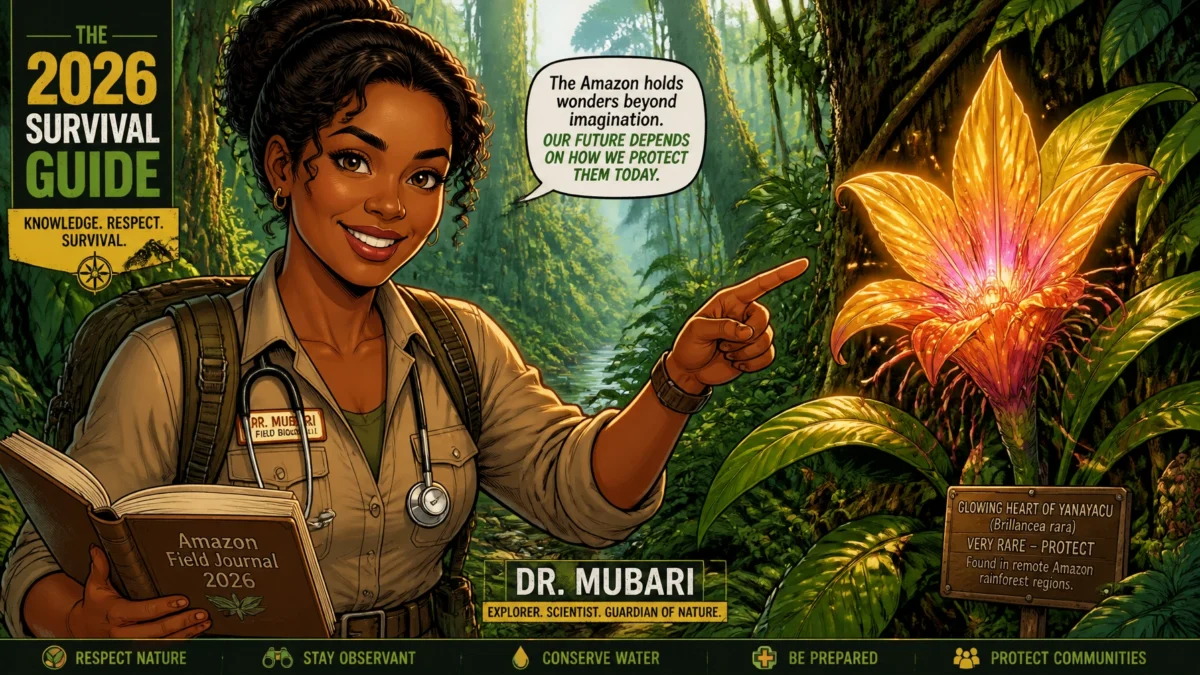
Hey everyone! Dr. Mubari here. If you’ve been following our latest expeditions into the deep Amazon this year, you know that 2026 hasn't exactly been a quiet time for us. Between dodging Bossman’s "development" crews and keeping Tom (or "Primal," as he insists on being called when he’s lifting whole trees) from accidentally sitting on rare orchids, I’ve had my hands full.
The Amazon isn't just a backdrop for our battles; it’s a living, breathing pharmacy, and sometimes, a living, breathing hazard zone. Whether you're a scientist, an adventurer, or an orangutan like my friend Alpha (who really should stop trying to eat everything that glows), you need to know your leaves.
Here is my official 2026 Field Guide to 15 plants you’ll find in the heart of the rainforest. Some will save your life. Others? Well, they’re the reason I carry a very large first-aid kit.
Part I: The Lifesavers (The Plants We Must Protect)
If we want to stop the deforestation fueled by corporate greed, we have to understand the value of what’s being cut down. These plants aren't just greenery; they are the future of medicine.
1. Sangre de Drago (Dragon’s Blood)

This is one of my favorites. If you nick the bark of Croton lechleri, a thick, bright red sap oozes out. It looks like blood, hence the name, but it’s actually an incredible liquid bandage. It’s antibacterial and speeds up wound healing. Primal uses it almost daily after his "disagreements" with Bossman’s mechanical loggers.
2. Cat’s Claw (Una de Gato)
Named for the hooked thorns that look like, you guessed it, a cat’s claws. This woody vine is a powerhouse for the immune system. We use it to treat everything from inflammation to stomach issues. Just watch your sleeves; it’s a clinger!
3. Cinchona (The Quinine Tree)
History buffs might know this one. The bark of the Cinchona tree gave us quinine, the first real treatment for malaria. Without this tree, the history of global exploration would look a lot different. In 2026, we’re still finding new alkaloids in its relatives that could help with modern respiratory issues.
4. Achiote (Annatto)
You might have seen the seeds as food coloring, but for the local tribes, Achiote is a medicinal staple. It’s used as a remedy for skin problems and even as a natural sunscreen. Plus, it makes for great team-bonding face paint when we’re trying to stay stealthy.
5. Lapacho (Pink Trumpet Tree)
It’s beautiful to look at, but its inner bark is where the magic happens. It’s been used traditionally to fight infections and even help with chronic pain. When the rainforest is under threat, we aren't just losing wood; we're losing the raw materials for the next generation of antibiotics.
6. Guayusa
Think of this as the "Amazonian Espresso." The leaves are packed with caffeine and antioxidants. It’s what keeps me awake during those long nights in the lab when we’re tracking Leonard West’s movements across the globe.
7. Cordoncillo
Commonly known as the "spiked pepper," the leaves of this plant are an amazing local anesthetic. If you have a toothache in the middle of a jungle trek, this is your best friend. Just don't mistake it for the next category of plants…
Part II: The "Do Not Touch" List (The Forest’s Defense System)
The Amazon knows how to protect itself. Some of these plants are just plain mean, while others were used by ancient warriors, and later, by 20th-century German researchers, to create some truly terrifying tech.
8. Angel’s Trumpet (Brugmansia)

Don't let the name or the beautiful, hanging bell flowers fool you. Every part of this plant is toxic. It’s a powerful hallucinogen and can be fatal if ingested. We’ve seen Leonard West’s team trying to synthesize compounds from this to create "confusion gas" for their operations. Stay away!
9. Curare (Strychnos toxifera)

This vine is the source of the famous arrow poison. It causes total muscle paralysis. While modern medicine uses it in controlled doses for anesthesia, in the wild, it’s a death sentence. Alpha once accidentally knocked my sample jar over, thankfully, he didn't try to taste it!
10. Castor Bean (Ricinus communis)
While it’s found all over the tropics now, its seeds contain ricin, one of the most poisonous naturally occurring substances on Earth. It only takes a tiny amount to be lethal. Bossman’s bio-weapon researchers have a weird obsession with this one, and for good reason.
11. Yellow Oleander
This ornamental-looking shrub is a heart-stopper, literally. It contains cardiac glycosides that can cause the heart to fail. It’s a stark reminder that "natural" doesn't always mean "safe."
12. Ayahuasca (The Sacred Vine)
I put this in the "dangerous" section not because it’s a poison, but because it’s extremely potent and must be handled with respect. It’s a psychoactive brew used for spiritual ceremonies. Misusing it or turning it into a "recreational" drug is a recipe for a psychological disaster.
13. Manchineel (The Little Apple of Death)
Though usually found closer to the coasts, this tree is the ultimate "nope." Its sap causes blistering on contact, and eating its small green fruit can be fatal. If it starts raining, do NOT stand under this tree; the water dripping off the leaves will burn your skin!
Part III: The Rare & Mysterious (The Sci-Fi Flora)
As we’ve discovered in our adventures from the Giza pyramids to the moon, some plants interact with things that shouldn't exist in nature, like ancient German tech and Red Mercury.
14. Red Mercury Ferns

These aren't exactly a natural species. We’ve found that near sites where Leonard West has been experimenting with Red Mercury, the local ferns start to exhibit bioluminescence and strange growth patterns. These "mutated" plants are a sign that the environmental balance is being thrown off by alien or high-tech interference. They’re beautiful, but they’re a warning sign of Mortalis’s influence.
15. The Spirit Tree
The crown jewel of the Amazon. The Spirit Tree isn't just a plant; it’s the heartbeat of the entire rainforest. It holds the power to restore or destroy, and it’s what we’re all fighting for. If Mortalis gets full control of the Spirit Tree’s energy, the "survival guide" for 2027 is going to be a very short book about how to live on a dead planet.
Dr. Mubari’s Final Survival Tip
Living in the Amazon has taught me that the forest is a mirror. If you treat it with respect, it provides you with everything you need to thrive. If you treat it like a resource to be mined and burned, well, it has plenty of ways to fight back.
Want to see how we’re putting this knowledge to use? Or maybe you want to see Alpha try (and fail) to use a high-tech scanner? Check out the full story of our battle for the planet.
Dive into the adventure! Get your copies of The Rainsavers series today at rainsavers.com.
Stay safe out there, explorers!
( Dr. Mubari)
