Meta Description: Are the secret chambers in adventure novels real? In 2026, science is proving that fiction is closer to the truth than we thought. Explore Giza’s newest secrets and how they tie into the high-stakes world of The Rainsavers.
Hey everyone, Steven G. Samuels here.
As we roll through April 2026, I’ve been spending a lot of time thinking about why we are still, thousands of years later, absolutely obsessed with the Great Pyramid of Giza. If you’ve been following The Rainsavers, you know we don’t just write about the environment; we dive deep into the mysteries that connect our planet’s past to its future.
With Book Four on the horizon (yes, the desert one!), I wanted to pull back the curtain on what’s actually happening in Egypt right now and why your favorite high-stakes adventure books are getting a lot more "right" than the skeptics would have you believe.
The 2026 Reality: Science is Finally Catching Up to Fiction
For decades, if an author wrote about a "hidden chamber" or a "secret corridor" inside the Great Pyramid, historians would roll their eyes. They’d say, "We’ve mapped it all, there’s nothing left to find."
Well, it’s 2026, and those skeptics are looking a little dusty.
Thanks to the ScanPyramids project and the latest in muon tomography (basically using cosmic rays to see through stone), we’ve confirmed that the pyramids are far from "fully explored." Just recently, scientists confirmed a massive, 30-foot-long corridor hidden right above the main entrance. When adventure books depict heroes crawling through narrow, undiscovered vents to save the world, they aren’t just making it up, they’re anticipating the next headline.
At The Rainsavers, we love that sweet spot where "maybe" becomes "definitely." In our upcoming adventures, the tech our team uses to navigate these ancient sites is based on the same high-tech tools researchers are using in the field today.

What Adventure Books Get Right (And Why It Matters)
When you pick up a high-stakes mystery, you expect booby traps, astronomical alignments, and technology that defies explanation. While we haven't found any giant rolling boulders lately (thankfully for the archaeologists), there are three big things that fiction gets 100% right:
1. The Mathematical Impossible
Adventure books often claim the Pyramids were built with a level of precision that shouldn't have been possible. Guess what? It’s true. The Great Pyramid is aligned to true north with an accuracy of within three-sixtieths of a degree. It’s more accurately aligned than the Meridian Building at the Greenwich Observatory in London. Fiction writers use this to hint at "ancient advanced tech," and honestly, looking at the data, it’s hard not to wonder the same thing.
2. The Missing Pieces
In every good thriller, there’s a missing artifact or a "key" to the pyramid. In reality, the Great Pyramid is the only one of the "Seven Wonders" that is largely empty. No mummies, no gold, no "Book of the Dead" was ever found in the main chambers. This "emptiness" is the perfect vacuum for adventure stories. If it wasn't a tomb, what was it? A power plant? A library? A map? We explore those exact questions in Book Four.
3. The Labyrinth Below
Most people think the pyramid is just what you see above ground. But adventure books always feature a subterranean world. In the last few years, ground-penetrating radar has hinted at a massive network of tunnels and voids beneath the Giza Plateau. The "underground city" trope isn't just a trope anymore; it’s a working hypothesis.

High-Tech Expeditions: Real Life vs. The Rainsavers
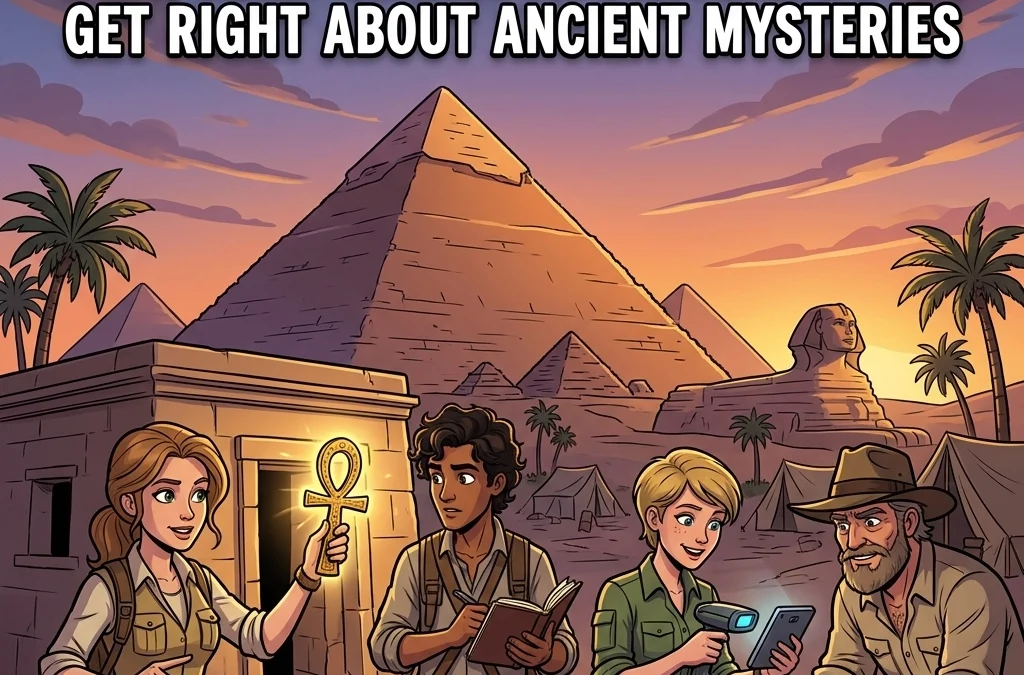
In the featured image for this post, you see a team using holographic maps in front of the pyramids at night. That’s not just a cool aesthetic; that’s the future of exploration.
In 2026, we aren't just swinging torches and hoping for the best. We’re using:
- Muon Imaging: Seeing through solid rock using subatomic particles.
- Holographic AR Overlays: Mapping 3D scans onto the physical world so explorers can "see" through walls.
- AI-Driven Linguistic Analysis: Decoding inscriptions in real-time to find hidden architectural clues.
In The Rainsavers, our team uses these exact types of tools. We believe that to save the future, you have to be able to read the past with the best technology available. This blend of "Ancient Tech vs. Modern Threat" is what keeps the stakes so high.
A Leaked Note from Leonard West’s Journal
I managed to "borrow" a page from Leonard West’s private notes (don't tell him). He’s been doing some prep work for the team's move into the North African sector, and his thoughts on Giza are… well, classic Leonard.
Log Entry: April 14, 2026
Still haven't shaken the sand out of my boots from the Cairo site. The locals keep talking about 'The Whispering Void': a section of the pyramid that supposedly hums at a frequency that messes with digital equipment. The experts call it 'geological interference.' I call it a security risk.
If the readings are right, the void we’re tracking isn’t just a room. It’s a conduit. If we can get the drone through the upper ventilation shaft without it getting fried, we might actually see what the 'ancients' were trying to keep hidden. Or what they were trying to power.
Note to self: Bring more backup batteries. And maybe a physical map. Technology is great until the 4,000-year-old stone starts singing.

Why the Giza Plateau is the Ultimate Setting for 2026
We live in a world of climate anxiety and shifting borders. People are looking for stability and for stories that remind them that humanity has survived "impossible" odds before. The Pyramids are the ultimate symbol of that survival.
When the Rainsavers head to Giza in Book Four, they aren't just there for a history lesson. They are looking for a solution to a modern-day ecological crisis that might have its roots in ancient engineering. Adventure books get the "vibe" of Giza right: it feels like a place that is waiting for the right person to show up and turn the lights back on.

The "Mystery" of the Alignment
One thing we’ve been playing with in the writers' room is the alignment of the three main pyramids with the stars of Orion’s Belt. While some scientists say it’s a coincidence, the precision is just too perfect for an adventure writer to ignore.
In 2026, we’ve discovered that this alignment might actually be a seasonal calendar designed to predict massive shifts in the Earth's Nile flow: a literal "rain-saving" device from the past. Imagine if the key to stopping a 21st-century drought was written in the stars and stones of 2500 BCE.

Join the Adventure
We’re getting closer to the big reveal of Book Four, and I can promise you one thing: the secrets we’re digging up are going to change the way you look at the Great Pyramid forever. We’re moving beyond the "mummies and gold" tropes and into a world where ancient wisdom is the only thing standing between us and a very dry future.
Are you ready to see what's really inside the void?
Keep your eyes on the horizon (and the stars). The team is just getting started, and the desert has a lot to say if you’re willing to listen.
Discover the mystery and stay tuned for more "Field Notes" as we get closer to the launch!
: Steven G. Samuels, CEO, The Rainsavers
