Meta Description: Is the Amazon really at a tipping point in 2026? We compare the high-stakes fiction of The Rainsavers with real-world conservation data to see if "eco-hope" can still save the planet.
Hey there, fellow earth-savers and bookworms!
It’s May 2026, and if you step outside or scroll through your feed, the conversation around the environment feels… heavy. We’ve all seen the headlines. We’ve felt the weirdly hot spring days. And if you’re a fan of The Rainsavers, you’ve seen our team: led by the likes of Dr. Mubari and Alpha Orangenius: battling high-tech villains to keep the lungs of our planet breathing.
But a question we get asked a lot at the office (usually over way too much coffee) is this: “Does protecting the Amazon actually matter anymore, or are we just writing pretty stories while the world burns?”
It’s a fair question. Is the Amazon "too far gone" in 2026? Is the fiction we write just a fantasy, or is it a roadmap? Today, we’re doing a reality check. We’re pitting the fictional stakes of our series against the hard data of 2026 to see where they meet, where they clash, and why stories of "eco-hope" are the secret weapon we actually need.
The Tipping Point: Fiction vs. Fact
In The Rainsavers, the threat is often immediate: a pulse-pounding race against a countdown clock. In the real world of 2026, the clock is more of a quiet, steady tick.
The Fiction: In our books, the villains often use ancient German tech or weather-altering machines to trigger an ecological collapse in days. It’s high-octane, ancient mysteries vs. modern threats kind of stuff.
The Reality: As of today, roughly 17% of the Amazon has been deforested. Scientists have been warning us for years that the "tipping point" sits somewhere between 20% and 25%. Once we hit that, the forest stops being a rainforest and starts turning into a dry savannah. It stops making its own rain. It stops breathing.
So, does it matter in 2026? Absolutely. We are currently standing in the "Yellow Zone." We haven’t hit the 20% mark yet, but we can see it from here. Every acre protected today isn’t just "saving a tree": it’s preventing that self-reinforcing cycle of drying out that would change the world’s weather forever.

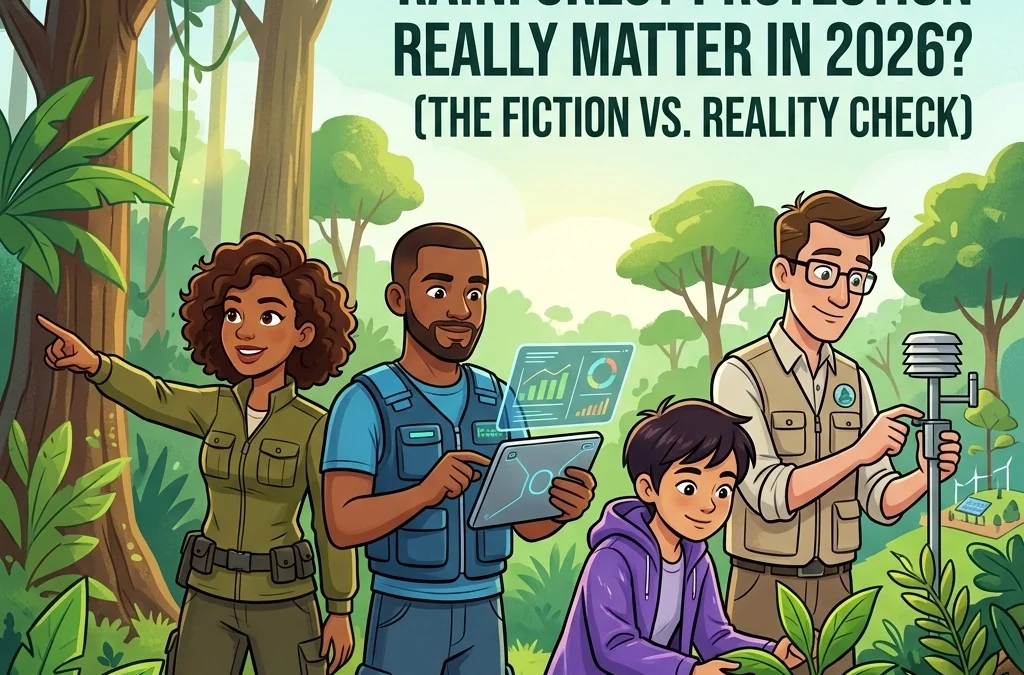
ALT text: A cartoonized Dr. Mubari in a tactical field respirator, presenting a comparison between fictional and real rainforest data on a high-tech screen.
The Tech Gap: Are We Actually Using "Rainsaver" Gadgets?
One of the coolest parts of writing The Rainsavers is coming up with the tech. Whether it’s Sunbyte’s hacking rigs or Dr. Mubari’s bio-scanners, we love a good gadget. But how close is real-life 2026 tech to the stuff in the books?
You’d be surprised.
In the real world right now, we have autonomous reforestation drones that can plant 40,000 seeds a day. We have AI-powered acoustic sensors (essentially "digital ears") hidden in the canopy that can detect the sound of a chainsaw from miles away and alert authorities in seconds.
In the series, Sunbyte takes on the machines behind deforestation using high-level coding. In reality, we are seeing "digital twins" of the Amazon: complete 3D virtual maps updated in real-time by satellites: that allow conservationists to predict where illegal logging will happen before it even starts.
The "fiction" isn't as far-fetched as it used to be. We’re living in an age where tech is finally catching up to the scale of the problem.
The Villains: Ancient Secrets vs. Modern Greed
In The Rainsavers, our heroes often face off against shadowy organizations utilizing ancient German technology found deep in the jungle. It’s pulp adventure at its finest.
But who are the real villains in 2026? They aren’t usually wearing capes or hiding in secret bunkers. The real "villains" are systemic:
- Illegal Cattle Ranching: Responsible for nearly 90% of deforested areas in the Brazilian Amazon.
- Wildcat Gold Mining: Which poisons the rivers with mercury, affecting both the fish and the Indigenous communities who live there.
- Apathy: The feeling that the problem is too big for any one person to solve.
This is where the fiction comes in. In a story, you can punch a villain. In real life, you "punch" deforestation by making better consumer choices, supporting Indigenous land rights, and staying informed. Our books serve as a metaphor for the fight we’re all in. When you see Jungle Dart protecting the forest, it’s a reminder that the "protector" instinct lives in all of us.
Why "Eco-Hope" is the Most Important Tool in 2026
Let’s be honest: the news is depressing. "Doomscrolling" is the national pastime of 2026. If you look at the raw data, it’s easy to feel like the Amazon is a lost cause.
But if we believe it’s a lost cause, we stop trying. And if we stop trying, it becomes a lost cause.
This is why we write "Eco-Fiction." We call it "Eco-Hope."
By creating stories where a team of diverse, flawed, but determined heroes can actually make a difference, we give our brains a break from the doom. We show that while the threats are massive, they aren't invincible. Stories like The Rainsavers help readers struggling with climate anxiety by focusing on action, community, and the idea that nature is worth fighting for.

ALT text: A wide, lush view of the Amazon canopy in 2026, with a futuristic drone hovering in the distance, symbolizing the merge of nature and tech.
The Reality Check: Does it Matter?
So, back to the big question. Does Amazon protection matter in 2026?
Yes. Here is why:
- Carbon Storage: The Amazon holds up to 200 billion tons of carbon. If that goes into the atmosphere, "global warming" becomes "global frying."
- Fresh Water: The forest provides 25% of Earth's freshwater.
- Biodiversity: We are still discovering new species every single week. Some of those species might hold the cure for diseases we haven't even named yet.
- Indigenous Wisdom: Over 2 million Indigenous people call the Amazon home. They are the most effective protectors of the land, and their rights are central to the forest's survival.
In The Rainsavers, the team realizes they can't save the world alone. They need local allies, high-tech tools, and a lot of heart. The same is true for us.
Meet the Team Saving the (Fictional) World
If you’re new to our universe, you might wonder who’s leading the charge in our pages. Our heroes aren't perfect, but they represent different ways we can all contribute:
- Dr. Mubari: The scientific mind who sees the data but chooses to believe in the solution.
- Alpha Orangenius: The genius orangutan who reminds us that we are part of the animal kingdom, not masters of it.
- Primal: The muscle, showing us that strength is best used for protection, not destruction.
Each of these characters faces the same question we do: "Does this matter?" And every time, they choose to act.
Final Thoughts: Fiction as a Spark
Reality tells us the Amazon is at a crossroads. Fiction gives us the courage to choose the right path.
In 2026, protection doesn't just "matter": it is the defining challenge of our generation. Whether you’re reading about our team navigating a trap-filled German ruin or you’re donating to a real-world reforestation project, you’re part of the same movement.
The Amazon is still breathing. It’s still rain-making. It’s still the most magical place on Earth. And as long as there are people (and orangutans) willing to fight for it, there’s hope.
If you’re looking for a way to channel that "save the world" energy, or you just want a rip-roaring adventure that makes you feel a little better about the planet, come join the team.
See the reality: Read Book One now.
