
Meta Description: Sunbyte files a funny 2026 mission report about hacking a German moonbase radio, juggling medical duty, and discovering that ancient technology has terrible customer service.
Field Note Date: 2026
Filed By: Carolina “Lina” Solimar, unofficially known as Sunbyte
Mission Status: Successful-ish
Coffee Status: Compromised
There are two kinds of people in the world:
- People who see a mysterious radio signal coming from an abandoned moonbase and say, “We should investigate.”
- People who see a mysterious radio signal coming from an abandoned moonbase and say, “We should investigate, but first I’m going to check whether the signal is encrypted, booby-trapped, or broadcasting extremely annoying music.”
I am the second kind.
Unfortunately, the Rainsavers were already halfway to the moon by the time I finished saying “probably don’t touch that.”
So, naturally, I touched it.
Mission Brief: The Radio That Wouldn’t Mind Its Business
The trouble began after the team recovered equipment connected to a crashed Haunebu II spacecraft. The gear was old, strange, and deeply committed to making every repair more difficult than necessary.
Then it picked up a signal.
Not a normal signal, either. This one was pulsing through a German-era radio system and bouncing between frequencies like it had somewhere to be. It wasn’t sending a simple distress call. It was layered with codes, timing patterns, and enough interference to make my left eye twitch.
Tom wanted to follow it.
Dr. Mubari wanted to understand it.
Alpha wanted to press the biggest button.
I vetoed Alpha’s plan.
Alpha pressed the button anyway.

The signal led us to the dark side of the Moon, where an abandoned German moonbase was apparently waiting for someone to arrive and make a series of poor decisions.
We were very qualified.
Sunbyte’s First Rule of Moonbase Hacking
Before I joined The Rainsavers, I worked in a clinic in Manaus and helped Dr. Mubari with scientific research. My days involved patients, medical supplies, data, and trying to convince people that “please stop using the sterilizer as a coffee warmer” was a reasonable request.
At night, I handled secure systems, encrypted networks, surveillance equipment, and corporate databases belonging to people who believed destroying the rainforest was an acceptable business strategy.
So the moonbase radio felt familiar.
In the same way that a crocodile feels familiar if you have previously met a large dog.
The basic problem was simple: the radio was built to keep outsiders out. The more complicated problem was that the radio had been designed decades earlier, yet it was still smarter than several modern security systems I’ve encountered.
The system used:
- A rotating frequency pattern
- Mechanical signal relays
- Analog encryption
- A backup power source that absolutely should not have still been working
- A warning tone that sounded like a kettle experiencing a personal crisis
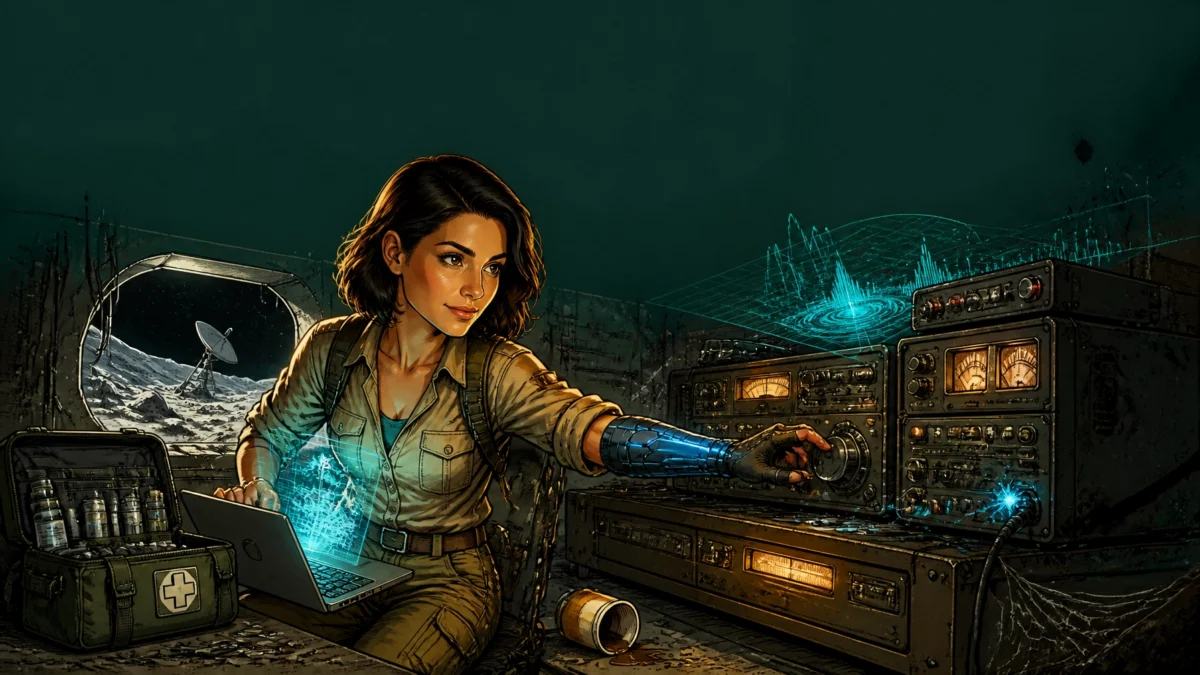
My Neural-Link Gauntlet could connect with the digital components, but the older systems had to be handled manually. That meant opening panels, tracing wires, reading faded markings, and avoiding anything that looked like it might explode.
I am excellent at all four.
Mostly.
Oops No. 1: The Door
The first obstacle was the moonbase entrance.
It had no visible keypad, scanner, handle, button, lever, or sensible design feature. Just a smooth metal door with a tiny red indicator light.
Naturally, Tom tried pushing it.
Nothing happened.
Jungle Dart tried looking for a hidden mechanism.
Nothing happened.
Alpha examined the door, made a thoughtful noise, and then sat down in front of it.
That actually helped. His harness picked up a faint Morse-code response from inside the wall.
The door was listening.
I connected my gauntlet to the nearest access panel and began mapping the system. It had three security layers: electronic, mechanical, and what I can only describe as “someone had too much time in 1943.”
I bypassed the electronic lock in eleven seconds.
The mechanical lock took another four minutes.
The third layer took twenty minutes and one embarrassing realization: the access code was printed upside down on the inside of the panel.
I had been reading it backward.
The door opened.
I stood there confidently for approximately half a second before tripping over the threshold.
For the record, the threshold was raised for no reason.
Oops No. 2: The Radio Was Listening Back
Inside the base, we found the communications room. It looked like a museum exhibit designed by someone who disliked museums.
There were reels, dials, cables, metal cabinets, blinking lights, and one enormous radio console humming in the corner. The signal was coming from that console.
I plugged in the gauntlet.
The console immediately activated every speaker in the room.
A deep mechanical voice began repeating a message in German.
Everyone looked at me.
“I didn’t do that,” I said.
The console repeated the message.
“I mostly didn’t do that.”
The message wasn’t a threat. It was a sequence of coordinates, followed by a status report from somewhere else in the base. The radio system was checking in with its own internal network.
That meant the moonbase wasn’t entirely abandoned.
It was just abandoned in the way a haunted house is abandoned: technically empty, but still full of noises that make you reconsider your life choices.
I started isolating the transmission while Dr. Mubari translated the data. Tom watched the corridor. Alpha watched me.
Alpha is very good at making you feel judged without saying a word.
What Sunbyte Actually Does on the Team
People sometimes think my job is “hacking things.”
That is technically true, but it’s like saying Dr. Mubari’s job is “having a laboratory.” There is more to it.
I keep the team connected. I track movement, intercept communications, analyze security systems, identify threats, and make sure our equipment works when we are several thousand miles from the nearest repair shop.
I also keep everyone alive when plans develop unexpected features.
That happens often.
My nursing background matters just as much as my technical skills. A mission can go wrong because of a locked door, a bad signal, a damaged power cell, a hostile security system, or one teammate deciding that a mysterious glowing object looks “probably safe.”
That last one is usually Alpha.
In the moonbase, I was monitoring the radio while checking everyone’s vital signs through my AR glasses. Tom had a bruised shoulder. Dr. Mubari had a minor cut. Alpha had somehow acquired a piece of equipment he was not authorized to touch.
I removed it from his hands.
He looked offended.
I gave him a bandage.
He looked more offended.

Oops No. 3: The Coffee Incident
At 02:17 lunar-base time, I found the encryption key.
At 02:18, I spilled coffee on the auxiliary control panel.
Before anyone panics: the coffee was not hot.
Before anyone applauds: that was because I had forgotten to drink it for six hours.
The panel flickered.
The radio signal changed.
The moonbase lights went out.
There was a pause.
Then the emergency lights came on in a color best described as “ominous tomato.”
Tom asked if the coffee had caused it.
“No,” I said.
The radio crackled.
A door somewhere behind us slammed shut.
“Probably no,” I added.
The good news was that the power interruption exposed a hidden section of the transmission. The bad news was that it also activated a security sweep.
So now I had to decrypt the signal while moving the team through a dark lunar facility before the base decided we were a problem it could solve with machinery.
This is why I prefer clinics. The vending machines are less aggressive.
The Trick: Don’t Fight the System
The radio looked impossible to crack because I was treating it like a modern digital network.
It wasn’t.
It was a conversation between old systems: the radio, the relays, the base’s power grid, and a set of automated routines that had been repeating for years. Instead of forcing my way through the encryption, I let the system explain itself.
I fed it a false maintenance response.
It replied with a diagnostic request.
I answered with a corrupted timestamp.
It sent back a repair protocol.
I gave it the correct protocol, but changed one small identifier.
The system accepted me as part of its own maintenance network.
Was this elegant?
Yes.
Was it ethical?
We were inside an abandoned moonbase connected to dangerous technology and hostile operators, so I’m comfortable with the answer.
Did I accidentally rename the entire radio network “PLEASE WORK”?
Also yes.
That name appeared on every display for the next twelve minutes.
Nobody mentioned it.
I appreciated that.
Why Sunbyte Matters
The Rainsavers are a team because no single person can solve every kind of danger.
Tom brings leadership and courage. Alpha brings astonishing intelligence, excellent instincts, and a troubling enthusiasm for buttons. Dr. Mubari brings science, compassion, and the ability to explain impossible discoveries without immediately running away.
I bring the connection between all of them.
I translate data into decisions. I turn scattered clues into a route forward. I keep one eye on the enemy network and one eye on everyone’s pulse rate.
And when a plan collapses, I am usually the person saying, “Okay, nobody panic,” while actively panicking in a highly organized manner.
That is not weakness. That is multitasking.
You can learn more about Lina’s background, medical work, and technical role in Sunbyte’s character spotlight, or meet the full team on The Rainsavers’ character page.
Final Mission Report
We decoded the German radio signal.
We discovered where the transmission was being routed.
We opened the moonbase doors.
We avoided most of the security systems.
We did not avoid all of them.
The team escaped with critical information, several new questions, one damaged radio component, and a coffee stain that may now be part of the lunar base’s permanent history.
As for the radio, it continued transmitting after we left.
I’m sure it has plenty to say.
Probably about us.
Probably using my coffee as evidence.
For more strange technology, impossible missions, rainforest stakes, and six connected adventures stretching from the Amazon to the Moon, explore The Rainsavers series.
And if you’re ready to start the mission from the beginning, visit The Rainsavers and begin with Primal Awakening.
Just remember: if you find a mysterious button, ask Alpha to stand very far away from it.
