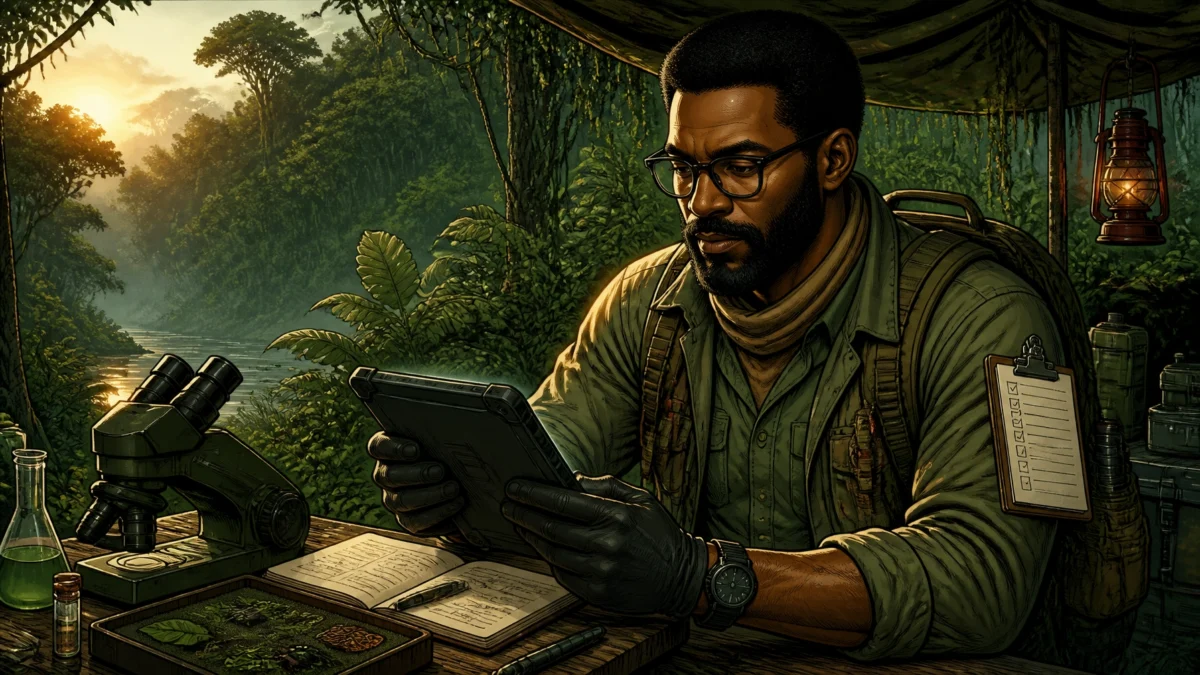
Meta description: Dr. Mubari explains why ethical science matters, from protecting the rainforest to building trust, solving problems, and saving the world responsibly.
Field Entry: August 10, 2026
Location: Somewhere humid, green, and absolutely full of mosquitoes
Research status: Promising
Coffee status: Compromised
Ethics status: Non-negotiable
Science can do incredible things.
It can help us understand diseases, restore damaged ecosystems, develop life-saving treatments, and reveal secrets hidden in the deepest corners of the planet. In the world of The Rainsavers, science can also involve mysterious crystals, experimental serums, moonbases, and machines that should probably come with several warning labels.
But here is the part that matters most:
Scientific knowledge is only a superpower when it is used responsibly.
A brilliant discovery without ethics can become a weapon. A powerful technology without accountability can harm the very people, or ecosystems, it was supposed to help.
I know this because I have seen what happens when science forgets why it exists in the first place.

Rule One: Ask “Should We?” Before “Can We?”
Scientists are naturally curious. We look at a problem and immediately start asking questions.
Can this plant help heal damaged tissue?
Can this organism adapt to changing conditions?
Can this machine collect better environmental data?
Can this energy source power an entire facility?
Those are useful questions. They are also incomplete.
Before moving forward, ethical science asks a second set of questions:
- Who could be helped?
- Who could be harmed?
- What happens if the experiment fails?
- Could the damage be permanent?
- Who gets to make the decision?
- Have the people and communities affected been heard?
- What safeguards are in place?
This is not science being timid. This is science being grown-up.
In The Rainsavers, the villains often have access to impressive technology. Their problem is not a lack of intelligence. Their problem is that they treat people, animals, and the rainforest as raw materials.
Bossman sees the Amazon as something to exploit. Rogue researchers see living beings as test subjects. Power-hungry strategists see discovery as a shortcut to control.
Dr. Mubari sees something different: responsibility.
That distinction changes everything.
Rule Two: Living Beings Are Not Equipment
Let me make this very clear for the benefit of anyone taking notes in a secret laboratory:
Animals are not disposable equipment.
Neither are human beings. Neither are communities. Neither are ecosystems.
Research involving living subjects requires care, oversight, and a serious effort to reduce harm. That means respecting welfare, avoiding unnecessary suffering, protecting personal information, and making sure participation is informed and voluntary whenever people are involved.
It also means recognizing that a successful result does not automatically justify a harmful process.
Alpha understands this better than most people I have met.
He was subjected to experiments designed to enhance intelligence, and the experience left him in danger. His rescue was not simply a dramatic jungle escape. It was a reminder that scientific ambition can become cruelty when the subject is treated as a problem to solve instead of a living being with needs and rights.
Alpha is not “the result” of an experiment.
He is Alpha.
And yes, he would like that distinction included in the official report.

Rule Three: The Data Must Tell the Truth
Ethical science depends on honest information.
That means recording results accurately: even when the results are disappointing. It means explaining methods clearly, reporting limitations, and allowing other researchers to review the work. It means not quietly deleting the inconvenient data because it ruins an otherwise excellent chart.
I have never done that.
Oops.
I once misplaced an entire page of notes because it stuck to the bottom of a sample tray. The page was eventually recovered, slightly damp, and decorated with what Alpha insists was an “excellent paw print.”
The result was not a scientific breakthrough. It was a reminder to use waterproof notebooks.
Transparent research helps people trust science because they can see how conclusions were reached. It also makes errors easier to find and correct.
That matters in the rainforest, where a wrong assumption can affect an entire habitat. It matters in medicine, where unreliable results can put patients at risk. It matters in technology, where an unchecked system can spread bad decisions faster than a rumor through a research camp.
Ethics does not demand perfection.
It demands honesty about the process.
For a useful real-world overview, organizations such as UNESCO discuss ethics in science and technology, while the World Health Organization outlines ethical standards for research involving human beings.
Rule Four: Protect the People Who Know the Land
The Amazon is not an empty backdrop for an adventure. It is a living environment and home to communities with generations of knowledge about its plants, animals, waterways, and seasons.
Ethical environmental science listens to the people connected to the land.
That includes respecting local knowledge, seeking meaningful participation, recognizing rights, and sharing benefits fairly. A researcher should not arrive, collect information, publish a report, and disappear while the community receives nothing but a thank-you paragraph.
That is not collaboration. That is borrowing someone’s library and returning it with pages missing.
The best research combines careful scientific methods with local experience. One perspective can identify a pattern. Two perspectives can reveal the whole system.
This is why the Rainsavers work with people who understand the rainforest from lived experience. José’s knowledge of the jungle is not a decorative character trait. It is essential expertise. Senhor Selva’s understanding of healing traditions and natural materials is not something to dismiss simply because it does not come in a laboratory bottle.
Different kinds of knowledge can work together: when they are treated with respect.
Rule Five: The Environment Gets a Seat at the Table
Environmental research has an unusual challenge: the subject cannot always speak in a meeting.
A river cannot object to contamination. A disappearing species cannot submit a formal complaint. A forest cannot attend a funding review and explain that the proposed “small intervention” may cause irreversible damage.
Scientists have to account for those consequences.
Ethical environmental work considers:
- Long-term effects, not just immediate results
- Biodiversity and habitat health
- Risks to nearby communities
- Impacts on future generations
- Whether the intervention can be reversed
- Who benefits and who carries the risk
This is especially important when science intersects with powerful technologies. A new tool may be exciting, efficient, and profitable: but that does not automatically make it wise.
In our world, red mercury technology has powered everything from dangerous weapons to catastrophic experiments. The lesson is not “science is dangerous.”
The lesson is: power needs boundaries.
Without boundaries, a discovery can be redirected toward greed. With strong ethical standards, the same curiosity that creates a risk can help solve one.
Field Note: The Team Is Part of the Safety System
Ethics is not a solo activity.
Even the smartest scientist in the room can miss something. That is why responsible research benefits from teams with different skills and perspectives.
I may understand biogenetics, healing, and rainforest biodiversity. Sunbyte can identify a security flaw before I finish explaining the password policy. Jungle Dart can hear movement in the canopy that the rest of us completely miss. Alpha can solve a pattern puzzle while the humans are still arguing about whether the puzzle is upside down.
It was upside down.
Oops.
A good team creates healthy friction. Someone asks the uncomfortable question. Someone notices the missing permission form. Someone points out that the experimental device is making a noise it absolutely should not be making.
That last person is usually Lina.
Responsible innovation works the same way in the real world. Scientists, communities, ethicists, policymakers, and environmental experts all bring different concerns to the table. Listening to those concerns early can prevent disasters later.
The Real Superpower: Trust
Scientific progress depends on trust.
People need to trust that researchers are telling the truth. Communities need to trust that their knowledge and safety matter. Patients need to trust that risks have been considered. Readers need to trust that the person holding the glowing red crystal has, at minimum, completed a basic safety course.
Trust is fragile. Once broken, it can take years to rebuild.
Ethical science protects that trust by making responsibility part of the discovery: not an apology added afterward.
That is why Dr. Mubari left an organization that treated living creatures as tools. It is why the Rainsavers protect knowledge from those who would turn it into control. It is why the team keeps asking not only how to stop the next threat, but how to avoid creating another one.
The strongest science does more than produce impressive results.
It protects life.
It respects people.
It tells the truth.
It considers the future.
And it knows when to stop.
Final Entry: Proceed Carefully, Then Proceed Bravely
If science is a superpower, ethics is the guidance system.
It helps us aim discovery toward healing instead of harm, cooperation instead of control, and restoration instead of destruction. It does not slow progress down. It helps progress move in the right direction.
And if you are wondering whether the Rainsavers ever manage to follow these principles perfectly, the official answer is:
Mostly.
There was the sample-tray incident. The upside-down puzzle. The coffee-ring event, which Alpha has classified as “evidence of poor field discipline.”
But the team keeps learning. That may be the most important part.
Ethical science is not about pretending mistakes will never happen. It is about building systems, relationships, and habits that make people more likely to catch those mistakes before they become catastrophes.
In 2026, with environmental challenges and powerful technologies shaping our future, that kind of responsibility matters more than ever.
The rainforest is calling. The equipment is packed. The consent forms are signed.
Probably.
Ready to join the adventure? Visit The Rainsavers and begin with Book One: Primal Awakening. For more character files, field reports, and expedition updates, explore the Characters Page and the Rainsavers blog.
: Dr. Manelo Mubari,
Biogeneticist, field researcher, and unwilling owner of one very judgmental coffee mug

