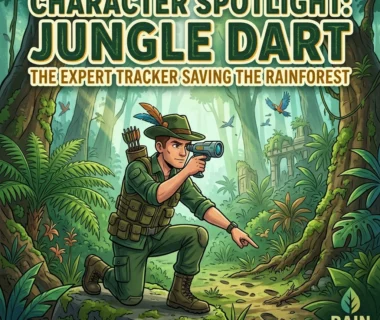

Filed by José “Jungle Dart” Verdura, rainforest protector, professional tracker, and accidental leaf-noise enthusiast.
Welcome to the 2026 Canopy Stealth Field Manual.
Before we begin: this guide is for fictional field training, wildlife observation, and adventure-story inspiration. The rainforest is beautiful, powerful, and extremely good at hiding things that bite. Never climb trees or move through the canopy without proper training, safety equipment, and an experienced local guide.
Now tighten your bootlaces, secure your gear, and try not to step on the loudest branch in the entire Amazon.
That last one is important.
I know from experience.
Rule One: The Canopy Notices Everything
The first mistake beginners make is thinking stealth means wearing camouflage and looking mysterious.
It does not.
Stealth is mostly about not becoming the most interesting object in the forest.
The canopy is full of movement: leaves shivering, vines swinging, birds hopping, insects buzzing, rain falling, and Alpha attempting to steal somebody’s lunch. If you move with the forest instead of against it, you become part of the background.
If you move like a startled furniture delivery, every living thing will know.
Jungle Dart’s 2026 stealth formula:
- Watch before moving.
- Choose your route before taking the first step.
- Stay in shade whenever possible.
- Avoid sudden gestures.
- Keep shiny gear covered.
- Stop when the forest changes.
That last point matters. If birds go quiet, animals suddenly flee, or everyone on your team looks at you at once, freeze and figure out why.
Usually, the reason is not “excellent stealth.”
Rule Two: Break Up Your Shape
A human silhouette is easy to recognize, especially against a bright patch of sky.
That is why I avoid standing upright on exposed branches. A person shaped like a tall stick against the sunlight is not exactly difficult to identify.
Instead, I use the natural shapes around me:
- Tree trunks
- Buttress roots
- Thick vines
- Broad leaves
- Shadowed branch junctions
- Clusters of tangled vegetation
The goal is not to disappear magically. The goal is to make your outline less obvious.
Stay low. Keep your shoulders relaxed. Avoid straight lines. Let leaves, branches, and shadows interrupt your shape.
And remember: camouflage clothing is helpful, but it is not a magical invisibility button.
Sunbyte once wore a perfectly color-matched jacket and then held a bright silver tablet directly in the sunlight.
The jacket worked beautifully.
The tablet announced her location to the entire continent.
Rule Three: Matte Gear Is Happy Gear
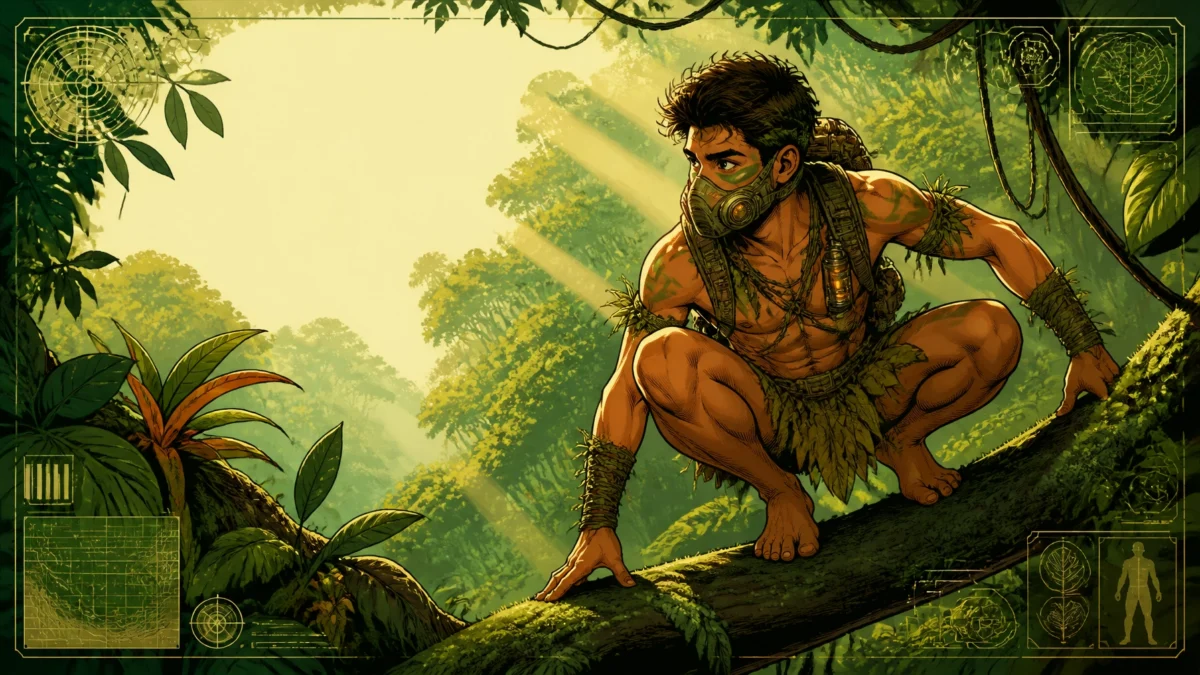
Rainforest light is sneaky. It bounces off wet leaves, metal buckles, plastic containers, watch faces, respirator lenses, and anything else that has ever dreamed of becoming a signal mirror.
In 2026, field equipment is smarter than ever, but smart gear still needs common sense.
Before heading out, check your kit:
- Cover reflective surfaces.
- Secure loose straps.
- Silence rattling clips.
- Remove unnecessary metal.
- Use dull, natural colors.
- Keep cords and tools from swinging.
My high-tech field respirator helps filter dust, smoke, and airborne irritants during difficult conditions. It also looks impressively serious.
Unfortunately, it cannot stop Alpha from pointing at me when my canteen starts clanking.
Technology is useful. Alpha is more useful.
You can meet the full team, including Alpha, Sunbyte, Dr. Manaus, Primal, and me, on The Rainsavers’ official character page.

Rule Four: Quiet Feet Beat Fast Feet
Fast movement is tempting when you are crossing an open patch or trying to reach cover.
But in dense rainforest, rushing creates problems:
- Leaves scrape.
- Branches snap.
- Equipment bounces.
- Roots grab your boots.
- You discover gravity’s strong opinions.
Move slowly enough to feel the ground before committing your weight. Pay attention to leaf litter, wet roots, hollow logs, loose stones, and anything that might shift underfoot.
A quiet step is not a dramatic ninja pose. It is a controlled step.
Place your foot carefully. Keep your balance. Shift your weight gradually. Then repeat.
If the ground is noisy, wait for natural sounds, rain, wind, running water, or a chorus of insects, to cover small movements. Never force your way through a noisy route when a quieter route is available.
And if you hear a branch crack?
Stop.
Do not immediately assume it was a villain.
It may have been a monkey, a falling fruit, or your own backpack making a career-ending decision.
Rule Five: Stillness Is the Superpower
Movement catches attention. Stillness gives the forest time to forget you are there.
When you reach a good observation point, pause. Let your breathing settle. Keep your head and shoulders quiet. Scan with your eyes rather than turning your entire body like a malfunctioning weather vane.
Stillness also helps you listen.
The rainforest has layers of sound. Nearby leaves sound different from distant movement. Water carries noise in strange ways. Birds may react before people notice anything unusual. A sudden silence can be as useful as a loud alarm.

When you are hidden, do not fidget.
This is where many missions go wrong.
Someone feels an itch. Someone adjusts a strap. Someone notices a leaf on their shoulder and decides it must be removed immediately.
Leave the leaf.
You are now wearing the forest.
Rule Six: Use Height Carefully
The canopy offers excellent viewpoints, but height is not automatically safer or stealthier.
A branch can look strong and still be weak, wet, rotten, or home to something that considers your hand an invitation.
If you are trained and properly equipped to climb:
- Keep three points of contact.
- Stay close to the trunk.
- Test supports before transferring your weight.
- Move slowly.
- Keep your center of gravity low.
- Never jump between branches.
- Avoid exposed limbs against the sky.
If you are not trained, stay on the ground and work with a qualified guide. There is no shame in choosing the route that does not involve falling through six layers of foliage while shouting, “I meant to do that!”
The best canopy position is usually not the highest one. It is the one that offers shade, a stable support, a clear view, and a safe way back down.
Rule Seven: Let the Forest Do the Disguising
The Amazon is already full of patterns. Leaves overlap. Vines twist. Shadows move. Light breaks into fragments.
Use that complexity.
Choose backgrounds with multiple layers instead of standing in front of a single bright leaf wall. Stay near natural cover. Avoid neat, geometric arrangements that look out of place.
Do not pile vegetation onto yourself until you resemble a compost heap with opinions. A little natural cover is useful. Too much makes movement difficult, damages plants, and may attract attention for all the wrong reasons.
The best disguise is often simple:
- A dull color
- A broken outline
- A quiet position
- A patient observer
Rule Eight: Watch for Wildlife, And Respect It
Stealth is not permission to disturb animals.
Keep your distance. Do not block trails, nests, feeding areas, or watering spots. Never reach into holes, tangled roots, hollow logs, or dense plants without seeing what is inside.
If an animal reacts strongly, give it room.
This is especially important because the forest’s residents know the terrain better than we ever will. An alarm call may be telling you about a predator, a stranger, a storm, or one extremely rude fruit falling from a tree.
Observe. Listen. Back away when necessary.
Protecting the rainforest means respecting the life already living there.
Jungle Dart’s Emergency “Oops” Checklist
Before moving, ask:
Gear
- Is anything shiny?
- Is anything loose?
- Is anything rattling?
- Is my respirator secure?
- Did I pack only what I can safely carry?
Route
- Where is my next safe position?
- Is there shade?
- Is the ground stable?
- Is there a clear way back?
- Am I about to cross the loudest-looking patch of leaves?
Canopy
- Am I trained and equipped for this?
- Are my supports stable?
- Do I have three points of contact?
- Am I silhouetted against the sky?
- Is there a safer ground-level option?
Team
- Does everyone know the plan?
- Are we giving wildlife space?
- Has Alpha stopped staring at my snacks?
- Where is Sunbyte?
- Why is Primal carrying three people’s backpacks?

Final Field Note: Stealth Is About Attention
The best canopy stealth is not about pretending to be invisible.
It is about paying attention.
Notice the light. Notice the wind. Notice the ground. Notice the animals. Notice your equipment. Notice when the forest tells you to stop.
And if you make a mistake, learn from it quickly.
Preferably before Alpha sends the incident report by Morse code.
The Rainsavers’ first mission begins when Tom “Primal” Swift crash-lands in the Amazon and joins forces with Alpha, Dr. Manaus, Jungle Dart, and Sunbyte to protect the rainforest from deforestation and corporate greed. It is a high-stakes adventure filled with science, danger, teamwork, and more than a few moments when somebody’s plan goes beautifully sideways.
Read The Rainsavers: Primal Awakening, Book One now, or visit https://rainsavers.com to see how we blend rainforest adventure, science fiction, environmental stakes, and global mystery.
Now move quietly.
And please do not step on that branch.
That branch has a reputation.