
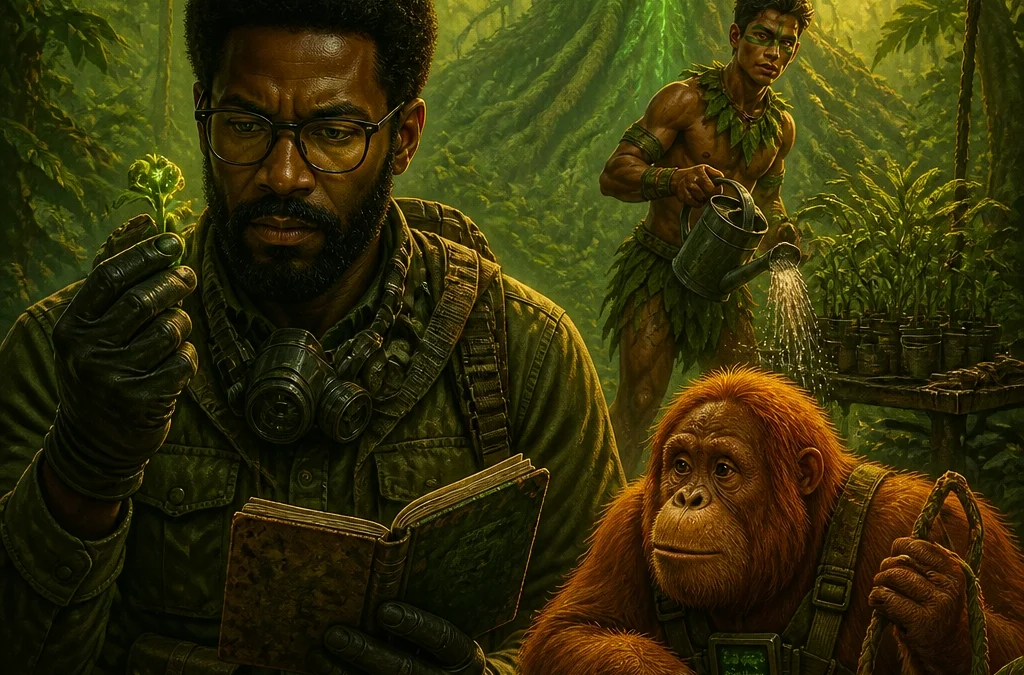
Meta description: A funny leaked 2026 lab manual reveals Dr. Mubari’s dos and don’ts for caring for the Spirit Tree: with help from Alpha, Jungle Dart, and a lot of accidental overwatering.
THE RAINSAVERS : INTERNAL DOCUMENT
LAB MANUAL 7-B: SPIRIT TREE CARE AND FEEDING
Author: Dr. Manelo Mubari
Status: Leaked
Revision: 2026.08
Warning: Do not let Alpha edit the margins again.
First: The Spirit Tree is not a houseplant
It does not need a sunny windowsill, a decorative pot, or inspirational music.
The Spirit Tree is an ancient rainforest life-force connected to the Amazon’s water cycles, wildlife, roots, and weather patterns. In other words, it is important for Amazon rainforest protection, rainforest conservation, and the continued survival of everyone who enjoys breathing.
Treat it with respect.
Also, do not call it “the big leafy one.” It has feelings.
Approved care instructions
1. Keep the soil alive
The Spirit Tree prefers rich, living soil filled with fungi, fallen leaves, insects, roots, and approximately zero corporate bulldozers.
Healthy forest soil supports new growth and helps the rainforest recover from stress. Protecting that soil is one small but meaningful part of fighting deforestation.
Team note: Tom once suggested “lifting the whole tree and moving it somewhere safer.” This was not practical. The tree is extremely large, and Tom is not allowed to make transportation plans without Dr. Mubari present.
2. Water carefully
The Spirit Tree appreciates rain. It does not appreciate being blasted with an industrial hose for forty-seven minutes.
Incident Report: Jungle Dart, 2026
Jungle Dart was assigned to mist the eastern roots.
He became distracted by a suspicious noise, forgot to release the trigger, and created a temporary stream through the laboratory.
Three sample trays floated away.
Alpha retrieved two.
The third is believed to be establishing a colony downstream.
Correct procedure: Use gentle, regular watering. Observe the ground. If the roots begin glowing blue, stop immediately and call Dr. Mubari.
If the roots begin glowing red, run.
3. Feed it biodiversity
The Spirit Tree does not require fertilizer pellets, protein powder, or whatever was inside the unlabeled tin Alpha found near the old research station.
It thrives when surrounded by many kinds of healthy plants, animals, fungi, and pollinators. Biodiversity makes the rainforest stronger and more resilient, especially as climate change affects rainfall, heat, and fire risk.
Plant native species. Protect habitats. Leave room for the insects.
And label your snacks.
Absolutely forbidden
No burning
This should be obvious, but after Bossman’s last visit, it needs to be written in large letters.
NO FIRE NEAR THE SPIRIT TREE.
Not campfire-sized fire. Not “controlled” fire. Not “just a little flame to see what happens.”
Deforestation and land-clearing fires can damage habitats, release stored carbon, and make recovery much harder. The Spirit Tree responds to fire by producing warning spores, emergency roots, and one extremely disappointed Dr. Mubari.
No suspicious vines
A vine is not automatically friendly because it is green.
Incident Report: Alpha, 2026
Alpha discovered a vine growing through the western observation hatch. He inspected it, sniffed it, and consumed approximately six inches before the vine attempted to tie his harness to a tree.
Alpha is now banned from taste-testing unidentified vegetation.
He has appealed the decision in Morse code.
New rule: If a plant moves when nobody is touching it, do not eat it. Photograph it. Isolate it. Inform the scientist.
No experimental energy crystals
The Spirit Tree is not a battery.
Do not insert red mercury crystals into its roots. Do not “boost” its energy with salvaged machinery. Do not connect it to a reactor because you believe the tree “looks underpowered.”
That last one was Leonard West.
We are still repairing the eastern canopy.
Daily inspection checklist
Before breakfast, the assigned team member must check:
- Root color and temperature
- Leaf movement when there is no wind
- Nearby animal activity
- Signs of illegal logging or fire
- Unusual changes in rainfall
- Unidentified glowing objects
- Alpha’s current location
- Whether Jungle Dart is holding a watering can
Record all findings in the field log. Do not write “tree seems fine” unless you have completed the entire checklist.
Do not draw a smiley face beside a serious warning.
This means you, Alpha.
What the Spirit Tree teaches us
The Spirit Tree may be mysterious, but its central lesson is easy to understand: the rainforest is a living system. When one part is damaged, the effects spread through the whole network.
Protecting forests means supporting conservation, respecting local knowledge, choosing more sustainable systems, and paying attention to the connections between everyday decisions and global problems.
That is where sustainable living comes in. We may not all have a Spirit Tree in the backyard, but we can reduce waste, think carefully about what we buy, support responsible businesses, and learn more about protecting threatened ecosystems.
Small actions do not replace major conservation work: but they help build the culture that makes conservation possible.
Final warning from Dr. Mubari
The Spirit Tree can survive drought, storms, invasive species, rogue agents, experimental technology, and Alpha’s snack decisions.
It cannot survive indifference.
Keep the roots protected. Keep the fire away. Keep asking questions. And if Mortalis appears near the southern ridge, close the lab doors and activate the emergency beacon.
For more rainforest-fueled adventure, meet the team and explore the full saga at The Rainsavers.
Read Book One now and discover how Primal, Alpha, Dr. Mubari, Jungle Dart, and Sunbyte begin the fight to protect the Amazon.
