
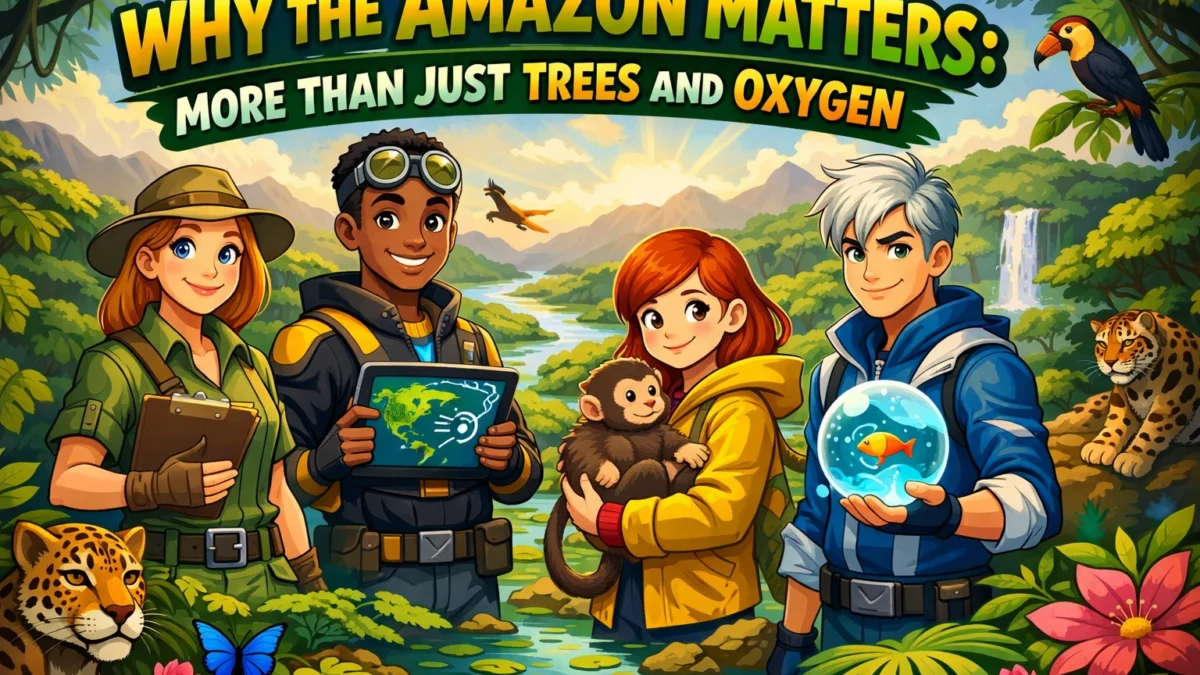
Meta Description: Think the Amazon is just the "Lungs of the Earth"? Think again. From flying rivers to massive carbon vaults, discover why the rainforest is the ultimate high-stakes battlefield in reality and in The Rainsavers series.
ALT Text: A lush, vibrant green Amazon rainforest canopy seen from above, with sleek, tactical drones patrolling the airspace to protect the ecosystem.
Hey everyone, Steven G. Samuels here.
When people talk about the Amazon, they usually lead with the "Lungs of the World" line. You’ve heard it a thousand times in school or on nature documentaries. And hey, it’s a great visual! It makes the forest feel human, like it’s literally breathing for us. But if I’m being honest: and if you’ve read any of The Rainsavers books, you know I like to get into the nitty-gritty: that title actually undersells what’s happening down there.
The Amazon isn’t just a pair of lungs. It’s the planet’s cooling system, its massive water pump, a giant carbon vault, and the most complex library of life ever assembled. It’s a high-tech masterpiece created by nature over millions of years.
In our stories, we use tactical drones and high-stakes missions to protect this place because the stakes couldn’t be higher. But today, I want to step out of the fiction for a second and talk about why this incredible place is the heart of everything we do at The Rainsavers.
The Giant Carbon Vault (The Earth's Pause Button)
Let’s talk numbers for a second. I know, I know: numbers can be dry: but these are "holy crap" numbers.
Right now, the Amazon holds somewhere between 100 and 200 billion metric tons of carbon. To put that in perspective, that is roughly equivalent to ten years of global fossil fuel emissions. If that forest goes away, all that carbon doesn’t just disappear; it goes into the atmosphere.
Imagine a giant balloon filled with carbon. The Amazon is the hand holding the string. If we let go, the "balloon" pops, and our climate goals become impossible to hit. It’s why the forest is essential to preventing catastrophic climate change. It’s not just about absorbing what we put out (though it does absorb about 100 million metric tonnes of CO2 every year); it’s about keeping what’s already trapped in the soil and the wood right where it belongs.
In The Rainsavers, our characters often find themselves racing against time to stop illegal clearing operations. Why? Because every acre lost isn’t just a few trees: it’s a leak in the planet’s most important storage unit.

ALT Text: Close-up of ancient, massive tree roots in the Amazon, symbolizing the deep carbon storage and stability of the rainforest floor.
Have You Heard of the "Flying Rivers"?
This is one of my favorite facts about the Amazon, and it sounds like something straight out of a sci-fi novel.
The trees in the Amazon release approximately 20 billion tonnes of water into the atmosphere every single day. For context, that is more water than the Amazon River itself discharges into the Atlantic Ocean. These "flying rivers": massive plumes of water vapor: travel across the continent.
They don’t just stay in the jungle. These vapor clouds regulate rainfall patterns thousands of miles away. They provide the rain that fuels agriculture in southern South America and even influence weather systems in the United States and Europe.
When we talk about the Amazon "mattering," we’re talking about food security. If the flying rivers stop, the farms dry up. If the farms dry up, the world gets a lot hungrier, a lot faster. This interconnectedness is exactly what inspires the team-based missions in our books. You can’t save one part of the world without realizing how it’s tied to the rest.
The Library of Life: 400 Billion Stories
The Amazon is home to nearly 400 billion individual trees. That is a number so big it’s hard to wrap your head around. It also hosts 10% of the planet's known biodiversity.
But it’s not just about "pretty birds" and "cool jaguars." This biodiversity is a working machine. You’ve got fungi and insects acting as the world’s best recycling crew, turning dead matter into nutrient-rich soil. You’ve got bats, bees, and butterflies acting as the logistics team, pollinating plants so the whole system can keep running.
From a writer’s perspective, this biodiversity is a goldmine. Every time I research a new species for a scene, I find something that seems impossible. Did you know there are ants that herd other insects like cattle? Or fungi that can communicate through underground networks?
In our fictional world, we see the Amazon as a place of mystery and ancient wisdom that modern tech is only just beginning to understand. Protecting it isn’t just about saving animals; it’s about protecting the blueprints for life itself.

ALT Text: A colorful macaw flying over a mist-covered jungle canopy, highlighting the vibrant biodiversity of the Amazon.
Why We Use Tech to Tell This Story
In the hero image for this post, you see tactical drones hovering over the canopy. Some people ask me, "Steven, why include drones in a story about nature?"
The answer is simple: because the threats to the Amazon are high-tech, and the solutions need to be too. In the real world, indigenous groups and conservationists are already using drones and satellite imagery to spot illegal logging before it gets out of control.
At The Rainsavers, we want to bridge the gap between "nature lovers" and "tech geeks." We believe that being an eco-hero doesn't mean you have to live in a cave; it means using every tool at your disposal: innovation, storytelling, and community: to stand up for the planet.
Our series focuses on "Eco-hope." It’s easy to look at the stats (like the fact that Brazil has lost 20% of its forest cover in 50 years) and feel defeated. But that’s not the vibe here. We focus on the action. We focus on the win. We focus on the idea that if we act now, we can keep the Amazon from hitting the "tipping point" where it turns from a carbon sink into a carbon source.
The Interconnected Impact
What happens in the Amazon doesn't stay in the Amazon. It affects the temperature of the ocean, the strength of hurricanes, and the success of a corn crop in the Midwest.
When you read The Rainsavers, you’re not just reading an adventure story. You’re engaging with the most important struggle of our time. We want our readers to walk away feeling inspired to learn more about how they can help, whether it's through supporting sustainable brands, staying informed, or just spreading the word about why this "green heart" of our planet is worth fighting for.

ALT Text: A high-tech command center map showing the interconnected weather patterns moving from the Amazon across the globe.
Join the Mission
We are more than just a publishing company; we’re a community of people who believe that fiction can change the way we think about the world. If you love fast-paced adventures, high-stakes environmental themes, and characters who actually give a damn about the planet, you’re in the right place.
The Amazon matters because it is our life support system. It matters because it is beautiful. And it matters because it is currently under threat. But as long as there are people willing to tell its story and fight for its future, there is hope.
Ready to dive into the adventure?
Check out our latest episodes and meet the team that’s taking the fight to the front lines. Whether you’re here for the tactical gear or the lush environments, we’ve got a seat for you on the team.
Explore The Rainsavers Universe Here!
Stay curious, stay bold, and let's save some rain.
: Steven G. Samuels
CEO, The Rainsavers
