Meta description: Discover Primal’s funny three-step morning routine for rainforest protection, sustainable living, and saving the Amazon before coffee in 2026.
CLASSIFICATION: Internal team memo
AUTHOR: Sunbyte, allegedly
SUBJECT: How to begin a planet-saving day before caffeine becomes available
Good morning, fellow humans, rainforest guardians, and anyone who has ever attempted to make coffee while still wearing yesterday’s socks.
It is 2026, the Amazon rainforest is still under pressure from deforestation and climate change, and Primal has once again decided that “sleeping in” is not an acceptable conservation strategy.
So, for the sake of team efficiency, environmental protection, and Alpha’s growing collection of judgmental expressions, I have documented Primal’s official three-step morning routine.
It is surprisingly practical.
It is mildly dramatic.
It involves one high-tech field respirator, two rainforest sensors, and at least one unnecessary leap from a moving object.
Let’s begin.
STEP ONE: Wake Up, Check the Gear, Do Not Punch the Alarm Clock
06:00 hours.
Primal wakes up before the sun, before the birds, and: most importantly: before Bossman can schedule another illegal clearing operation.
His first move is not a dramatic speech. It is a gear check.
This includes:
- Field boots secured and suitable for wet terrain
- Reusable water flask filled
- Compact first-aid kit packed
- High-tech field respirator inspected and clipped within reach
- Satellite communicator charged
- Rainforest sensor online
- Emergency snacks accounted for
The last item is critical.
According to Sunbyte’s notes, Primal once reported that “two granola bars should be plenty for a morning patrol.” Alpha disagreed by sending a Morse-code message that translated roughly to:
THIS IS NOT A PLAN. THIS IS A CRY FOR HELP.

The respirator is especially useful during wildfire smoke, heavy particulate conditions, or situations involving unknown airborne hazards. It is not a magical solution, and it is definitely not an excuse to wander into unsafe areas. The Rainsavers’ rule is simple: protect yourself first, then gather information from a safe distance.
That rule applies in real life, too.
If you are heading outdoors in 2026, you do not need an action-hero wardrobe to make a difference. A reusable bottle, weather-appropriate clothing, a charged phone, and awareness of local conditions are a strong start. If wildfire smoke or poor air quality is present, follow local public health guidance and avoid unnecessary exposure.
Primal’s first step is really about readiness.
You cannot protect the rainforest: or your neighborhood park, watershed, or community garden: if your equipment is missing, your information is outdated, or you have walked into the jungle wearing flip-flops.
That last mistake was Jungle Dart’s.
He insists it was tactical.
No one believes him.
STEP TWO: Read the Forest Before You Try to Save It
At 06:15, Sunbyte activates the team’s environmental dashboard.
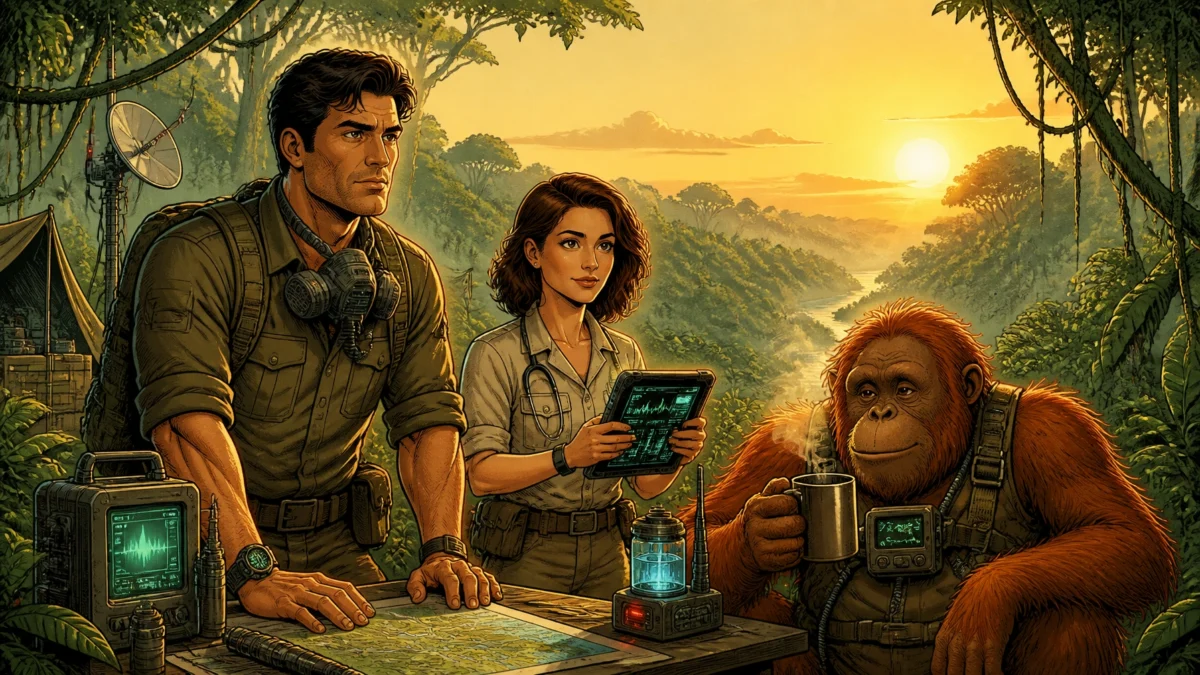
The screen displays rainfall, river levels, heat patterns, recent satellite imagery, and possible signs of illegal clearing. Dr. Mubari reviews the biological data while Alpha studies the terrain with the quiet focus of someone who has already noticed three things everyone else missed.
Primal looks at the screen and says:
“Which direction is the danger?”
Sunbyte replies:
“That depends. Are you asking about the fire risk, the river level, the suspicious vehicle, or the fact that Alpha has stolen your breakfast?”
Alpha sends one short Morse-code message.
YES.

This is the most important step in the routine: observe before acting.
Real rainforest conservation depends on information. Researchers, Indigenous communities, local organizations, and environmental agencies use tools such as satellite monitoring, field observations, biodiversity surveys, and community reporting to understand what is happening on the ground.
In 2026, there is encouraging news in some parts of the Brazilian Amazon, where deforestation has fallen compared with recent peaks. But progress remains fragile. Illegal logging, land grabbing, mining, fire, and climate-driven heat and drought continue to threaten the forest.
A better morning routine is not about panicking over every headline. It is about paying attention, checking reliable sources, and supporting people who already do the hard work of protecting the Amazon.
For readers, that could mean:
- Learning where everyday products come from
- Choosing responsibly sourced wood and paper
- Reducing food waste
- Eating more plant-rich meals when practical
- Supporting conservation and Indigenous-led organizations
- Sharing accurate information instead of unverified social media claims
- Contacting elected representatives about strong climate and forest policies
The goal is not perfect living. The goal is better decisions, repeated consistently.
Sunbyte calls this “low-drama sustainability.”
Primal calls it “doing the right thing.”
Alpha calls it “stop buying suspicious bananas.”
We are still investigating that last recommendation.
STEP THREE: Take One Useful Action Before Coffee
At 06:40, the team chooses a mission.
Not every mission involves a villain, an ancient artifact, or a red-glowing device hidden beneath a pyramid. Sometimes the assignment is simply to document a damaged area, alert local partners, repair a sensor, or help restore a safe section of habitat.
The important word is useful.
Primal’s morning routine does not require him to solve deforestation before breakfast. That would be unrealistic, even for a man with extraordinary strength. Instead, he asks:
“What can we improve today?”
That question creates momentum.
Maybe the team verifies a report of clearing and sends it to the proper authorities. Maybe Sunbyte repairs a solar-powered monitoring station. Maybe Dr. Mubari checks a water sample. Maybe Alpha identifies an animal corridor that should remain undisturbed.
And sometimes Jungle Dart plants a seedling in the wrong place because he was distracted by a particularly impressive frog.
The seedling is relocated.
The frog receives a formal apology.

For people living far from the Amazon, “one useful action” might look different:
- Buy fewer items and repair what you already own
- Use energy-efficient appliances
- Walk, cycle, car-share, or use public transportation when possible
- Choose products with transparent, deforestation-free supply chains
- Donate to a credible rainforest or Indigenous-rights organization
- Attend a local conservation event
- Grow native plants that support local wildlife
- Talk with friends about climate change without turning the conversation into a doom spiral
Small actions do not replace laws, enforcement, corporate responsibility, or community-led conservation. They support a wider system of change.
The Rainsavers’ approach is teamwork: science, technology, local knowledge, courage, and the occasional orangutan intervention.
That is also a useful way to think about sustainable living. No single person has to carry the entire planet on their shoulders. We need better systems, responsible businesses, strong environmental protections, and millions of people making thoughtful choices together.
Primal may be able to lift heavy equipment, but even he needs Sunbyte’s data, Dr. Mubari’s expertise, Alpha’s problem-solving, and Jungle Dart’s knowledge of the rainforest.
Also, someone has to make the coffee.
The Official Pre-Coffee Checklist
Sunbyte’s final version of the routine is much shorter than Primal’s original 47-step tactical briefing.
1. Prepare
Check your gear, your health, the weather, and your route. Bring reusable supplies and avoid creating unnecessary waste.
2. Observe
Look for reliable information. Understand the conditions before acting. Listen to local expertise and respect the people who live in and protect the forest.
3. Act
Choose one practical step that helps: reduce waste, support conservation, report a genuine concern through the right channel, or make a more sustainable purchase.
Then drink coffee.
Preferably after confirming that Alpha has not replaced it with river water again.
Why This Routine Matters in The Rainsavers
The Rainsavers is built around a simple mission: protect the Amazon rainforest from deforestation, corporate greed, dangerous technology, and threats that keep getting bigger.
But the team’s strength does not come from one character acting alone. It comes from continuous cooperation.
That is what makes the six-book adventure especially fun. In Book One, Primal Awakening, Tom Swift becomes Primal after a crash in the Amazon and joins Alpha, Dr. Mubari, Sunbyte, and Jungle Dart. Their first major conflict brings them face-to-face with Bossman, a ruthless tycoon determined to profit from the destruction of the rainforest.
From there, the story expands into bioweapons, ancient mysteries, German technology, space exploration, red mercury, and the Spirit Tree. The stakes become global, but the core idea stays grounded:
Protecting the planet takes a team.
That idea connects fiction with real-world concerns such as Amazon rainforest protection, climate change, biodiversity, and sustainable living. The adventure is larger than life, but the values are familiar: pay attention, respect nature, use knowledge wisely, and do something useful.
Even if you are not equipped with superhuman strength.
Even if your morning coffee is doing most of the heavy lifting.
Final Memo: Coffee Is Not a Strategy
Primal’s three-step morning routine is not a promise that one person can fix every environmental crisis before breakfast.
It is a reminder that meaningful change often begins with three repeatable habits:
- Prepare responsibly.
- Pay attention.
- Take one useful action.
That is how a team stays ready. That is how sustainable living becomes less overwhelming. And that is how an ordinary morning can become the first scene in a much bigger adventure.
Want to see where Primal’s mission begins?
Read Book One now and enter the rainforest with The Rainsavers.
