
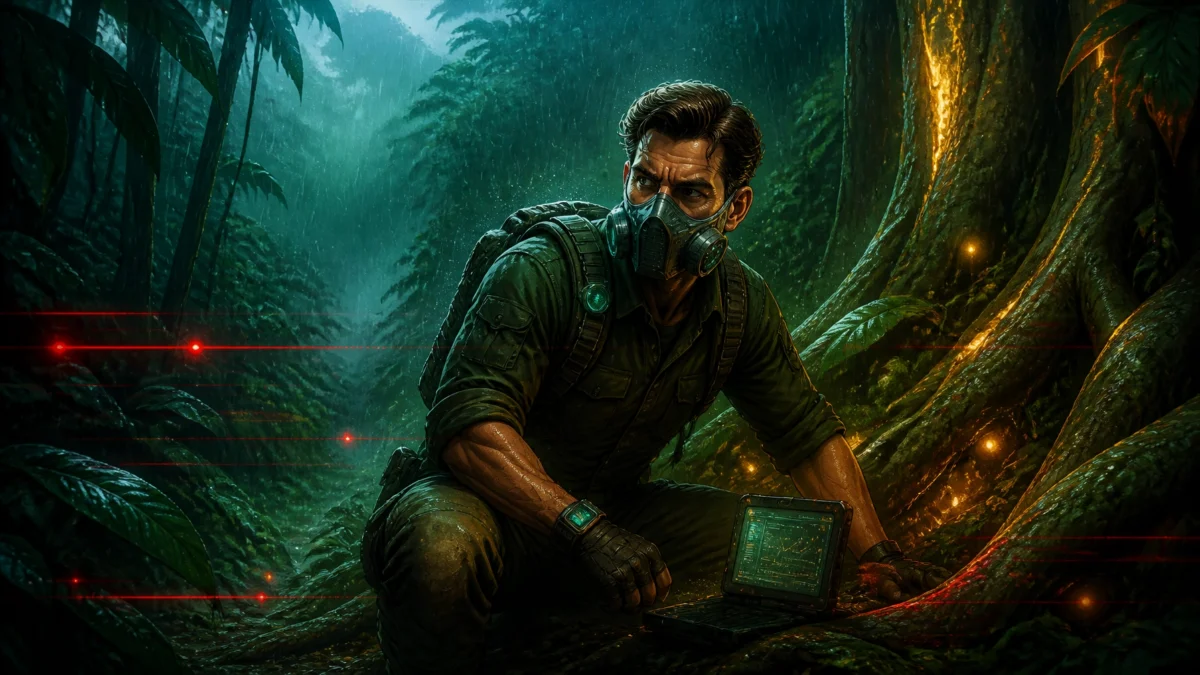
Meta description: An emergency broadcast from the Spirit Tree reveals five Amazon rainforest warnings for 2026, and practical ways readers can support conservation and sustainable living.
PRIORITY TRANSMISSION: SPIRIT TREE NETWORK
Location: Amazon rainforest
Date: 2026
Status: Extremely leafy. Increasingly concerned.
Message: The forest is sending warnings. Please do not mute the giant ancient tree.
The Spirit Tree has seen a lot: storms, droughts, illegal clearing, strange science experiments, and at least one villain who thought controlling nature was a reasonable career goal.
But its latest message is less mysterious than usual.
In 2026, researchers are warning that the Amazon is being pushed by two connected forces: deforestation and climate change. There is encouraging news, Brazil’s official deforestation rate has fallen sharply in the first half of the year, but wildfires, forest degradation, drought, and rising temperatures are still putting enormous pressure on the rainforest.
So, consider this your official Rainsavers emergency briefing. Here are five warnings we should not ignore.
WARNING 1: The rainforest is closer to a tipping point than it looks
Spirit Tree transmission:
“Just because the forest is still standing does not mean everything is fine.”
Recent research suggests that the Amazon could face widespread ecological collapse if deforestation and global warming continue together. A 2026 study reported by the Potsdam Institute for Climate Impact Research warns that deforestation may lower the warming threshold at which large areas of the rainforest begin shifting toward degraded, savanna-like conditions.
That matters because forests are not simply “there” or “gone.” They can be weakened long before the last tree disappears.
When large areas are cleared, the forest loses shade, moisture, wildlife corridors, and the ability to help generate rainfall. The remaining trees may face hotter temperatures and longer dry seasons. The result is a dangerous feedback loop:
- Trees are cleared.
- The landscape becomes hotter and drier.
- Fires become easier to start and harder to control.
- More forest is damaged.
- The region stores less carbon and produces less moisture.
Researchers have warned that significant portions of the Amazon could approach a tipping point as early as the 2040s if warming and deforestation continue.
That is not a “future problem.” It is a right-now problem wearing a very intimidating calendar.
WARNING 2: Lower deforestation does not mean lower danger

Sunbyte’s field report:
“Good news detected. Additional danger also detected. Please hold all celebrations until after the data review.”
Brazil’s official monitoring data show that Amazon deforestation fell significantly during the first half of 2026. Reports from Mongabay and other outlets describe the decline as the lowest level in roughly a decade.
That progress matters. It shows that environmental enforcement, satellite monitoring, public pressure, and conservation policies can make a difference.
But clear-cutting is only one part of the story.
Forest degradation, damage caused by fires, drought, logging, and repeated disturbance, can affect much larger areas than outright deforestation. An Associated Press report noted that degradation has become a major concern as fires and climate extremes intensify.
A damaged forest may still appear green from above. That does not mean it is healthy. Beneath the canopy, fires may have altered the soil, wildlife may have disappeared, and trees may be struggling to recover.
In other words, the forest’s status should not be reduced to a simple “trees: yes/no” checkbox. Nature has more tabs open than that.
WARNING 3: Deforestation is changing the weather
Dr. Mubari’s scientific note:
“The rainforest does not merely receive rain. It helps create and recycle it.”
The Amazon’s trees release water vapor into the atmosphere through a process called evapotranspiration. That moisture contributes to cloud formation and rainfall, helping sustain the forest and communities across the region.
When forests are cleared, that natural water cycle can weaken. A 2026 study reported by Phys.org linked deforestation with significant drying across the Amazon. Another study found that deforested areas can become several degrees hotter than nearby intact forest during the dry season.
That temperature difference is not a minor inconvenience. It can affect:
- Rainfall patterns
- River levels
- Crops and food production
- Wildlife survival
- Fire risk
- Indigenous and local communities
- The forest’s ability to store carbon
Climate change adds another layer of pressure by increasing heat and shifting rainfall patterns. The rainforest is being asked to function like a climate-control system while someone keeps removing the machinery.
The good news is that protecting existing forests is one of the most effective ways to preserve this natural system. Restoration can also help, especially when it is locally led and focused on native ecosystems rather than quick, one-size-fits-all planting schemes.
WARNING 4: Fire season is becoming a bigger threat

Alpha’s field note:
“Smoke detected. Banana detected. Team morale complicated.”
Wildfires are not just a dramatic backdrop for adventure stories. In a rainforest, they can be a sign that the ecosystem is already under severe stress.
Healthy, intact rainforest is generally too damp to burn easily. But after logging, clearing, drought, or repeated fires, the landscape becomes more vulnerable. A single fire can damage trees without completely clearing an area, leaving the forest weaker and more flammable the next time.
This creates another feedback loop:
- Hotter conditions dry vegetation.
- Drier vegetation burns more easily.
- Fires release stored carbon.
- More carbon in the atmosphere contributes to warming.
- Warming increases heat and drought risk.
The Rainforest Foundation US describes this as a fire-climate feedback loop. It is a grim phrase, but an important one.
What can help? Strong fire prevention, better monitoring, enforcement against illegal burning, protection for Indigenous territories, and restoration of damaged areas. Technology can help identify fires quickly, but it cannot replace people on the ground who understand the forest and know how to respond.
Also, a reminder from Jungle Dart: if your “controlled burn” has escaped into the trees, it is no longer controlled. That is an oops of spectacular proportions.
WARNING 5: Our everyday choices connect to the rainforest
Emergency broadcast conclusion:
“The Amazon is far away for many people. Its future is not.”
The decisions made in homes, stores, businesses, and governments can influence demand for products connected to land clearing. That does not mean individual shoppers are responsible for solving deforestation alone. Systemic change, strong laws, corporate accountability, and Indigenous leadership are essential.
Still, sustainable living gives us practical ways to reduce pressure on forests.
A few Rainsavers-approved actions:
- Choose products with transparent, deforestation-free supply chains when possible.
- Reduce food waste, especially foods connected to large land-use impacts.
- Try more plant-rich meals without turning dinner into a competitive sport.
- Buy fewer disposable products and repair useful items before replacing them.
- Support conservation groups and community-led restoration.
- Use energy efficiently and choose lower-carbon transportation when practical.
- Learn where products come from, and ask companies better questions.
- Support policies that protect forests, climate stability, and Indigenous rights.
Small actions are not magic spells. They are signals. When enough people send the same signal, markets and policymakers start receiving it.
The Spirit Tree’s final message
The 2026 warning is not that the Amazon is doomed. It is that the window for protecting its resilience is narrowing.
There is real progress. Deforestation has fallen in important areas. Satellite technology, conservation science, Indigenous stewardship, and environmental enforcement are creating new tools for protection. The forest can recover in many places when destruction stops.
But recovery needs time. It needs protection. And it needs people willing to care before the emergency sirens become the background noise.
That is the heart of The Rainsavers: a continuous adventure about people who decide the rainforest is worth defending, even when the threat is bigger, stranger, and more powerful than they expected.
The Spirit Tree is calling. Alpha has already packed the field snacks.
Read Book One now and join Tom “Primal” Swift, Dr. Mubari, Alpha, Jungle Dart, and Sunbyte on a high-stakes mission to protect the Amazon from deforestation, corporate greed, and threats that should absolutely not be allowed near experimental equipment.
Transmission ended. Please recycle your emergency briefing.
