Meta Description: Are ancient Nazi artifacts more dangerous than a futuristic virus? We break down the high-stakes threats from The Rainsavers Book Two and Three in this tactical comparison.
Hey everyone, Steven G. Samuels here.
As we cruise through March 2026, I’ve been thinking a lot about the nature of "the threat." In The Rainsavers universe, our team doesn’t just face off against greedy corporations or climate change: they go toe-to-toe with some of the most terrifying "what-if" scenarios history and science have to offer.
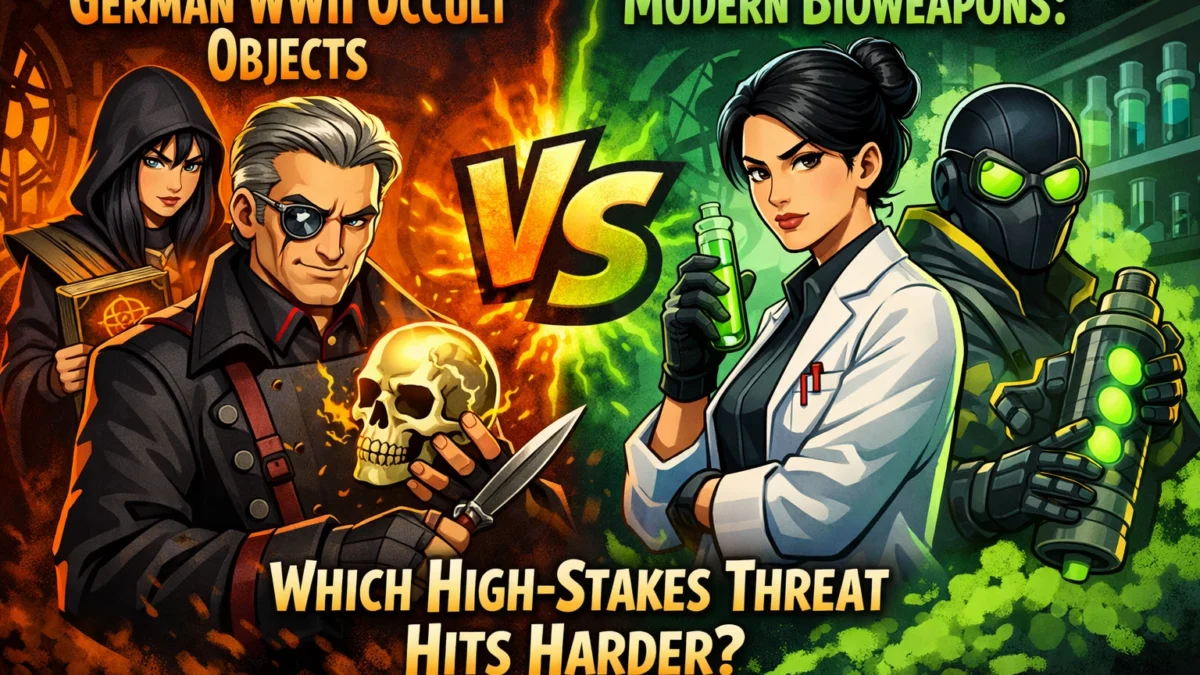
Specifically, I’m looking at the transition from Book Two to Book Three. In Book Two, we dive deep into the dusty, blood-stained history of German WWII occultism. In Book Three, we pivot to the sterile, terrifyingly efficient world of modern bioweapons.
It raises a fun (and slightly terrifying) question: if you’re a Rainsaver, which one keeps you up at night? Let’s break down the tactical specs of ancient German relics versus the lab-grown horrors of today.
The Ghost in the Machine: German WWII Occult Objects (Book Two)
In Book Two, our heroes face a threat that feels like it’s pulled straight from a nightmare: or a secret SS file. We’re talking about the Ahnenerbe, the real-life Nazi research institute that was obsessed with proving "Aryan" superiority through archaeology and the occult.
In our story, these aren't just museum pieces. We’re dealing with Wunderwaffe (Wonder Weapons) that cross the line between engineering and the supernatural.
The "Schwarze Sonne" (Black Sun) Factor
The occult threats often center around symbols like the Schwarze Sonne. To the Nazis, these weren't just decorations; they were conduits for what they believed was Vril energy: a primal, unstoppable force. Tactically, an occult object is a nightmare because it doesn’t follow the laws of physics.
Imagine a relic that messes with local gravity or an artifact that "remembers" the violence of the 1940s and projects it into the present. How do you fight something that requires a priest, a historian, and a demolitions expert all at once?
The Psychological Toll
There’s a specific kind of dread that comes with WWII relics. These objects are often linked to Sonderauftrag H (Special Mission H), Himmler’s secret task force that hunted for evidence of medieval witchcraft and supernatural power. When the Rainsavers encounter these, they aren’t just fighting a weapon; they’re fighting the "ghost" of a regime that tried to rewrite the laws of the universe. It’s heavy, it’s eerie, and it’s deeply personal.

Alt Text: A dimly lit underground bunker filled with ancient-looking German artifacts, stone tablets, and a faint, eerie blue glow emanating from a metallic bell-shaped object.
The Invisible Killer: Modern Bioweapons (Book Three)
Now, flip the script. We move from the damp, occult-heavy bunkers of Book Two into the blindingly white, pressurized labs of Book Three. Here, the threat isn't a cursed relic: it's a sequence of DNA.
Precision Engineering
Modern bioweapons are the ultimate "silent" threat. Unlike a Wunderwaffe that might make a lot of noise or create a localized supernatural event, a bioweapon is designed to be invisible. In Book Three, the villains aren't looking for ancient gods; they’re looking for a way to use CRISPR technology to "edit" the environment: and anyone standing in it.
From a tactical standpoint, this is terrifying for the Rainsavers. You can’t outrun a virus. You can’t punch a pathogen. Our team has to rely on high-tech containment suits and cutting-edge science just to stay in the room. It’s a different kind of stakes: where one accidental tear in a glove means game over.
The Scale of Destruction
While an occult object might destroy a city block or open a portal (bad enough, right?), a bioweapon has the potential to go global. In the context of 2026, with our world more connected than ever, the "hit" of a bioweapon is felt everywhere at once. It’s an existential threat that targets the very biology of the planet.

Alt Text: A high-tech laboratory setting with robotic arms handling glowing green vials of bioluminescent liquid, representing a modern bioweapon threat.
The Showdown: Which Hits Harder?
Let’s look at this from a Rainsaver's perspective. Our team: those brave souls you can read about on our characters page: has to deal with both. But which one is the "Heavyweight Champion of Threats"?
1. Unpredictability vs. Inevitability
Occult Objects: You never know what they’ll do. They might ignite your soul or just make the room smell like ozone. They are wild cards.
Bioweapons: They are incredibly predictable… in their lethality. Once the incubation period ends, the outcome is math. And math is hard to argue with.
2. The Villain Motivation
In our recent blog post about ancient mysteries vs. modern threats, we talked about how mixing these two creates unstoppable villains. A villain using an occult object usually wants power or ascension. A villain using a bioweapon usually wants control or cleansing.
The occult villain is often a fanatic, making them erratic and dangerous in a "mad scientist" kind of way. The bioweapon villain is often a cold, calculating corporate type, making them dangerous because they’ve already run the simulations and think they’ve already won.
3. The Cleanup
If the Rainsavers stop an occult ritual, they usually just have to bury the artifact in a lead-lined box and maybe see a therapist. If they stop a bioweapon launch at the last second, they’re still dealing with environmental contamination for years. In terms of long-term "impact," the bioweapon leaves a much nastier scar on the world.

Alt Text: The Rainsavers team standing together, looking determined: one member holding a high-tech scanner and another holding a weathered, ancient map.
Why This Matters for the Series
In The Rainsavers, we love playing with these themes because they represent the two biggest fears of the human experience: the fear of the Unknown Past and the fear of the Uncontrollable Future.
Book Two asks: What if the darkest parts of our history weren't just history? What if they were still active?
Book Three asks: What if our quest for progress creates something we can't actually control?
By pitting our heroes against both, we get to see what they’re really made of. It’s not about having superpowers (because, as we’ve said, superhero stories are evolving); it’s about human ingenuity, teamwork, and the will to save the planet.
Steven’s Verdict
If you ask me, the German WWII occult objects "hit harder" on a visceral, emotional level. There’s something deeply unsettling about an object that shouldn't exist, humming with a power that feels evil. It challenges your perception of reality.
However, modern bioweapons "hit harder" on a logical, terrifying level. They represent a very real possibility in our world today. They are the ultimate environmental threat, and for a group like the Rainsavers, they are the ultimate test of their mission.
What do you think? Are you more scared of a haunted Die Glocke or a lab-engineered "Super-Flu"?
Join the Adventure
If you haven't started the journey yet, now is the time. We’re building a community of readers who love high-stakes adventure, historical mysteries, and eco-thrillers.
- Check out the books: Dive into the series over at rainsavers.com.
- Get the gear: Visit our shop for exclusive Rainsavers tactical gear and merch.
- Win Big: Don't forget to enter our latest contest! Check the details at Down the Rabbit Hole.
The world needs saving, and the Rainsavers are on the clock. Are you in?
Stay curious, stay tactical.
: Steven G. Samuels
CEO, The Rainsavers
