
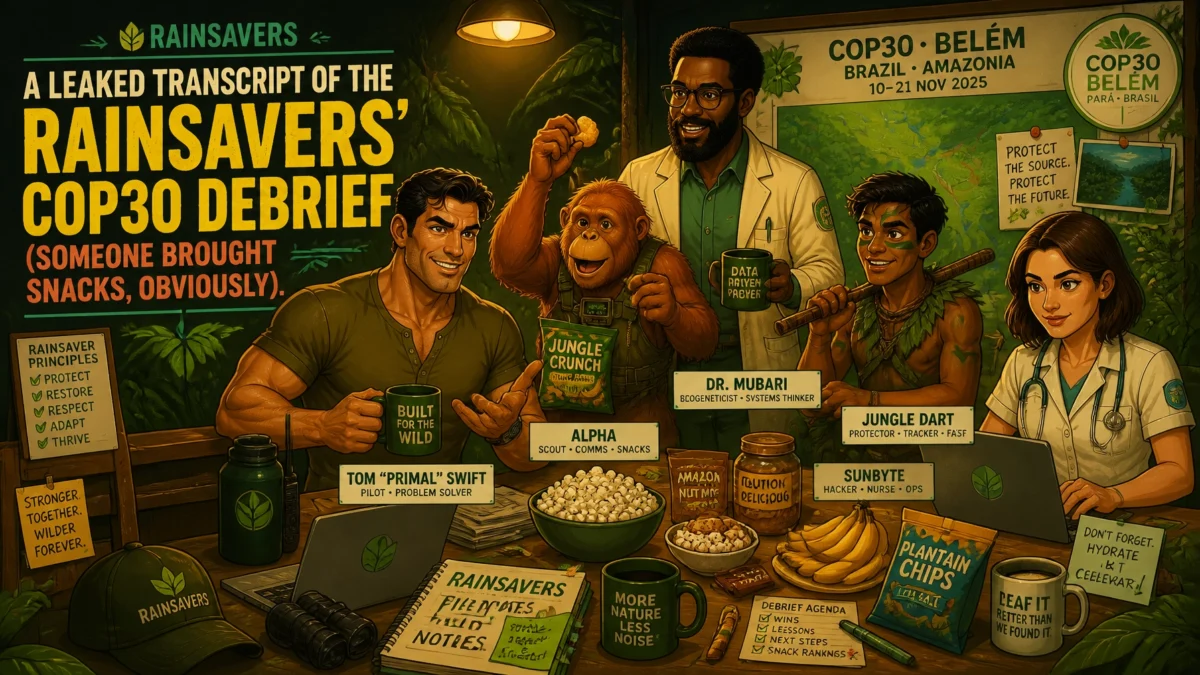
Meta description: A fictional leaked transcript reveals how the Rainsavers debriefed COP30 in 2026, with rainforest strategy, team banter, and one extremely suspicious snack table.
EDITOR’S NOTE: The following transcript was recovered from a damaged laptop, three damp notebooks, and what appears to be a banana-based encryption system.
It has been lightly edited for clarity. Alpha’s snack-related interruptions remain completely unedited.
LEAKED FILE: COP30_DEBRIEF_FINAL_FINAL_USE_THIS_ONE
Location: Rainsavers jungle operations base
Date: 2026
Status: Technically confidential
Status after Sunbyte posted it online: Not confidential
SUNBYTE: Recording started. Everyone ready?
PRIMAL: Ready.
DR. MUBARI: Ready.
JUNGLE DART: Ready.
ALPHA: [Raises one hand. Holds up a plantain chip.]
SUNBYTE: Alpha asks whether snacks count as “ready.”
PRIMAL: They do if you brought enough for everyone.
ALPHA: [Slowly hides the bag behind his back.]
JUNGLE DART: That is not a yes.
Agenda Item One: What Actually Happened at COP30?
DR. MUBARI: COP30 in Belém made one thing very clear: protecting rainforests requires more than speeches. It requires funding, cooperation, Indigenous leadership, and measurable action.
PRIMAL: And fewer people treating the Amazon like an empty warehouse.
SUNBYTE: Correct. The conference focused heavily on climate finance, forest protection, adaptation, and supporting communities on the front lines of the climate crisis.
JUNGLE DART: Did anyone mention the people who already know how to care for the forest?
DR. MUBARI: Yes. Indigenous Peoples and local communities were central to the conversation. Their knowledge, land rights, and leadership are essential to protecting rainforest ecosystems.
PRIMAL: Good.
ALPHA: [Types on tablet: “Also essential: snacks.”]
SUNBYTE: We are not putting that in the official report.
ALPHA: [Deletes nothing.]

Agenda Item Two: The Forest Finance Question
SUNBYTE: COP30 also advanced new ways to direct climate finance toward tropical forests. The basic idea is simple: keeping forests standing should be worth more than clearing them.
PRIMAL: That sounds obvious.
JUNGLE DART: It is obvious.
DR. MUBARI: Unfortunately, obvious does not always mean easy. Money must reach the people and programs doing the work. It must be transparent, dependable, and connected to real protection, not just impressive announcements.
PRIMAL: So the mission is not finished.
DR. MUBARI: No. COP30 created momentum, but 2026 is about implementation. Pledges need to become projects. Projects need to become results.
SUNBYTE: And results need to be trackable.
JUNGLE DART: Meaning?
SUNBYTE: Meaning if somebody says, “We protected 10,000 hectares,” we should be able to check whether 10,000 hectares were actually protected.
ALPHA: [Types: “Can we check the snack inventory?”]
SUNBYTE: That is a different spreadsheet.
ALPHA: [Types: “All spreadsheets are connected.”]
Agenda Item Three: The Part Nobody Wanted to Hear
PRIMAL: Did COP30 create a binding global plan to end deforestation?
DR. MUBARI: Not in the way many people hoped.
JUNGLE DART: That sounds bad.
DR. MUBARI: It is a gap. There was progress on finance and forest protection, but some major goals remained voluntary or dependent on individual countries and future action.
SUNBYTE: Which means nobody gets to sit back and declare victory.
PRIMAL: Especially not the people still cutting down the forest.
JUNGLE DART: Especially not Bossman.
ALPHA: [Makes a very serious face and circles “Bossman” on the whiteboard.]
SUNBYTE: We are not adding Bossman to an international climate policy document.
PRIMAL: We should. He is a case study.
DR. MUBARI: Technically, he is a fictional case study.
PRIMAL: Technically, he keeps trying to burn down the rainforest.
JUNGLE DART: Also technically, he has terrible ideas.
Agenda Item Four: The Rainsavers’ Official Position
SUNBYTE: Let’s make this simple. What do we want people to remember in 2026?
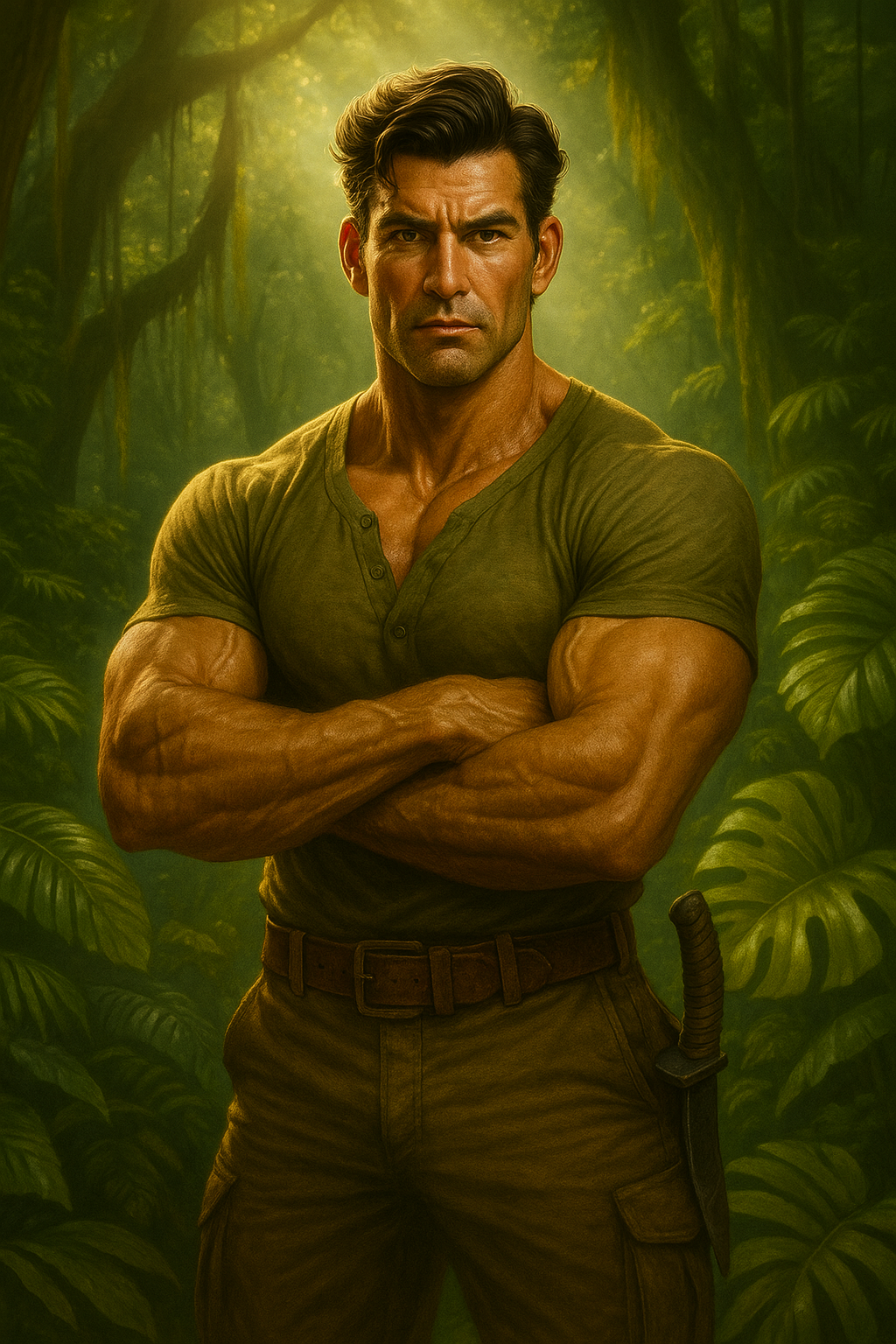
PRIMAL: The rainforest is not a backdrop.
JUNGLE DART: It is home.
DR. MUBARI: It is a living system connected to climate, water, biodiversity, culture, health, and human survival.
SUNBYTE: And protecting it takes science, technology, community leadership, political courage, and people willing to keep pushing when the headlines move on.
ALPHA: [Raises both hands.]
SUNBYTE: Alpha?
ALPHA: [Signs: “And orangutans.”]
DR. MUBARI: Yes, Alpha. And orangutans.
PRIMAL: Especially orangutans.
ALPHA: [Nods with satisfaction.]
Emergency Break: The Snack Situation
JUNGLE DART: Who brought the enormous bag under the conference table?
SUNBYTE: Alpha.
ALPHA: [Points at Primal.]
PRIMAL: I did not bring six kilograms of plantain chips.
DR. MUBARI: The bag is labeled “Emergency Canopy Rations.”
JUNGLE DART: That is just a fancy name for snacks.
ALPHA: [Signs: “Preparedness.”]
SUNBYTE: We have been in this room for twenty minutes.
ALPHA: [Signs: “The future is uncertain.”]
PRIMAL: I support his planning.
DR. MUBARI: Of course you do.
Final Debrief: Mission Status
SUNBYTE: COP30 showed that rainforest protection is gaining stronger financial and political attention. But the work ahead is enormous.
DR. MUBARI: In 2026, the focus must be on delivery: funding conservation, supporting Indigenous and local communities, strengthening climate resilience, and making sure commitments survive contact with reality.
JUNGLE DART: Reality usually has mud.
PRIMAL: And sometimes armed helicopters.
SUNBYTE: That is more of a Rainsavers-specific complication.
DR. MUBARI: The larger point stands. Saving the rainforest is not one dramatic moment. It is thousands of decisions, repeated every day.
PRIMAL: And occasionally one dramatic moment.
JUNGLE DART: Usually involving Primal crashing through a wall.
PRIMAL: It was a very weak wall.
SUNBYTE: Recording ending.
ALPHA: [Leans toward microphone.]
SUNBYTE: What did he say?
DR. MUBARI: He says the meeting needs a sequel.
ALPHA: [Points to snack table.]
JUNGLE DART: He means the snacks need a sequel.
PRIMAL: Same thing.
The Rainsavers’ 2026 Takeaway
COP30 brought important attention to forest finance, climate support, and the rights of communities protecting tropical ecosystems. But a conference cannot defend the rainforest by itself.
People still have to turn commitments into action.
That idea sits at the heart of The Rainsavers, a six-book adventure series where environmental protection collides with espionage, science fiction, ancient mysteries, German-engineered technology, and villains who really should not be allowed near a chainsaw.
Meet the full team on the Rainsavers characters page, then explore the continuing adventure at rainsavers.com.
Just remember: if Alpha invites you to a debrief, bring your own snacks.
COP30 background: United Nations overview of the Belém climate conference.
