It’s May 2026, and if you’ve checked the news lately, the Amazon isn’t just a backdrop for a vacation brochure: it’s a literal battleground. We’re currently hovering at about 18% deforestation, and scientists are sounding the alarm that once we hit that 20–25% mark, the whole system might flip into a dry savanna.
Scary? Absolutely. But at The Rainsavers, we believe that the best way to process these high-stakes realities is through the lens of a pulse-pounding adventure. Real-world threats like illegal mining, corporate greed, and toxic runoff aren't just environmental talking points; they are the fuel for the high-octane drama our team faces every day.
When we created The Rainsavers series, we didn't have to look far for inspiration. The real Amazon is already providing the ultimate high-stakes plot. Here are seven real threats currently facing the rainforest and how they’ve shaped the adventures of Tom "Primal" Swift and his crew.
1. The "Arc of Deforestation": Industrial Agriculture
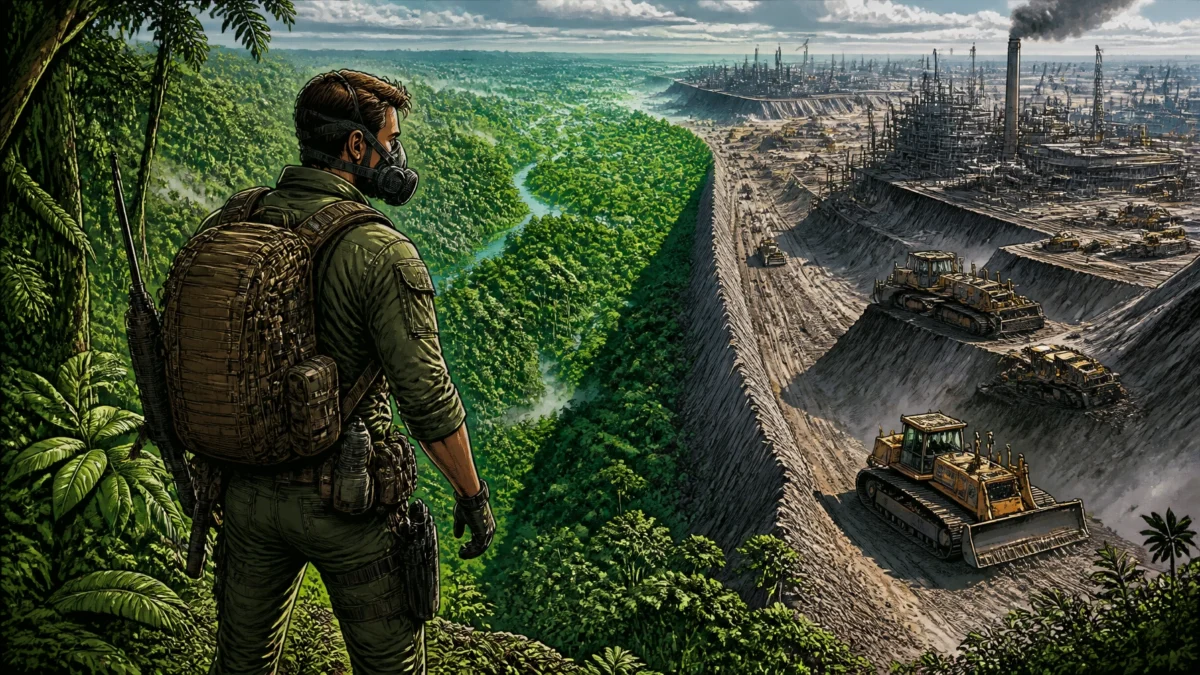
The single biggest threat to the Amazon is surprisingly mundane: cattle ranching and soy production. About 80% of deforested land in the Amazon is now pasture for cattle. This creates a literal "arc" of destruction moving deeper into the green heart of the continent.
In The Rainsavers, this threat is personified by Bossman. He isn't just a guy with a chainsaw; he represents the faceless corporate machinery that views trees as obstacles to "progress" (and profits). When Tom Swift looks out over a cleared patch of jungle, he isn't just seeing lost trees: he’s seeing the erosion of the Earth’s life support system. This real-world tension makes the physical battles in Book One: Primal Awakening feel that much more urgent.

2. E-Waste and Toxic Runoff
You might not think your old smartphone has much to do with the Amazon, but e-waste is a growing nightmare. Rare earth minerals and gold are required for our electronics, and much of that comes from unregulated mining in South America. When these electronics are discarded, the heavy metals: lead, mercury, and cadmium: often leach back into the water table.
In our series, we take this a step further. What if that toxic runoff wasn't just poison, but a catalyst? In Black Rain, the team discovers that rogue agents are using discarded technology and toxic byproducts to develop bioweapons. The "e-waste" in our books often glows with a sinister red light: a nod to the very real chemical contamination that Dr. Mubari has to fight in the field.
3. Corporate Greed and "Greenwashing"
We’ve all seen it: a company that destroys habitats on Monday and releases a "sustainability report" on Tuesday. This corporate gaslighting is a massive hurdle for real-world activists. It makes it hard to tell who the real villains are until the damage is already done.
This is exactly why we love writing about the internal politics of the Amazon. In The Rainsavers, the villains aren't just mustache-twirling bad guys in the woods; they are often in high-rise offices, using legal loopholes to fund their expeditions. If you’ve ever felt struggling with climate anxiety, seeing Tom and Alpha (our resident orangutan genius) physically dismantle these corporate schemes is incredibly cathartic.
4. Illegal Mining for "Critical Minerals"
The world is hungry for "green" energy, but the minerals needed for batteries: like bauxite, iron, and niobium: often lie directly beneath protected rainforest. Illegal gold mining is even worse, as it uses mercury to separate gold from the soil, which then flows into the rivers, poisoning fish and the Indigenous communities that rely on them.
In Tempest of the Crimson Skies, we introduce the concept of Red Mercury crystals. While these are fictional, they serve as a stand-in for the "critical minerals" the world is currently fighting over. The hunt for these crystals leads the Rainsavers into dangerous territory, mirroring the real-life dangers faced by environmental defenders who go up against illegal mining syndicates.

5. Climate Tipping Points and the "Spirit Tree"
The Amazon is often called the "Lungs of the Planet" because it breathes out oxygen and recycles its own rain. But as we lose more trees, that cycle breaks. If the forest can't produce enough rain, it dies from the inside out.
We represented this delicate balance through the Spirit Tree in Books Five and Six. It’s the heart of the rainforest’s power. When Mortalis (the evolved form of Leonard West) gains control of the tree, the entire ecosystem begins to unravel. It’s a literalization of the tipping point we are facing in 2026. Protecting the Spirit Tree isn't just about saving one plant; it's about saving the atmosphere itself.
6. Bio-Terrorism and Genetic Engineering
While most of us worry about natural viruses, the Amazon is a treasure trove of genetic information. Biotech companies are constantly scouting the jungle for the "next big thing" in medicine. In the wrong hands, this biological data can be weaponized.
This is where Leonard West comes in. A rogue agent with a background in advanced science, West uses ancient German technology (discovered in the deep jungle) to mutate rainforest life. He isn't just trying to kill the forest; he’s trying to rewrite its DNA to serve him. This mirrors the real-world ethical debates over "bioprospecting" and who truly owns the genetic code of the Amazon’s unique species.

7. Poorly Planned Infrastructure (Roads and Dams)
A single road cut through a pristine forest is often the beginning of the end. It provides access for loggers, poachers, and land-grabbers. Similarly, massive hydroelectric dams might provide "clean" energy, but they flood huge areas of forest and displace thousands of people.
In The Rainsavers, the team is constantly navigating these fragmented landscapes. One minute they are in a lush, untouched paradise, and the next, they are crossing a scarred industrial highway. This contrast is a key part of our world-building, showing that modern eco-heroes have to be just as comfortable in a high-tech lab as they are swinging through the canopy.
Why Pulp Adventure is the Perfect Way to Save the World
You might ask: Why write an action series about environmental destruction? Why not just a documentary?
Because documentaries can be heavy. They can make you feel small. But an adventure story? That makes you feel like you can fight back.
When you read The Rainsavers, you’re not just reading about the destruction of the Amazon: you’re joining a team that refuses to let it happen. Whether it's Sunbyte’s tech skills or Alpha’s raw strength, everyone has a part to play. It’s about why team-based adventure series are taking over: because the problems we face in 2026 are too big for one person to solve.
The Amazon is at a crossroads. Real threats like deforestation and e-waste aren't going away, but by telling stories where heroes stand up to these forces, we keep the conversation alive. We remind ourselves that the rainforest is worth fighting for, whether it's through real-world activism or by diving into a six-book epic.
Ready to join the hunt? The battle for the Amazon starts with a single step: or in this case, a single page.
See how we blend both: Read Book One now at RainSavers.com
