

Meta description: Crack open Bossman’s leaked corporate playbook and discover four villain-level tactics from The Rainsavers universe. Then read Book One.
THE RAINSAVERS , INTERNAL MEMO
Document recovered from: Bossman’s executive office
Security rating: Extremely suspicious
Coffee stains: Numerous
Recommended action: Read immediately, then hand to Sunbyte for hacking.
Date: Monday, August 17, 2026
Subject: How to Become Everyone’s Least Favorite Corporate Villain
Hello, aspiring business overlords.
If you’re reading this, congratulations: you’ve discovered Bossman’s Playbook, the executive guide to turning forests into profits, responsibility into paperwork, and every suspicious decision into a “strategic growth opportunity.”
Naturally, The Rainsavers do not approve of these tactics.
We are sharing them for educational purposes, dramatic irony, and because Alpha found the file in a ventilation shaft.
ALPHA’S NOTE: “File was not in ventilation shaft. It was in Bossman’s desk.”
SUNBYTE’S NOTE: “Alpha is protecting a source.”
PRIMAL’S NOTE: “Why is there a tree leaf inside this memo?”
ALPHA’S NOTE: “Because Bossman’s desk is in the rainforest.”
Let’s turn the page.
Tactic One: Launch the Greenwashing Smokescreen
Bossman’s official instruction:
When people notice the trees, distract them with a very shiny presentation.
The first rule of villainous corporate camouflage is simple: the public enjoys trees.
Therefore, every destructive operation must be surrounded by a cloud of encouraging phrases:
- Sustainable growth
- Community partnership
- Environmental renewal
- Responsible extraction
- Nature-forward innovation
- Green excellence
- Definitely-not-burning-anything initiative
Use each phrase at least twelve times per press release. Add a photograph of one healthy seedling. Make sure the seedling is centered, well-lit, and nowhere near the thousands of acres being cleared outside the frame.
Bossman understands that a small feel-good project can create a very large distraction. Fund one tree-planting event, invite several cameras, hand out reusable water bottles, and then quietly continue the operation behind a curtain marked “Long-Term Ecological Strategy.”
SUNBYTE’S MARGIN NOTE: “The curtain is not a legal document.”
MUBARI’S MARGIN NOTE: “Nor is a seedling a substitute for a rainforest.”
This is why Bossman is such a dangerous villain in The Rainsavers. His schemes aren’t only about machines, money, or muscle. He understands the power of appearances. If he can make exploitation look like stewardship, he can keep people arguing about the brochure while the real damage happens off-page.
Unfortunately for him, brochures do not fool a team with a hacker, a scientist, an orangutan, a jungle tracker, and a super-strong pilot.
Tactic Two: Manufacture Scarcity, Then Sell the Solution
Bossman’s official instruction:
Create the panic. Control the supply. Charge extra for calm.
Step one: release a forecast predicting that a valuable resource is about to become dangerously scarce.
Step two: arrange for three respectable analysts to repeat the forecast in serious voices.
Step three: buy up the resource quietly while everyone else is busy refreshing their news feeds.
Step four: launch a premium “stability program” that sells access to the resource at a heroic markup.
Step five: ensure nobody gets a clear look at the original data.
It’s a beautiful system if your definition of beauty is “a spreadsheet wearing a fake mustache.”
Bossman’s version of corporate power depends on controlling not just resources, but information about those resources. If he can make people afraid of running out, he can turn fear into demand. If he controls the supply, he can turn demand into profit. And if he controls the explanation, he can make the whole thing sound like responsible leadership.
That’s the sort of maneuver that turns a businessman into a full-scale adventure villain.
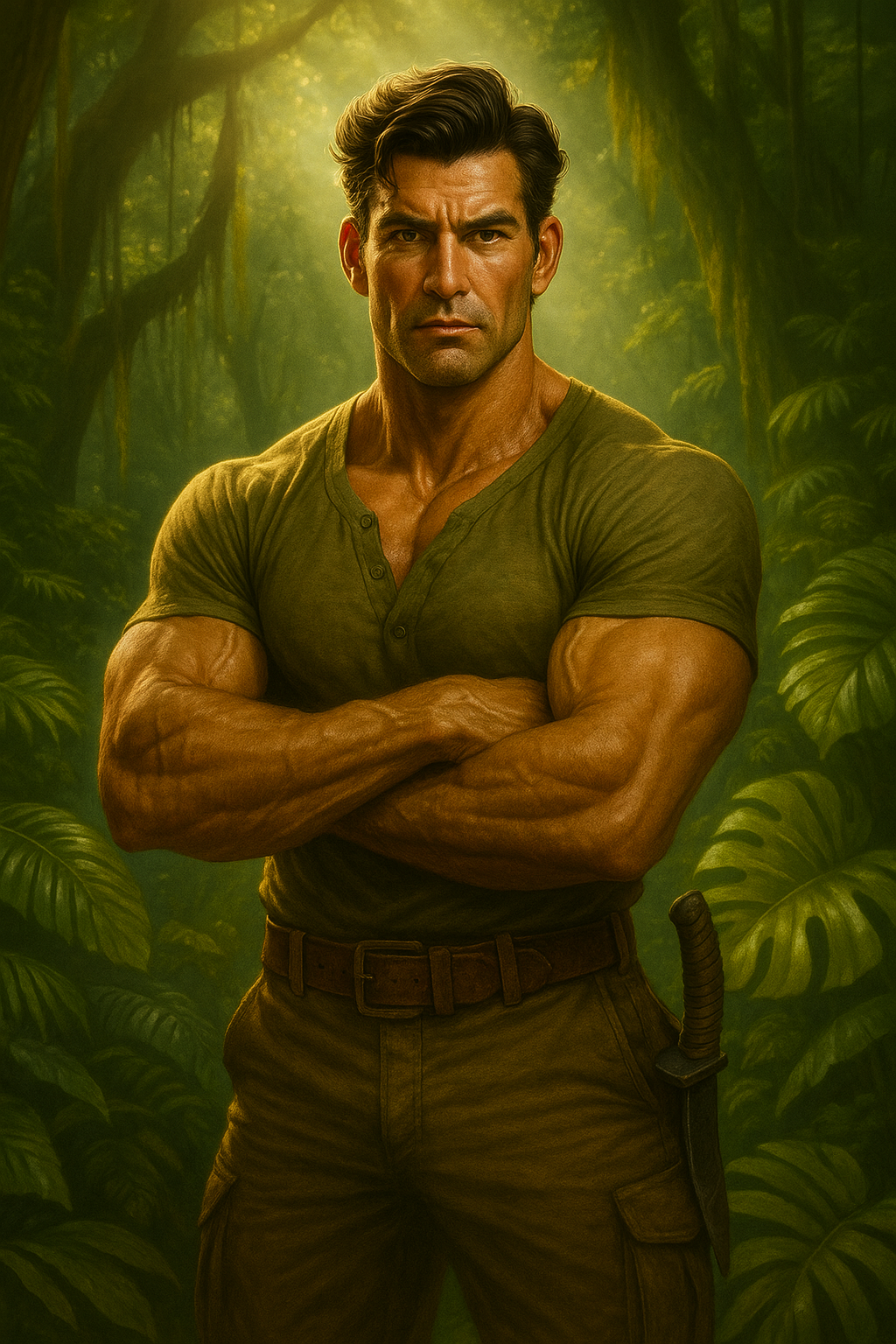
FIELD REPORT , PRIMAL:
“Bossman thinks everything is a supply chain. Trees, rivers, people. He’s wrong.”
This is also where the Rainsavers become the perfect counterforce. Bossman sees the Amazon as a collection of assets. Tom “Primal” Swift sees a living place worth protecting. Dr. Mubari brings the science. Jungle Dart knows the land. Sunbyte follows the data. Alpha notices the things everyone else missed.
And when the situation requires a door to stop being a door, Primal is available.
Tactic Three: Turn Ownership Into a Maze
Bossman’s official instruction:
If anyone asks who is responsible, provide a diagram with too many arrows.
The ideal villainous corporation should contain:
- A holding company
- Several subsidiaries
- A trust with an impressive name
- A “consulting partner”
- Three contractors
- A public-relations firm
- An “independent” research group
- At least one office that exists primarily to forward emails
One company hires the workers. Another owns the equipment. A third manages communications. A fourth signs the contract. A fifth claims it has never heard of the first four.
Eventually, a journalist, regulator, or furious orangutan reaches the top of the structure and asks, “Who approved this?”
The answer should be: “That’s complicated.”
ALPHA’S NOTE: “No. It is not complicated.”
SUNBYTE’S NOTE: “Alpha has highlighted the ownership chart in red.”
ALPHA’S NOTE: “And circled Bossman’s name.”
PRIMAL’S NOTE: “That seems efficient.”
Bossman uses complexity as armor. The more tangled the structure, the harder it becomes to connect a decision to the person who benefits from it. Responsibility gets passed from desk to desk until it disappears into a conference room with no windows.
But The Rainsavers are not impressed by fancy organizational charts. Sunbyte can trace a digital trail. Alpha can remember every face, symbol, and signal he encounters. Dr. Mubari can identify what a project is doing to the ecosystem. Jungle Dart can spot a threat long before it appears on a corporate map.
The rainforest has its own filing system. It is called “pay attention.”
Tactic Four: Replace Responsibility With a Committee
Bossman’s official instruction:
Make every decision collective enough that nobody feels responsible for it.
Here is the recommended approval chain:
- Strategy approves the objective.
- Finance approves the potential return.
- Legal approves the wording.
- Security approves the access.
- Communications approves the announcement.
- Operations approves the machinery.
- Leadership approves the general concept.
- Everyone becomes unavailable for comment.
If anything goes wrong, form a review committee. The committee should investigate the committee’s process and conclude that all procedures were followed.
This is the most advanced tactic in the playbook because it transforms bureaucracy into a force field. Nobody has to say, “I ordered the rainforest cleared.” They only need to say:
- “That was above my pay grade.”
- “I wasn’t in that meeting.”
- “I inherited the project.”
- “We are reviewing the situation.”
- “Our commitment to the environment remains unwavering.”
Meanwhile, the bulldozer is still running.

ALPHA’S TRANSMISSION:
“Committee has seven members. None can climb tree.”
That, in summary, is Bossman’s major weakness.
He has money, influence, private security, public relations, and enough paperwork to bury a small moon. But his entire system depends on people staying disconnected from the consequences of their decisions.
The Rainsavers work in the opposite direction.
They share information. They trust one another. They notice when something feels wrong. They don’t wait for a committee to approve an emergency rescue. They act because the rainforest cannot afford a twelve-step approval process.
The Counter-Playbook: Four Things Bossman Forgot
Every villain handbook has a missing chapter. Bossman’s is titled “What Happens When People Care More Than Profit.”
The Rainsavers’ counter-tactics are surprisingly simple:
- Look past the presentation. A green logo does not automatically mean a green mission.
- Ask who benefits. Follow the money, the ownership, and the decisions.
- Demand clear information. Confusion is often useful to the person creating it.
- Work together. A corporate machine is much less intimidating when people stop facing it alone.
That is the heart of The Rainsavers. The story brings together action, science fiction, environmental stakes, espionage, ancient mysteries, and one extremely intelligent orangutan: but beneath all of it is a simple question:
What happens when ordinary people refuse to let powerful villains define the future?
Bossman believes the rainforest can be owned.
The Rainsavers know it must be protected.
File Closed. Adventure Open.
The playbook has been returned to the ventilation shaft.
Probably.
If you want to see Bossman’s tactics in action—and watch the Rainsavers push back—start with Book One: Primal Awakening. Meet Tom Swift, Alpha, Dr. Mubari, Jungle Dart, and Sunbyte as they take on deforestation, corporate greed, and a villain who thinks every living thing comes with a price tag.

Read Primal Awakening now, then visit rainsavers.com to explore the full six-book adventure.
Just remember: if anyone offers you a “Nature Optimization Partnership,” ask to see the original data.
And check the ventilation shaft.
