
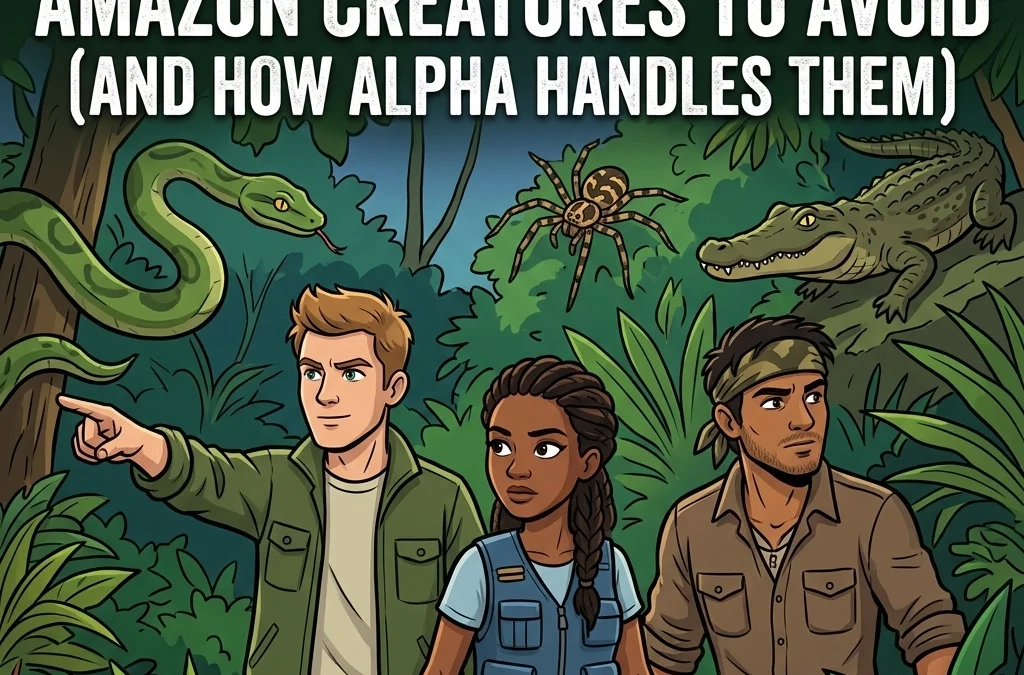
Meta Description: Dive into the deep Amazon with The Rainsavers! Learn about 3 deadly creatures to avoid and how Alpha manages to survive the jungle’s most dangerous residents (mostly with high-tech gear and a little bit of luck).
LOG ENTRY: Leonard West
SUBJECT: Amazon Survival (Or, Why I Should’ve Stayed in the Lab)
Listen, I love trees. I love the rain. I love the smell of damp earth and the way the canopy filters the sunlight into those pretty little god-rays. But let’s be real: the Amazon rainforest is essentially a giant green room where every single resident has a personal vendetta against human ankles.
When we founded The Rainsavers, we knew the mission would be tough. Protecting the lungs of the planet isn't just about planting saplings and stopping illegal loggers; it’s about not getting dissolved by a snake or bitten by an ant that makes you wish you’d never been born.
Alpha, our lead field operative, keeps telling me that "the jungle is a partner, not an enemy." Easy for him to say: he has the high-tech tactical gear and the reflexes of a caffeinated jaguar. Me? I have a clipboard and a tendency to sneeze at pollen.
Here are the top three "Nope" candidates we’ve encountered in the field, and exactly how Alpha handles them (versus how I handle them, which is usually by screaming).
1. The Fer-de-lance (The "Leaf-Pile of Doom")
The Bothrops atrox. To the untrained eye, it looks like a pile of dead leaves. To the trained eye, it still looks like a pile of dead leaves, but you’re already sweating because you know that pile has fangs and a very short temper.
This snake is responsible for more bites in the Amazon than almost any other reptile. Its venom is hemotoxic, which is a fancy scientist way of saying it turns your blood into something resembling a failed strawberry smoothie.
How Alpha Handles It:
Alpha doesn't do "sneaking" when it comes to snakes. He uses the R-1 Tactical Field Respirator (you can see it in my gear photo below) to filter out any pheromones or swamp gases that might dull his senses.
The Move: Alpha uses a carbon-fiber trekking pole to gently move debris as he walks. When he spots a Fer-de-lance, he doesn't poke it. He stands perfectly still, waits for the snake to realize he’s not a giant, delicious rodent, and then takes a very, very wide detour.
The "Oops" Moment: Last Tuesday, Alpha was so busy checking his wrist-mounted HUD for environmental anomalies that he stepped right next to a juvenile Fer-de-lance. He did this weird, mid-air parkour twist that looked like a glitch in the Matrix, landed on a log, and then spent ten minutes pretending he meant to do it for "training purposes." Sure, Alpha. We saw the panic-shimmy.

2. The Black Caiman (The River Log with Teeth)
Imagine a crocodile, but make it black, six meters long, and give it the ability to vanish in tea-colored water. That’s the Black Caiman. It is the undisputed heavyweight champion of the Amazonian river systems.
They are nocturnal hunters, which means they spend their days looking like very grumpy logs and their nights looking for anything that splashes.
How Alpha Handles It:
Caimans are all about territory. Alpha’s approach is tech-first. When we’re navigating the tributaries, he deploys a Sub-Surface Sonic Emitter. It’s a tiny device that fits in his tactical backpack and sends out a low-frequency pulse that basically tells the Caimans, "Move along, nothing to eat here but metal and waterproof fabric."
The Move: If we’re on foot near the water’s edge at night, Alpha switches his goggles to thermal mode. The Caiman’s heat signature is low, but their eyes reflect light like two burning embers. He keeps the team at least twenty feet from the bank, usually whistling a low tune to keep his own nerves steady.
The "Oops" Moment: During a night-op near the Xingu River, the Sonic Emitter’s battery died. Instead of a pulse, it emitted a high-pitched squeal that sounded remarkably like a distressed capybara. Every Caiman within three miles suddenly thought the buffet was open. Alpha had to carry me and the gear up a Kapok tree in record time. We spent six hours sitting on a branch while a four-meter Caiman watched us from below. Alpha called it "enhanced surveillance practice." I called it "I want to go home."
3. The Bullet Ant (The Spicy Raisin)
Don't let the size fool you. This 3cm ant packs a punch that has been compared to being shot with a gun. Hence the name. The pain lasts for 24 hours, waves of agony that make grown men weep and ask for their mothers.
They live in the roots of trees and occasionally fall from the canopy, which is why "looking up" is just as important as "looking down."
How Alpha Handles It:
Armor. Plain and simple. Alpha’s field suit is made of a reinforced synthetic weave that’s specifically designed to be sting-proof. But even the best suit has gaps.
The Move: Alpha is a fanatic about "clean camps." He sprays the perimeter of our tents with a non-toxic, eco-friendly repellent we developed in the lab. It smells like citrus and victory. He also checks his boots every single morning with the intensity of a diamond appraiser.
The "Oops" Moment: You’d think the guy would learn. While adjusting his high-tech respirator on a giant tropical leaf (it makes for a great gear shelf, honestly), Alpha didn’t notice a single Bullet Ant had hitched a ride on his tactical backpack. It crawled inside his glove.
I have never heard a sound like the one Alpha made. It was a mix of a teakettle whistle and a heavy metal scream. He spent the next day vibrating with sheer pain, refusing to admit he was hurting while accidentally crushing his titanium canteen with one hand.

Why This Matters (Besides My Blood Pressure)
Living and working in the Amazon isn't just about surviving the wildlife; it’s about respecting it. At The Rainsavers, we believe that the more we understand these "dangerous" creatures, the better we can protect the environment they call home.
The Amazon is a delicate balance of predators and prey, and as fiction writers and environmental enthusiasts, we love bringing that tension to life in our stories. Every time Alpha gets bitten or chased, it’s a lesson in humility: and great inspiration for a new chapter!
Whether it's dodging vipers or stopping a global ecological conspiracy, the stakes are always high. If you think the creatures are scary, wait until you meet the humans who are trying to tear the jungle down.
Ready for the Real Adventure?
If you want to see Alpha in action (and see how many more "oops" moments he can survive while saving the world), you need to dive into our series. It’s got the tech, the tension, and the tactical gear you’ve been dreaming of.
Read Book One now and join the mission to save the planet, one "spicy raisin" at one time.
Visit The Rainsavers Homepage for more field notes, character bios, and gear leaks!
