
Meta Description: WWII mustard gas or lab-grown pathogens? We dive into which threat makes for a better eco-thriller in 2026 and how The Rainsavers blends historical grit with high-tech bio-scares.
Hey everyone, Steven G. Samuels here.
As we sit here in mid-2026, the world of adventure fiction has taken some wild turns. We’ve moved past the era of simple "bad guys with a base" and into something much more atmospheric, and frankly, much more terrifying. At The Rainsavers, we spend a lot of time thinking about what keeps you up at night. Is it the rusting, forgotten machinery of a century-old war? Or is it the invisible, hyper-intelligent biological "oopsie" cooked up in a sleek modern lab?
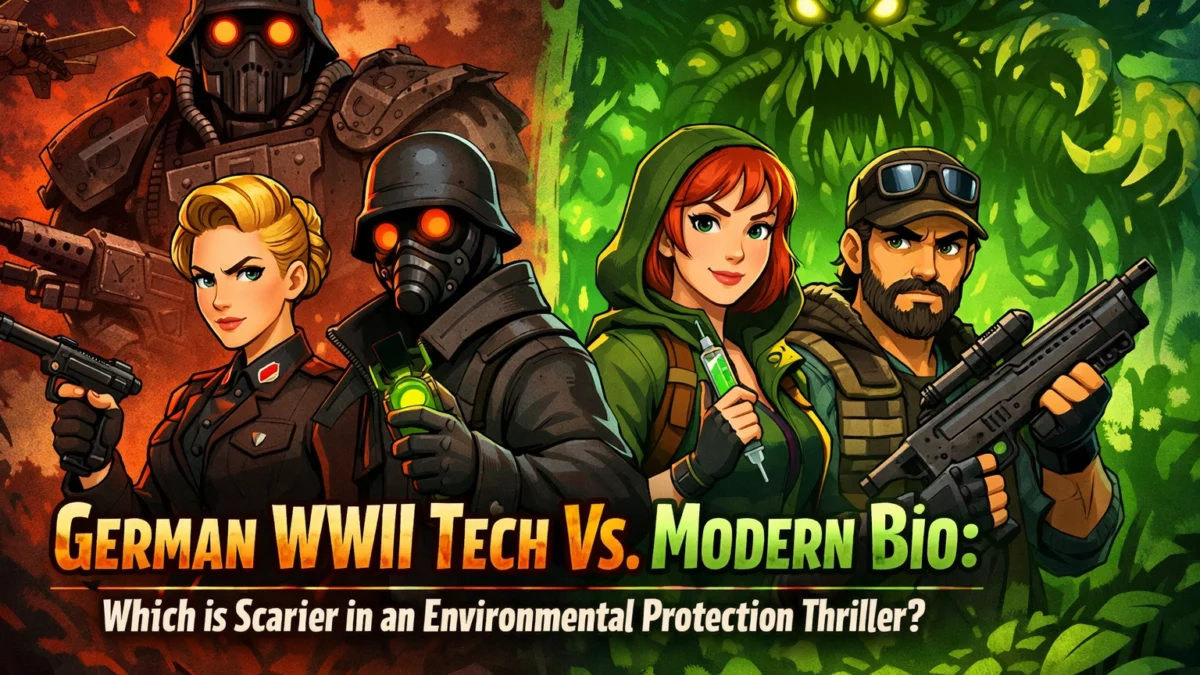
In our series, we don’t like to choose. We like to mash them together. But for today’s debate, let’s break down the two heavyweights of environmental horror: German WWII Tech vs. Modern Bio.
Which one actually wins the "scare" trophy in a modern environmental thriller? Let’s find out.
The Rusty Ghost: WWII Chemical Tech
There is something inherently creepy about WWII-era technology. It’s heavy, it’s analog, and it’s usually built out of lead, iron, and pure spite. When we talk about WWII tech in an environmental context, we aren't just talking about tanks; we’re talking about the 50,000 metric tons of chemical weapons dumped into the Baltic Sea after the war ended.
Imagine this: You’re on a tactical expedition, checking water quality sensors, and you realize your boots are melting. Why? Because a shell casing that has been sitting on the ocean floor for 80 years finally corroded through, releasing sulfur mustard gas into the ecosystem.
Why WWII Tech is Scarier:
- The Ticking Clock: According to real-world research (yes, we do our homework), many of these bomb casings are projected to fully disintegrate within the next few years. In an eco-thriller, that’s a literal countdown to disaster.
- The "Invisible" Physicality: Unlike a virus, you can trip over a WWII drum. But once it leaks, it forms lumps that don’t dissolve. It stays there, waiting for a fisherman or an environmental hero to touch it.
- The Sin of the Past: It represents a threat we thought we buried. There’s a psychological weight to cleaning up a mess your great-grandfather’s generation left behind.

The Invisible Architect: Modern Biotech
Now, flip the script. You aren't looking for a rusty drum in the mud. You’re looking for a sequence of code. In 2026, biotechnology has reached a point where we can practically "print" life. In the hands of a villain: or even a well-meaning scientist: that power is nightmare fuel.
Modern bio-threats in thrillers often involve things like "Gene Drives" (designed to wipe out entire species) or synthetic pathogens that can target specific genetic markers. It’s clean, it’s high-tech, and it’s completely invisible until people start coughing or the local forest starts turning gray.
Why Modern Bio is Scarier:
- No Boundaries: You can’t build a wall against a microscopic spore. It moves with the wind, the water, and the trade routes.
- Unpredictability: Evolution is messy. A bio-engineered "solution" to fix a drought could easily mutate into something that eats every green leaf in sight.
- The High-Tech Requirement: To fight it, our heroes need those cool, high-tech field respirators you see in our tactical expedition art. You aren't just holding your breath; you’re trusting a computer to filter out death.

The Showdown: Historical Grit vs. Genetic Glitch
When we sit down to plot a new episode at The Rainsavers, we look at how these two threats interact with the environment.
Scale of Destruction
WWII tech is usually localized but devastating. It ruins a coastline, a bay, or a forest for decades. It’s a "hot zone" that stays hot. Modern bio, however, is a global threat. It’s the difference between a house fire (WWII) and a planetary fever (Bio).
The Hero’s Toolset
This is where the fun starts. If our team is dealing with old German tech, it’s all about heavy lifting, containment, and old-school engineering. It’s gritty work. If they’re facing a bio-threat, it’s about PCR machines, data analysis, and wearing those sleek, intimidating respirators while navigating a silent, dying landscape.
The "Ooze" Factor
Let’s be honest: WWII chemical agents are just grosser. Mustard gas that turns into solid lumps on the seafloor? That’s peak thriller material. Bio-threats are more "intellectual" scares: the fear of the unknown.
Why We Blend Both in The Rainsavers
At the end of the day, the best thrillers don't just pick one. The most terrifying scenario we can imagine? A modern bio-terrorist group using a forgotten WWII chemical site as a "nursery" for their new synthetic plague.
By mixing the historical grit of the 1940s with the terrifying possibilities of 2026, we create a world that feels both grounded and futuristic. It allows our characters to use their brains and their brawn. They have to understand history to find the site, and they have to understand science to stop the leak.

The Verdict: Which is Scarier?
If you ask me, WWII Tech wins on the "impending doom" front. We know it’s there. We know it’s rusting. We know the casings are failing right now. There’s no "maybe" about it.
However, Modern Bio wins on the "helplessness" front. There’s something uniquely chilling about a threat you can’t see, smell, or touch until it’s already inside you.
In our books, we treat the environment like a character. And right now, that character is being bullied by both the ghosts of the past and the tech of the future. Our job as storytellers is to show how a team of dedicated environmental heroes can stand up to both.
What do you think?
Are you more afraid of the rusting bomb in the basement of history, or the designer virus in the lab of tomorrow?
If you want to see how we tackle these threats head-on, dive into our latest adventures. We’re constantly pushing the limits of what an "eco-hero" can do, from deep-sea salvage to high-stakes bio-containment.
Stay safe out there, and keep your respirators handy.
: Steven G. Samuels
CEO, The Rainsavers
Enjoying the deep dives into eco-thriller tech? Check out our other posts on the The Rainsavers Blog or join the conversation on our latest Poll.
