
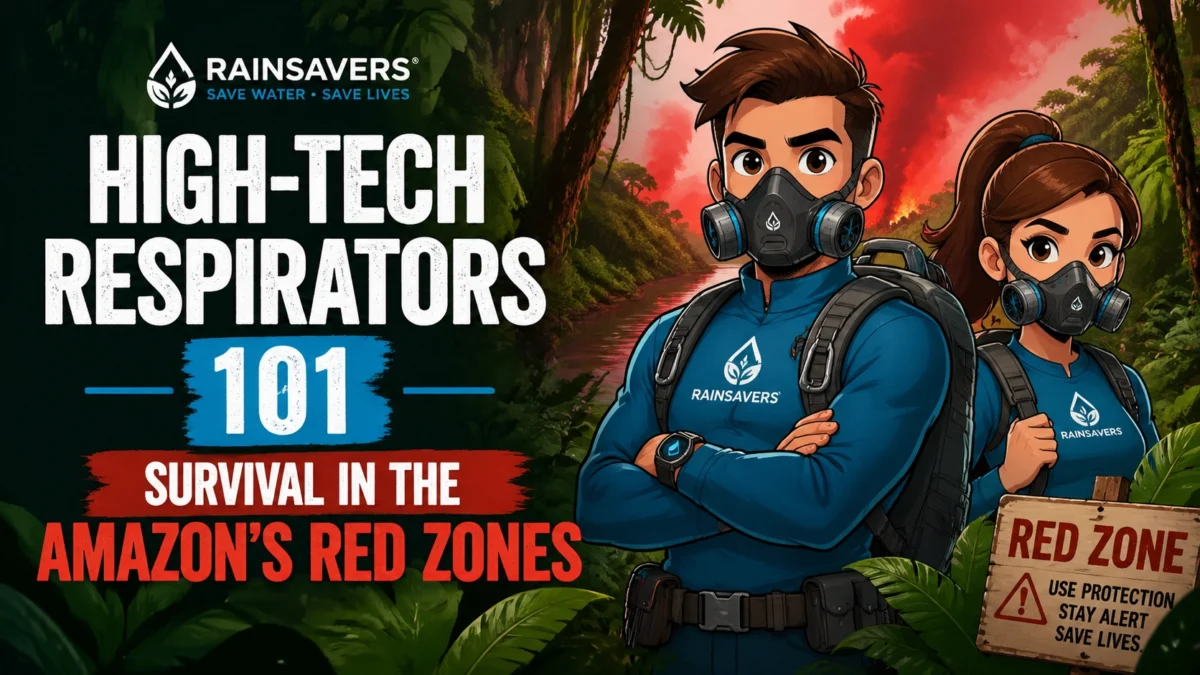
Meta Description: Navigating the toxic "Red Zones" of the Amazon in 2026 requires more than just grit. Discover the tech behind the Aegis-7 and why high-tech respirators are the ultimate survival gear for the modern eco-hero.
Hey there, adventurers! Steven G. Samuels here.
If you’ve been following our latest releases at The Rainsavers, you know that the Amazon of 2026 isn't exactly the lush, postcard-perfect paradise we once imagined. Between the hyper-accelerated fungal blooms and the industrial "Red Zones," the air down there has become… let’s just say, a bit spicy.
If you’re planning on venturing into the deep green (or the neon red) this year, your old hardware store N95 mask isn’t going to cut it. You need tech. You need something that can filter out spores the size of a nanometer while you’re sweating through a tropical storm.
Today, we’re doing a deep dive into the gear that keeps our team breathing: High-tech field respirators, featuring the crown jewel of survival tech, the Aegis-7.
What Exactly is a "Red Zone"?
Before we talk about the masks, we have to talk about why we need them. By mid-2026, the term "Red Zone" has become shorthand for areas of the rainforest where the ecosystem has essentially turned toxic to human lungs.
These aren't just polluted areas; they are biological hotspots where ancient spores: disturbed by climate shifts and industrial runoff: have created a literal "soup" in the air. One deep breath without protection, and you’re looking at fungal pneumonia before you can say "eco-disaster."
The Rainsavers team spends a lot of time in these zones, and let me tell you, the view is spectacular, but the atmosphere is deadly. That’s where the high-tech respirators come in.
The Evolution of the Field Respirator
In the early 2020s, we were all used to those little paper masks. They were great for dust and the occasional virus, but the Amazon’s Red Zones require something closer to a space suit than a medical supply.
High-tech respirators in 2026 have evolved to be:
- Self-Cleaning: No one wants to change a filter in the middle of a swarm of toxic gnats.
- Active-Flow: Using tiny fans to assist your breathing so you don’t get exhausted just trying to inhale.
- Smart-Integrated: Showing you air quality stats on a heads-up display (HUD).

Caption: A blueprint of the Aegis-7 showing the internal active-flow turbine and the nano-pore filtration layers.
Meet the Aegis-7: The Gold Standard
If you’ve read our latest adventures over at The Rainsavers, you’ve seen the Aegis-7 in action. It’s not just a mask; it’s a life-support system for your face.
Here is why the Aegis-7 is currently the top-tier choice for field agents:
1. The Quad-Stage Nano-Filtration
Standard filters trap particles. The Aegis-7 destroys them. Using a proprietary "bio-zapping" layer, the mask uses a micro-electric charge to neutralize spores on contact. This prevents the "clogging" that usually happens in high-humidity environments.
2. The Humidity Compensator
The biggest enemy of any respirator in the Amazon isn't the toxins: it's the water. When the humidity hits 98%, standard filters turn into wet rags. The Aegis-7 features a centrifugal moisture trap that spins excess water out of the air before it ever touches the filter.
3. Haptic Alerts and HUD Sync
Ever been so focused on a mission that you forgot to check your filter life? The Aegis-7 syncs with your survival watch or HUD-enabled goggles. If the air quality dips or your battery hits 10%, you’ll get a gentle vibration on your jawline. No more guessing games.

Caption: A field agent demonstrating the HUD interface of the Aegis-7 while navigating a dense Red Zone thicket.
Other Competitors in the Field
While we swear by the Aegis series, there are other units out there making waves in 2026.
- The Spore-Slayer X: A bulky but reliable beast. It’s heavy, and it makes you look like a sci-fi villain, but its battery life is legendary. Great for long-haul treks where you won't see a charging port for weeks.
- The Vapor-Shield Mini: This is a "half-mask" design. It’s lightweight and great for "Yellow Zones" (moderate risk), but we wouldn’t recommend it for the heart of a Red Zone. It’s the favorite for many of our younger characters who value mobility over total tank-like protection.
Field Maintenance: Keeping Your Lungs Happy
Having the gear is only half the battle. If you don't maintain your respirator, the Amazon will reclaim it (and you) pretty quickly.
Here are the "oops" moments our team has learned the hard way:
- The "Mud-Plug": If you fall in a swamp, clean your intake valves immediately. One of our field techs once tried to push through a mud-clogged intake and ended up sucking the mask onto his face like a plunger. Not his best look.
- Battery Management: In 2026, we use solar-kinetics, but they aren't perfect under the thick canopy of the rainforest. Always carry a manual hand-crank charger. It’s a workout, but it’s better than breathing spores.
- Seal Checks: Facial hair is the enemy of a good seal. If you’re rocking a "survival beard," make sure your mask has a silicone "skirt" deep enough to compensate.

Caption: An exploded view of the filter housing, showing how the different layers of the Aegis-7 click into place for easy cleaning.
Why This Matters for the Planet
At The Rainsavers, we write fiction, but we keep it grounded in the realities of where our world is heading. The tech we describe, like the Aegis-7, represents the bridge between human ingenuity and environmental survival.
As we explore the mysteries of the Amazon and face off against modern threats (and some ancient ones too!), these respirators symbolize our need to adapt. We aren't just fighting villains; we're fighting for the right to breathe clean air again.
If you’re interested in how these tech pieces play a role in our stories: from escaping high-speed chases through toxic groves to uncovering the secrets of the rainforest: you really need to see them in action.
Quick Comparison Table: 2026 Survival Masks
| Feature | Aegis-7 | Spore-Slayer X | Vapor-Shield Mini |
|---|---|---|---|
| Protection Level | Red Zone (High) | Red Zone (High) | Yellow Zone (Med) |
| Weight | 0.8 lbs | 2.5 lbs | 0.4 lbs |
| Battery Life | 24 Hours | 72 Hours | 12 Hours |
| HUD Sync | Full Integration | Basic Alerts | None |
| Best For | Stealth/Exploration | Heavy Industrial | Light Trekking |

Caption: The Rainsavers team geared up and ready to enter a restricted sector, their Aegis-7 units glowing faintly in the dim jungle light.
The Future of Breathing
As we move further into 2026, the technology is only going to get better. We're already hearing rumors of "rebreather" tech that can extract oxygen directly from water molecules in the air: no intake needed. Imagine a mask that never needs to "breathe" external air at all!
Until then, we’re sticking with the Aegis-7. It’s saved Leonard West’s life more times than he’d care to admit, and it’s a staple of the gear we feature in our books.
Want to know more about the gadgets that keep our team alive? Or maybe you want to dive into the stories where this tech actually gets put to the ultimate test? We’ve got plenty of adventures waiting for you.
Keep your seals tight and your filters clean, adventurers!
Enjoyed this tech breakdown? Check out our other field notes on the Rainsavers Blog and don't forget to enter our latest giveaway for a chance to win some (slightly less toxic) survival gear!
