
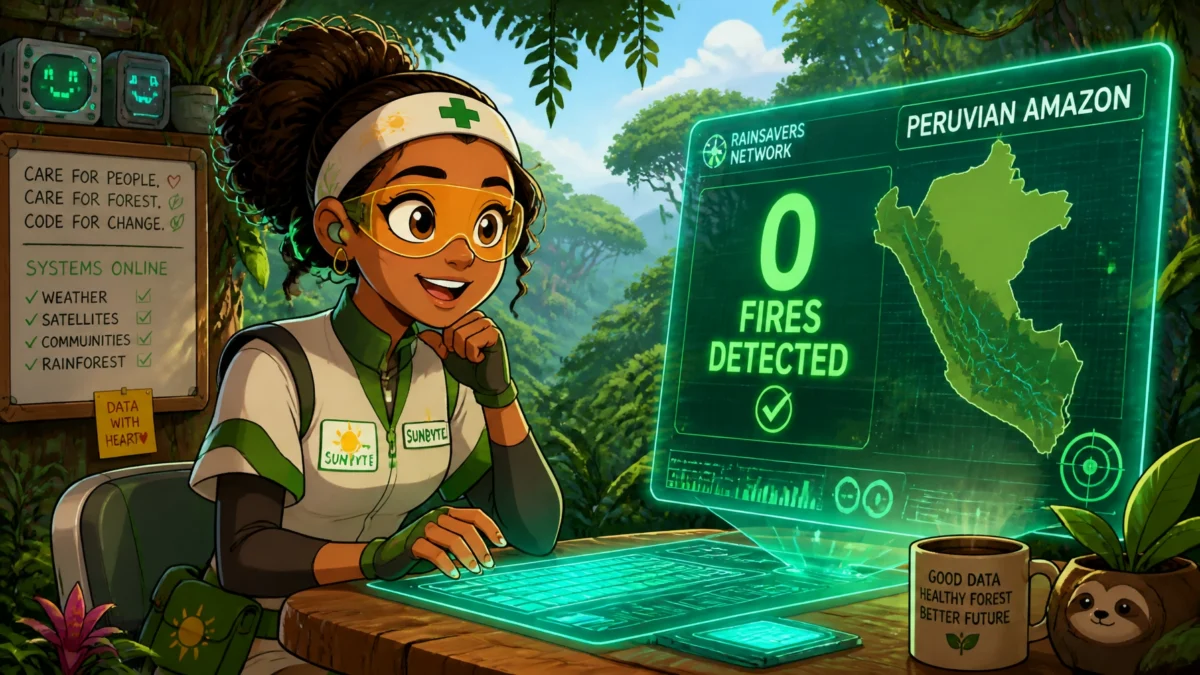
FIELD NOTES: LOG ENTRY #72526
LOCATION: Rainsavers Mobile Command (Deep Canopy)
STATUS: Highly Caffeinated / Extremely Impressed
If you’ve been following our journey through the Amazon, you know that Sunbyte, our resident hacker-nurse and the brain behind most of our tactical hardware, is usually the one teaching us about "the next big thing" in tech. But this morning, she almost short-circuited her own workstation with excitement.
It turns out that while we’ve been busy dodging Mortalis and trying to figure out why the Spirit Tree is acting like it has a cosmic fever, some incredible people in the real world have been pulling off tech feats that even Sunbyte finds "moderately legendary."
We’re talking about the Paamari project in Peru. And here’s the kicker: they just beat NASA to the punch when it comes to spotting wildfires.
The Paamari Project: Faster Than a Satellite Pulse
Let’s set the scene. It’s July 2026. The world is getting hotter, and the rainforest is usually a tinderbox this time of year. But in the Ene River basin, the Asháninka communities have essentially built their own version of a Rainsaver monitoring grid.
Named "Paamari" (which means "fire" in the Asháninka language), this isn't just some guys with binoculars. It’s a full-blown, AI-driven, early-warning masterstroke. By combining satellite data with an AI algorithm that can process heat signatures faster than traditional systems, they’ve managed to do the impossible.
In 2023, they were seeing 25 major fires a year. By 2025? Zero.
You read that right. While the rest of the planet is scrambling to find AI that can write grocery lists, the Asháninka have built an AI that actually saves the Earth. Sunbyte says the way their SAT-CARE system aggregates heat-spot data is "elegant enough to make a German engineer weep." (Wait, we're not talking about those old WWII-era German tech experiments today, let's stick to the good stuff).
Field Notes: Tech vs. Jungle (Tom’s Oops Moment)

Of course, implementing high-tech solutions in the middle of a triple-canopy jungle isn't always as smooth as it looks on a tablet screen. Just ask Tom "Primal" Swift.
While the Asháninka were successfully deploying drones to pinpoint fire outbreaks before they even became "outbreaks," Tom decided he’d try his hand at some "aerial reconnaissance" with one of Sunbyte’s custom-built mini-copters.
Log Entry (Tom’s perspective):
"Sunbyte said the drone was 'user-friendly.' She did NOT mention that an angry macaw would mistake it for a very shiny rival. I tried to pull a 180 to avoid a branch, hit the 'Turbo' button by mistake, and… well, let's just say the drone is now a permanent part of a Spirit Tree branch forty feet up. Oops."
Alpha, our orangutan teammate, spent the next twenty minutes pointing at the tree and making a sound that was suspiciously like laughter. The lesson? Technology is only as good as the person, or primate, managing it. Luckily, the Asháninka are much better at this than Tom. Over 170 community members have been trained in the "Escuela CARE," learning to pilot drones and read GPS data like they were born with a joystick in their hand.
Sunbyte’s Tech Corner: Real World vs. The Rainsavers
Sunbyte has been comparing the Paamari AI to our own systems, and she’s identified some serious parallels.
| Feature | Paamari Project (Real World) | Rainsavers Tech (Book Universe) |
|---|---|---|
| Detection Speed | Faster than NASA satellite processing | Real-time bio-link through Sunbyte's "Eye-in-the-Sky" |
| Data Source | Brazil’s Queimadas & NASA satellites | Red mercury-powered orbital scanners |
| Ground Team | Trained Asháninka Brigades | Primal, Jungle Dart, and Alpha |
| 2025/26 Results | Zero registered forest fires | Preventing Mortalis from burning the Spirit Tree (ongoing) |

"What I love about Paamari," Sunbyte told us while soldering a new motherboard for Tom’s replacement drone, "is that it proves you don't need a massive laboratory or a corporate budget like Bossman’s to make a difference. You need local knowledge and the right tools. They are using the same kind of algorithmic predictive modeling I used to track the 'Black Rain' bioweapon back in Book Two."
It’s a blend of ancient wisdom and futuristic tech. The Asháninka aren't just using the AI to stop fire; they are using it to manage "cultural fire", knowing exactly when and where to use controlled burns that have been part of their tradition for centuries, but with the precision of a laser.
Why This Matters in 2026
We often talk about high-stakes adventures and global threats in The Rainsavers series. We’ve seen Tom gain superhuman strength, we’ve seen Nazi-era, er, German-era tech resurface in Antarctica, and we’ve even chased villains to the moon.
But the most high-stakes battle is the one happening right now in the actual Amazon.
The success of projects like Paamari shows that the "environmental protection" theme isn't just a plot point in a sci-fi thriller: it’s a blueprint. When we wrote about the Rainsavers protecting the rainforest from corporate greed and mutant-inducing bioweapons, we wanted to capture that same spirit of indigenous protection and technological innovation.
Seeing it happen in real life in 2024, 2025, and now into 2026 is better than any plot twist we could write. It means the "good guys" are winning on the ground.
A High-Five for the Future

Jungle Dart and Alpha are already celebrating. (Alpha mostly celebrates with extra bananas, but the high-five was genuine).
Whether it's a team of heroes in a book or a community of guardians in Peru, the message is the same: the rainforest is worth fighting for, and we have the tools to do it.
If you want to see how we blend these real-world environmental struggles with heart-pounding action, you should dive into the series. From the mutation-causing "Black Rain" to the final assault in "Wrath of Mortalis," the battle for the Spirit Tree is just beginning.
Read Book One: Primal Awakening now and join the fight.
Or, if you’re a tech nerd like Sunbyte, browse our site to see how we blend both real science and epic fiction to create a world where the Earth actually has a chance.
Stay wild, stay techy, and maybe: just maybe: don't let Tom pilot your drone.
Meta Description:
Discover how the Indigenous Paamari project in Peru used AI to beat NASA to fire detection in 2026. A "Field Notes" style look at real-world eco-tech through the lens of The Rainsavers adventure series.
