
Meta Description: In a real-life plot twist, the Asháninka people in Peru are using AI to detect wildfires faster than NASA. Explore how this 2026 breakthrough mirrors the high-stakes missions of The Rainsavers.
Hey there, eco-adventurers!
If you’ve been following the adventures of The Rainsavers, you know that saving the rainforest usually involves superhuman strength, ancient spirit trees, and the occasional high-speed chase through the Amazon. But sometimes, reality catches up to fiction in the coolest way possible.
It’s July 17, 2026, and the biggest news in the environmental tech world isn’t coming from a lab in Silicon Valley or a NASA launchpad. It’s coming from the Ene River basin in Peru. The Asháninka people, the indigenous guardians of that land, just proved they can spot a wildfire faster than a billion-dollar satellite system.
And honestly? It sounds like something straight out of Dr. Mubari’s playbook.
The Paamari Project: Real-Life Rainsavers
In the world of The Rainsavers, our team uses cutting-edge tech (and a bit of Sunbyte’s digital wizardry) to stay ahead of Bossman’s corporate goons. In the real world, the Paamari Project is doing something very similar.
"Paamari" is the Asháninka word for "fire," and for the last few years, they’ve been developing a system called SAT-CARE. It’s an AI-driven monitoring platform that combines daily satellite imagery with meteorological tracking. In a recent report this month, these local brigades were able to flag a blaze and contain it within 30 minutes, beating NASA’s standard satellite alerts which were, at the time, obscured by cloud cover.
This isn't just a win for the tech; it’s a win for the people who know the land best. It’s "High-Tech meets Ancestral Knowledge," and it’s the exact kind of synergy we celebrate in every book of our series.

Field Notes: The "Oops" Files
While the Asháninka seem to have their tech down to a science, our team… well, we’re still working on the "graceful" part of field operations.
Entry #442 – Tom "Primal" Swift
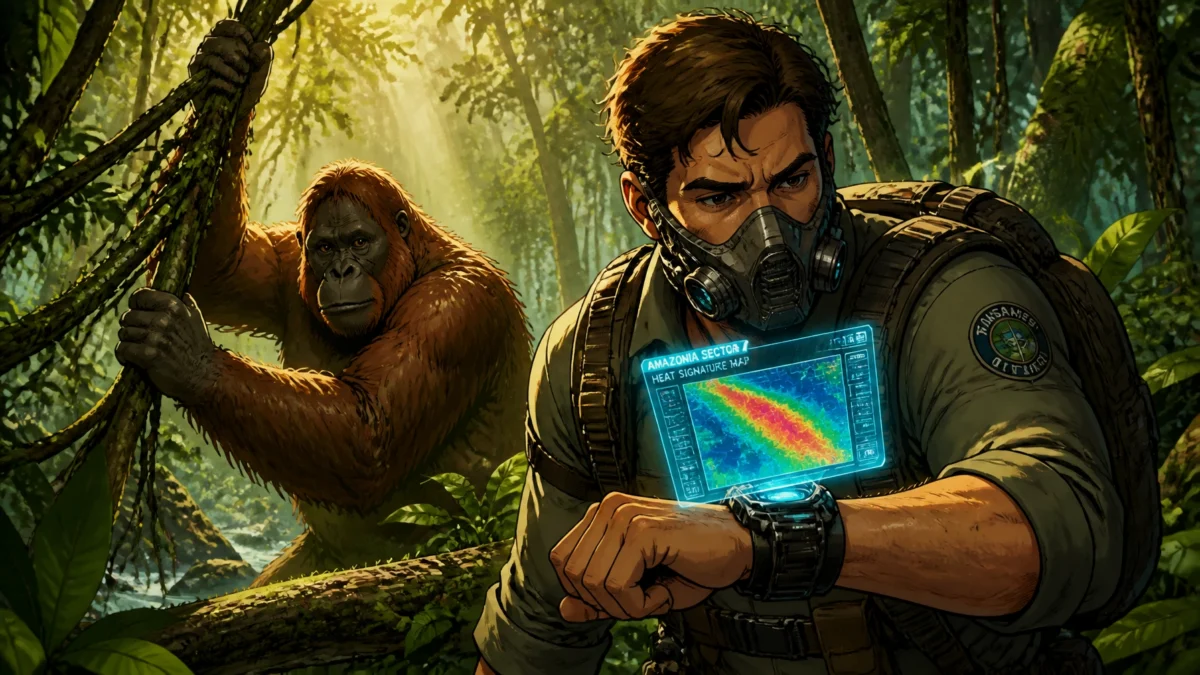
“So, Dr. Mubari handed me one of those new AI thermal sensors. Said it was ‘calibrated for delicate heat signatures.’ I was trying to mount it on a mahogany branch when a swarm of Bullet Ants decided my bicep looked like a prime real estate opportunity. I didn’t drop the sensor… I just sort of… threw it at Alpha. Who caught it. With his mouth. Dr. Mubari says the AI is now very confused why the Amazon has a moving heat signature that smells like bananas and disappointment.”

Entry #443 – Jungle Dart
“The AI predicted a 98% chance of fire near the northern sector. We geared up, tactical masks on, scanners ready. Turned out to be a massive cluster of bioluminescent fungi having a particularly bright night. The AI is learning, but I think it’s been hanging out with Sunbyte too much. It’s starting to get a sarcastic tone in its readouts.”
Why This Matters for Book Two: Black Rain
In Book Two: Black Rain, the stakes for detection are even higher. The Rainsavers are chasing bioweapons and old German technology (no, not that kind: we're talking about the secret labs and weird tech from the 1940s that somehow ended up in the jungle).
In the story, Leonard West uses a bioweapon designed to mutate rainforest life. Imagine trying to stop a mutating forest fire that’s also trying to rewrite your DNA. Without early detection, Tom and the gang would be toast (literally).
The Paamari Project’s success shows that we don't need to wait for a hero with superhuman strength to save the planet. We need a combination of the right tools, the right data, and the people who actually live in the heart of the forest.

Is Reality Imitating Art?
The similarities between the Asháninka’s SAT-CARE and our fictional tech are uncanny:
- Localized Alerts: Both systems prioritize the people on the ground over centralized government hubs.
- Predictive AI: Just like Sunbyte’s algorithms, the Paamari Project uses weather data to predict when a fire is likely to start, not just where it is currently burning.
- Brigade Response: In The Rainsavers, the team is the first line of defense. In Peru, the 275 trained Asháninka members are the ones actually putting out the fires before they become catastrophes.
Since the project fully ramped up, uncontrolled forest fires in their territory have dropped by nearly 100%. In 2025, they had zero major wildfires. That’s a stat that even Bossman couldn’t ignore.
Join the Adventure
We love seeing real-world heroes take a page out of the The Rainsavers handbook. Whether it's using AI to beat NASA or standing up against corporate greed, the battle for our planet is happening right now: and it’s more exciting than any thriller.
Want to see how our team handles the high-tech (and the high-stakes) of the Amazon? Dive into the series today. From the primal strength of Tom Swift to the tactical genius of Jungle Dart, every book is a reminder that the Earth is worth fighting for.
Explore the full Rainsavers Series and meet the characters here!
Stay wild, stay vigilant, and maybe keep your AI sensors away from the orangutans.
: Penny
Lead Writer, The Rainsavers Field Notes
