

Meta description: What is red mercury? Discover how this mysterious sci-fi MacGuffin powers The Rainsavers’ wildest missions from Tempest of the Crimson Skies through Curse of the Spirit Tree.
Spoiler warning: This post discusses story elements from Books Three through Five.
First things first: Is red mercury real?
In the real world, red mercury is best understood as a myth, hoax, and conspiracy-fueled legend: not a verified wonder material waiting in a secret laboratory.
Over the years, rumors have described it as everything from an ultra-powerful energy source to a mysterious ingredient for advanced weapons. The claims have never settled into one consistent scientific explanation, and tested samples marketed as “red mercury” have turned out to be ordinary substances.
That real-world uncertainty is exactly what makes the idea so useful in science fiction.
In storytelling terms, red mercury is a perfect MacGuffin: a mysterious object or substance that drives the plot because everyone wants it, fears it, or is willing to betray someone for it. The audience does not need a ten-page chemistry lecture. We only need to know three things:
- It is rare.
- It is powerful.
- The wrong person must not get it.
Naturally, in The Rainsavers, the wrong person gets dangerously close.
How red mercury enters The Rainsavers universe
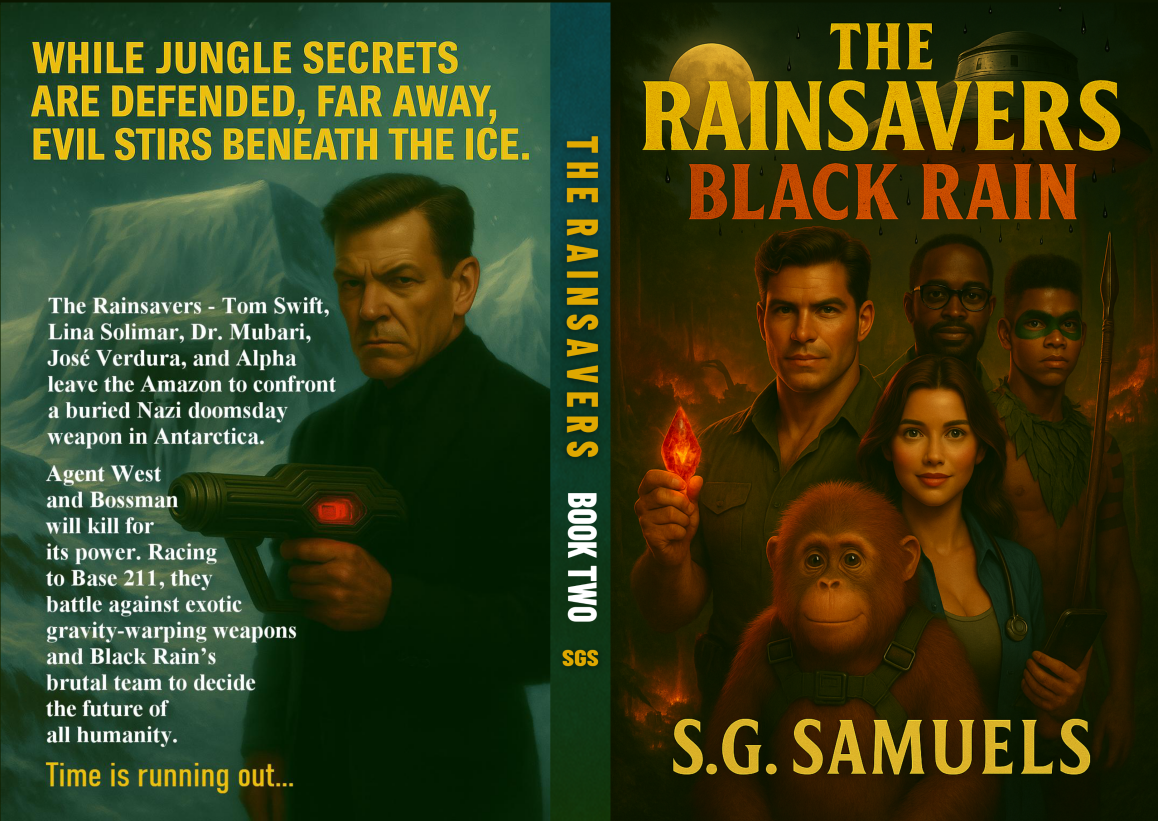
Red mercury first becomes a serious concern during the global chase surrounding Black Rain, Book Two of the series. That story introduces a dangerous alliance, a mutating bioweapon, and the first signs that red mercury is connected to something much larger than a single criminal operation.
But Book Three is where the mystery truly ignites.
In Tempest of the Crimson Skies, Leonard West hunts for red mercury crystals capable of powering ancient weapons. He is not chasing a shiny souvenir for his office shelf. West believes the crystals can unlock technology connected to lost German research, forgotten formulas, and the legendary Spirit Tree in the Amazon.
That is a lot of trouble to attach to one glowing mineral.
The Rainsavers follow West to Antarctica, where the mission becomes a race across frozen landscapes, deep ocean caverns, sabotage attempts, and hidden facilities. The setting matters. Red mercury is not discovered in a convenient glass case labeled “Extremely Important Plot Device.” It is buried beneath ice, wrapped in secrets, and connected to a history that powerful people would rather keep hidden.
And because this is The Rainsavers, the team also has to deal with mercenaries, impossible weather, and Alpha probably making a better tactical decision than everyone else in the room.
Why red mercury works so well as a sci-fi MacGuffin
A good MacGuffin should create momentum. Red mercury does that by connecting several different kinds of adventure:
1. It brings science into the mystery
Red mercury sounds scientific enough to feel plausible, but mysterious enough to leave room for imagination. That makes it a great bridge between real-world technology and the stranger corners of The Rainsavers mythology.
Dr. Mubari can approach it as a scientific problem. Sunbyte can investigate the machinery built around it. Primal can focus on keeping everyone alive when the machinery starts doing something deeply alarming.
Everyone has a different reason to care about the same object.
2. It raises the stakes without slowing the story down
The red mercury crystals do not need a long technical explanation before the danger becomes clear. If they can power ancient weapons, activate a fusion reactor, or unlock a formula tied to the Spirit Tree, the consequences are immediate.
A single crystal can turn an expedition into a global emergency.
That gives the story a satisfying escalation:
- First, the team is protecting the Amazon.
- Then, they are chasing a bioweapon.
- Next, they are racing to Antarctica.
- After that, the trail reaches the Moon.
- Suddenly, the Giza Pyramid is involved.
- Meanwhile, the rainforest is still waiting for everyone to stop setting off world-changing machinery.
This is how a continuous six-book adventure keeps expanding without losing its central mission: protect the Earth.

Book Three: Red mercury under the ice
Tempest of the Crimson Skies turns red mercury into the centerpiece of a globe-spanning treasure hunt.
West manipulates a powerful tycoon into funding an Antarctic expedition, but the mission has a hidden purpose: recover lost technology and locate red mercury crystals before the Rainsavers can stop him.
The Antarctic setting gives the red mercury mystery a wonderfully hostile playground. Every discovery comes with an environmental threat attached. Ice shifts. Equipment fails. Visibility disappears. The cold does not care about anyone’s evil plan, heroic plan, or carefully organized snack schedule.
The Rainsavers must survive the expedition while preventing West from unlocking an ancient formula linked to the Spirit Tree. Red mercury becomes more than a power source. It becomes a key: one that may connect distant eras, forgotten machines, and the living heart of the Amazon.
That connection is what makes the substance so important to the series. It does not simply make one weapon stronger. It links the story’s major themes: technology, greed, environmental destruction, ancient knowledge, and the danger of treating nature like a machine that can be switched on and off.
Book Four: From the Moon to the Giza Pyramid
In Shadow of the Moon, the red mercury mystery leaves Earth’s familiar landscapes behind.
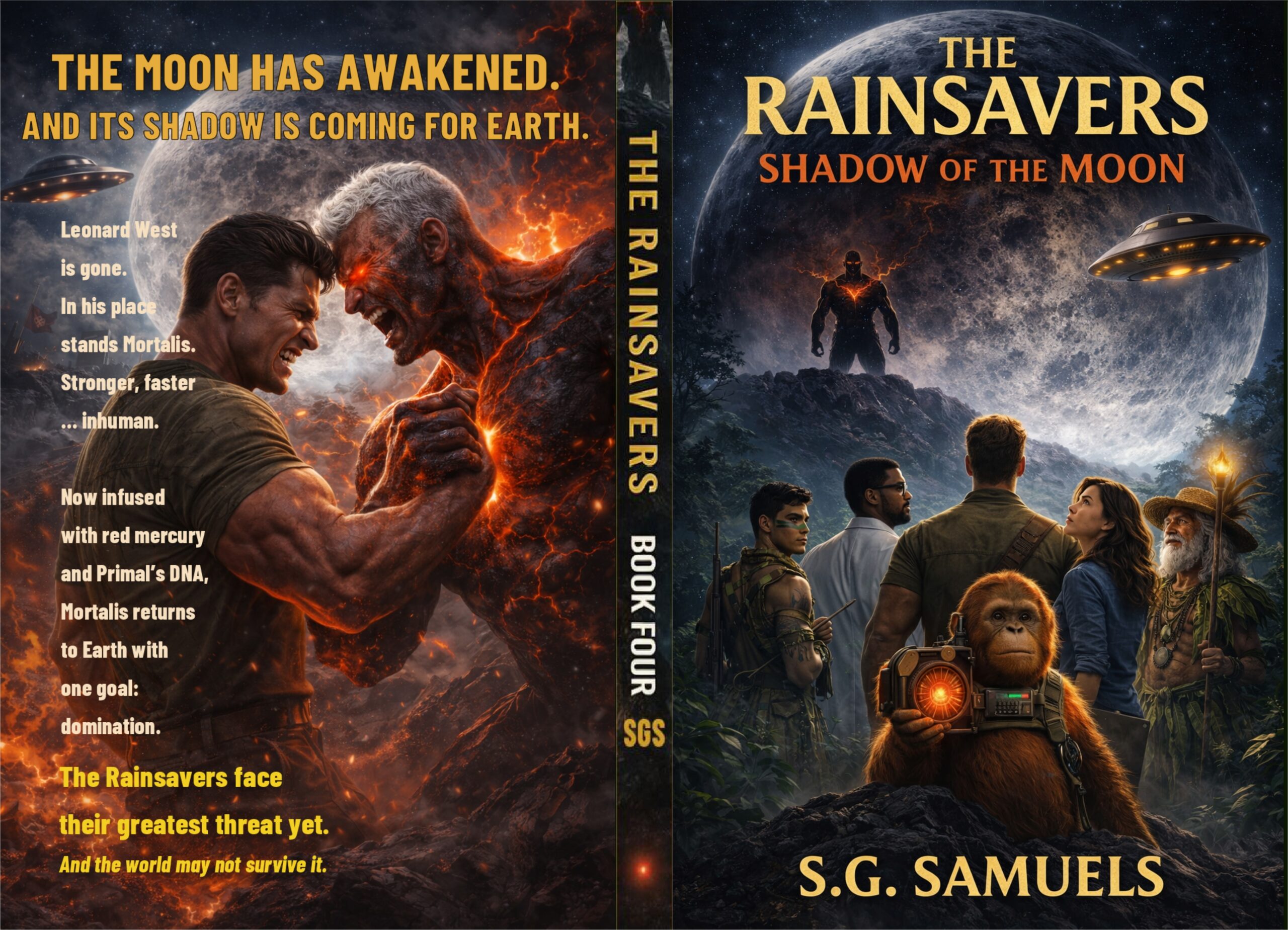
The Rainsavers follow strange signals to an abandoned lunar base, where West discovers technology far beyond what anyone should reasonably find sitting on the dark side of the Moon. The adventure shifts from jungle expedition to space thriller, but red mercury remains the thread connecting the pieces.
West eventually uses Primal’s DNA to transform into Mortalis, creating a threat that is both personal and catastrophic. Mortalis then escapes to Egypt and activates a red mercury fusion reactor beneath the Giza Pyramid.
That sentence alone contains enough material for several emergency meetings.
The reactor threatens the Nile and millions of lives. The Rainsavers must stop the immediate disaster, but the larger problem survives: Mortalis is still determined to claim the Spirit Tree and control its power.
Red mercury has now moved through three layers of danger:
- The physical: a volatile energy source.
- The historical: a link to buried technology and lost research.
- The environmental: a force capable of threatening rivers, forests, and entire ecosystems.
That combination makes it much more than a flashy sci-fi prop. It becomes a symbol of what happens when powerful technology is separated from responsibility.
Book Five: When technology meets the Spirit Tree
By the time the story reaches Curse of the Spirit Tree, red mercury has helped push the Rainsavers toward their most difficult decision yet.
Mortalis now controls the Spirit Tree, and ancient forces begin stirring throughout the rainforest. The tree’s roots spread across the land, consuming everything in their path. The forest is no longer simply under attack from outside forces. Its own power has been twisted against it.
This is where the red mercury storyline becomes especially interesting.
The crystals and reactor represent control through technology. The Spirit Tree represents a living, ancient power that cannot be neatly contained. Mortalis wants to combine those forces and bend them to his will.
The result is not progress. It is corruption with excellent lighting.
Primal faces an impossible choice: destroy the Spirit Tree or risk losing the rainforest entirely. The red mercury may have helped unlock the chain of events, but the final conflict is not about owning the strongest weapon. It is about understanding what must be protected: and what should never be controlled.
The real power of red mercury in The Rainsavers
Red mercury works because it keeps asking a simple question:
Just because we can unlock something, should we?
That question fits The Rainsavers perfectly. The series combines action, science fiction, espionage, ancient mysteries, and environmental stakes, but its emotional center remains the same: the Earth is not an object to exploit.
Bossman treats the rainforest as a resource. West treats secrets as tools. Mortalis treats power as proof that he deserves to rule. The Rainsavers see the consequences differently. Every river, animal, community, and forest matters beyond its usefulness to someone’s plan.
So red mercury is both a thrilling fictional material and a warning sign. Whenever it appears, someone is trying to turn mystery into machinery, machinery into power, and power into control.
Usually, this goes badly.
Sometimes, it goes badly beneath a pyramid.
What fictional tech should we investigate next?
Red mercury may be the most explosive mystery in The Rainsavers universe, but it is not the only piece of wild technology waiting to be examined.
Should we explore:
- The abandoned lunar base?
- The Haunebu II spacecraft?
- The red mercury fusion reactor?
- Sunbyte’s hacking equipment?
- The Spirit Tree’s ancient power?
- Alpha’s suspiciously excellent survival gadgets?
Tell us which fictional technology you want to see in the next field report.
Ready to follow the mystery from the Amazon to Antarctica and beyond? Explore The Rainsavers saga at rainsavers.com and discover where the red mercury trail begins.
