Meta description: Sunbyte ranks Amazon rainforest threats from mildly annoying to full boss-battle level, including deforestation, fires, mining, climate change, and corporate greed.
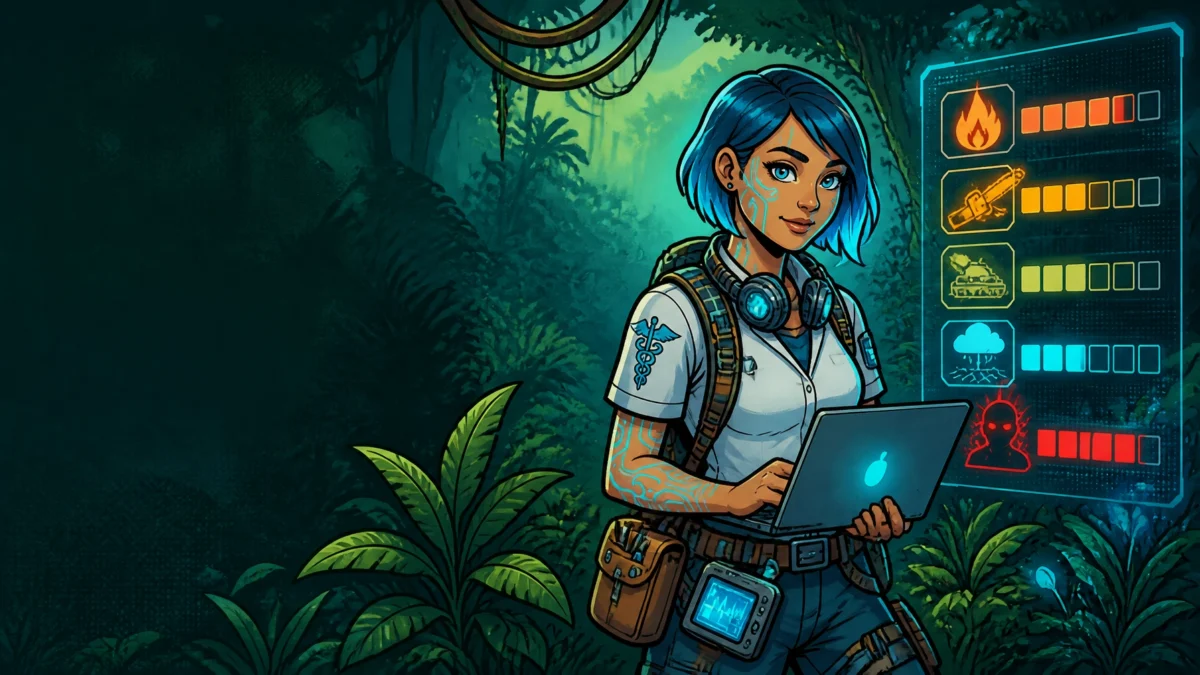
Sunbyte here. Yes, I made a spreadsheet.
Greetings from the Amazon, where the humidity is 98%, my laptop has opinions, and one frog has officially been added to the threat database.
As The Rainsavers’ hacker, nurse, satellite-feed watcher, and part-time fixer of everyone else’s mistakes, I have reviewed the major dangers facing the rainforest in 2026.
The ranking system is highly scientific.
I considered:
- Damage to the forest
- How difficult the threat is to stop
- Whether it can ruin perfectly good equipment
- Number of emergency snacks required
- Probability of someone saying, “How bad could it be?”
The answer to that last question is usually: very bad, Lina. Very bad.
So here we go.
Rank 1: Mosquitoes, Mud, and Other Tiny Menaces
Threat level: Annoying
Let’s begin with the threats that do not normally require a global response team.
Mosquitoes. Leeches. Mud that grabs your boots like it has legal ownership. Vines that wrap around antenna cables. Rain that arrives horizontally for no reason.
And frogs.
One frog in particular has developed a disturbing interest in my touchscreen. I am not saying it understands encryption, but it has now opened the emergency communications menu three times.
The rainforest is an extraordinary ecosystem, and its wildlife is not the enemy. Still, when you are trying to upload deforestation evidence and a beetle lands directly on the biometric scanner, the situation becomes… operationally irritating.
Sunbyte’s countermeasure: Waterproof cases, insect repellent, backup batteries, and never placing your tablet on a log without checking whether the log is already occupied.
Rank 2: Bad Batteries and Worse Weather
Threat level: Mildly annoying, with dramatic potential
Rainforest conservation depends on good information. Satellite images, camera traps, GPS trackers, water sensors, radios, all of it helps communities and researchers monitor changes across enormous areas.
Unfortunately, electronics and tropical weather are not natural friends.
Heat drains batteries. Humidity attacks circuit boards. Rain finds the one unsealed connection in your entire setup and moves in permanently.
Then there are sudden storms, river surges, and long stretches of cloud cover that make satellite monitoring more complicated. A minor equipment failure can become a major delay when the nearest replacement part is several hours away by boat.
This is not glamorous. Nobody writes an action scene called The Capacitor That Was Slightly Damp. But reliable technology matters when teams are tracking illegal logging or responding to fires.
Sunbyte’s countermeasure: Solar chargers, redundant systems, sealed equipment, and a strict “do not charge anything next to the suspicious puddle” policy.
We are still workshopping the policy.

Rank 3: Roads That Should Not Be There
Threat level: Sneaky problem wearing a boring hat
A road can look like infrastructure. Sometimes it is. But in the wrong place, a new road can act like an open invitation to further destruction.
Roads make it easier to move timber, machinery, fuel, livestock, and mining equipment into previously difficult-to-reach areas. Once access improves, forest clearing and land grabbing can spread outward.
This is why deforestation is not always one dramatic event with smoke and cinematic thunder. Sometimes it begins with a line on a map.
Then the line becomes a dirt road.
Then the dirt road becomes traffic.
Then someone says, “It’s only a little clearing,” while standing beside several thousand acres of missing trees.
Sunbyte’s countermeasure: Track the changes early. Compare satellite data. Listen to local communities. Follow the money. And never trust a map labeled “temporary access route” when it appears to be heading straight through protected forest.
Rank 4: Illegal Logging and Mining
Threat level: Serious, destructive, and extremely bad for rivers
Now we are leaving the “annoying” section.
Illegal logging removes trees, fragments habitats, and makes the surrounding forest more vulnerable to fire and drought. Illegal gold mining can destroy riverbanks, contaminate waterways, and damage the health and livelihoods of communities that depend on clean water.
The damage does not stop when the machines leave.
A polluted river can affect fish, drinking water, food systems, and traditional ways of life. A cleared patch of forest can become a pathway for more clearing. A weakened forest edge can dry out faster and burn more easily.
The Amazon is not an empty backdrop for somebody else’s business plan. It is a living system and home to countless species and communities.
Sunbyte’s countermeasure: Expose illegal operations, support responsible supply chains, and remember that traceability is not just a fancy word for putting a sticker on a product. It means knowing where materials came from and whether standing forests were harmed to obtain them.
For readers interested in practical choices, the Forest Stewardship Council’s information on deforestation is a useful place to start.
Rank 5: Fire Season Turned Up to “Why Is the Sky Orange?”
Threat level: Extremely dangerous
Fires are a natural part of some ecosystems, but rainforest fires can become catastrophic when forests are cleared, dried, fragmented, or deliberately burned.
A fire used to clear land can escape. Smoke can travel enormous distances. Wildlife loses shelter. Communities face dangerous air quality. Trees that survive may still be weakened, leaving the forest less able to recover.
In 2026, the big concern is the combination of land clearing, drought, heat, and climate change. These pressures reinforce one another:
- Deforestation removes tree cover.
- Less tree cover can mean less moisture moving through the local atmosphere.
- Drier conditions increase fire risk.
- Fires further damage the forest.
- A damaged forest becomes even more vulnerable.
That is not a healthy cycle. That is a villain’s flowchart.
Sunbyte’s countermeasure: Early detection, rapid response, protecting intact forest, and reducing the emissions that make extreme heat and drought more likely.
Also, please stop sending me photos of campfires with the message: “Is this yours?” No. It is not mine. I am in the communications tent.

Rank 6: Corporate Greed With Heavy Machinery
Threat level: Full human-made disaster
Some threats are not mysterious. They do not require ancient prophecies, secret laboratories, or a villain monologue beside a glowing reactor.
They require money, machinery, weak enforcement, and the belief that a rainforest is worth more cleared than alive.
Cattle ranching and industrial agriculture remain major drivers of Amazon deforestation. Land grabbing, poorly planned development, extractive projects, and demand for commodities can all place pressure on forests.
This is where Bossman enters the ranking.
In The Rainsavers, Bossman represents the most recognizable form of environmental destruction: profit first, consequences later, and absolutely no one allowed to interrupt the bulldozer schedule.
Unfortunately, the real world does not always provide a convenient villain with a cigar and a clearly labeled lair. The systems behind deforestation can be complicated, spread across supply chains, financial networks, regulations, and political decisions.
That makes accountability harder, but not less necessary.
Sunbyte’s countermeasure: Better enforcement, deforestation-free supply chains, support for Indigenous and local forest defenders, and pressure on companies to prove that their products are not connected to destruction.
Rank 7: Climate Change, the Threat That Buffs Every Other Threat
Threat level: Final-stage difficulty modifier
Climate change does not always arrive like a monster crashing through a wall. Sometimes it arrives as hotter temperatures, altered rainfall, longer droughts, stronger fire conditions, and stressed ecosystems.
The problem is that it makes other threats worse.
A forest already damaged by logging is less resilient during drought. A fragmented forest edge dries more quickly. A burned area may recover with fewer species and less ability to store carbon. As the Amazon loses resilience, its role in regulating regional climate becomes more difficult.
That is why rainforest protection and climate action cannot be separated. Stopping deforestation matters enormously, but so does reducing global emissions.
You cannot patch one hole in the boat while drilling three more underneath it.
Sunbyte’s countermeasure: Protect standing forests, reduce fossil-fuel use, support restoration, choose lower-impact products where possible, and push for policies that treat the Amazon as essential, not expendable.
Rank 8: Mortalis and the Actual Boss Battle
Threat level: Please put down the glowing red crystal
At the top of the list: Mortalis.
Not because every rainforest threat is secretly a superhuman villain. Most are not. But Mortalis combines nearly every danger we have discussed: obsession with control, reckless technology, exploitation of living systems, environmental destruction, and the deeply suspicious belief that one person should control an ancient power source.
In the Rainsavers saga, his threat escalates from covert schemes to global consequences. By the time the Spirit Tree is involved, this is no longer a local crisis. It is a battle over the future of the rainforest, and the future of life on Earth.
That is the difference between a problem and a boss battle.
The good news? Boss battles are easier when the team works together.
Scientists. Indigenous communities. Local defenders. Engineers. Nurses. Readers who care enough to learn, ask questions, and make better choices.
And yes, one exceptionally clever orangutan with a communication harness.

Final Scorecard: What Can We Actually Do?
Not every person can monitor satellite feeds from a jungle outpost. I mean, I can, but my schedule is unreasonable.
Everyone can still help support Amazon rainforest protection and rainforest conservation:
- Reduce waste and unnecessary consumption.
- Choose recycled or responsibly sourced paper and wood products.
- Look for better traceability in food, jewelry, electronics, and clothing.
- Cut energy use where practical.
- Support organizations defending Indigenous rights and local communities.
- Learn how deforestation connects to climate change.
- Share accurate information instead of doom-posting with a blurry photo and six alarm emojis.
Sustainable living is not about achieving perfection. It is about making choices that reduce pressure on forests: and supporting the larger policies and systems that make protection possible.
For the full fictional version of this fight, visit The Rainsavers, where environmental stakes meet action, science fiction, espionage, and the occasional extremely stressful field mission.
And if you want to see where the whole adventure begins, read The Rainsavers: Primal Awakening, Book One.
The forest has enough threats.
It does not need more frogs opening emergency menus.
