Meta description: Discover why 2026 readers want hopeful eco-adventure stories with real victories, and how The Rainsavers delivers action, science, and planet-saving wins.
Reader Field Report: The Doom Fatigue Is Real
Status update from the 2026 reading public: we have seen the collapsing cities. We have processed the endless ash. We have stared thoughtfully at too many abandoned satellites.
Climate fiction has spent years asking readers to imagine what happens when everything goes wrong. Those stories can be powerful, urgent, and beautifully written. But lately, many readers are asking a follow-up question:
What if something goes right?
Not perfectly. Not magically. Not because one inspirational speech solves climate change before the credits roll.
Readers want stories where the characters face enormous environmental threats, make difficult choices, take meaningful risks, and actually win something.
A rainforest is protected. A community gets warned in time. A destructive operation is stopped. A dangerous technology is shut down. A team survives long enough to fight another day.
That kind of victory is not escapism. In 2026, it feels like oxygen.
The New Reader Demand: Hope, But Make It Explosive
Hopeful climate storytelling does not mean removing danger. It means giving danger somewhere to go.
The villains can still be ruthless. The storms can still be terrifying. The corporations, rogue agents, experimental technologies, and ancient mysteries can still make terrible decisions at extremely inconvenient times.
But the heroes need more than emotional resilience.
They need plans.
They need tools.
They need backup.
They need the occasional highly intelligent orangutan who can spot the solution everyone else missed.
This is where eco-adventure hits differently. It combines the urgency of environmental storytelling with the momentum of a thriller. The planet is not just a symbol or a tragic background. It is the reason the mission matters, and the reason every victory feels personal.
In The Rainsavers, protecting the Amazon is not an abstract goal listed on a poster. It is the team’s central mission, woven through action, science, espionage, survival, and yes, the occasional “that equipment was definitely not supposed to explode” moment.

Receipt #1: Readers Want Problems That Can Be Fought
Doom-only stories often create a familiar pattern:
- The crisis gets worse.
- Everyone discovers the crisis is even worse than expected.
- A character gives a devastating speech.
- The crisis gets worse again.
- The story ends with a meaningful look toward the horizon.
Beautiful? Sometimes.
Satisfying? Not always.
Eco-adventure offers a different rhythm. The crisis may be huge, but the story gives characters something concrete to do.
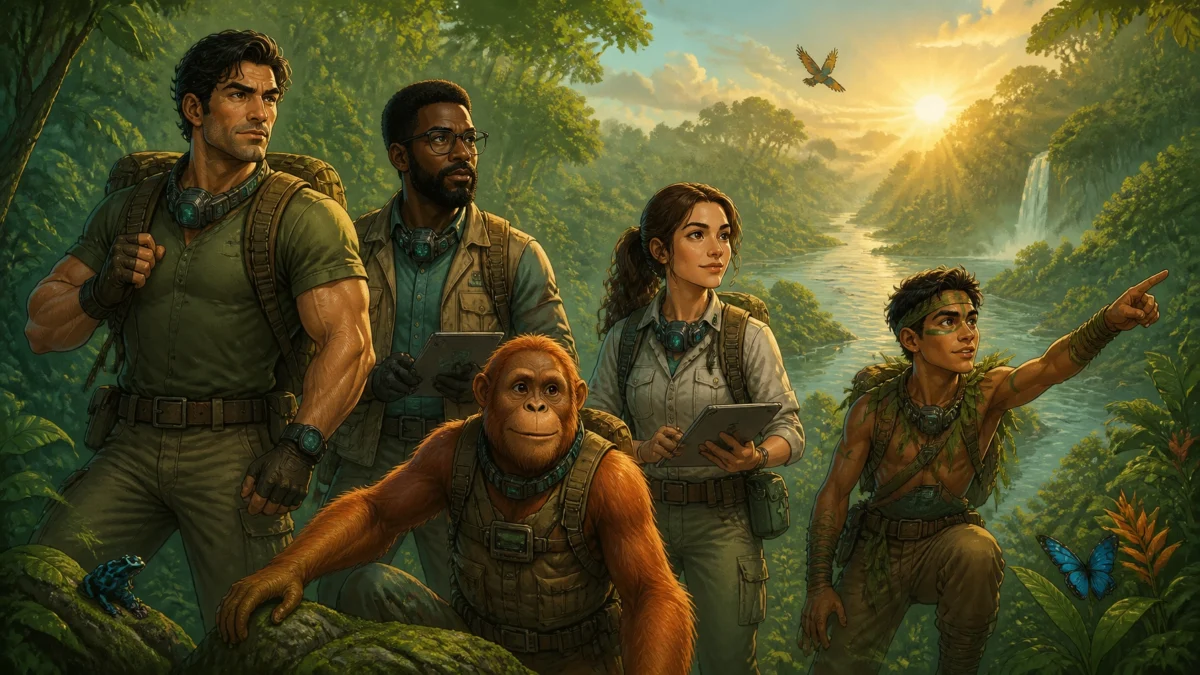
In The Rainsavers, Tom Swift becomes Primal after a crash in the Amazon and an accidental encounter with an experimental serum. His new strength and heightened senses are not simply cool upgrades. They are tools he uses to confront the people and systems threatening the rainforest.
Dr. Mubari brings biogenetics, natural medicine, and scientific expertise. Sunbyte combines nursing with hacking, tracking the digital systems behind environmental destruction. Jungle Dart knows the rainforest as home, not scenery. Alpha brings human-level intelligence, Morse code communication, and an entirely different way of seeing patterns.
The point is not that one hero can punch climate change into submission.
The point is that a team with different skills can create pressure, uncover evidence, rescue people, interrupt destruction, and force powerful enemies to lose.
That is a much more energizing reading experience.
Receipt #2: A Win Does Not Have to Be the Final Win
Here is a crucial feature of serialized adventure:
Victory can be real without being permanent.
Book One can deliver a meaningful win against immediate threats while revealing that the larger conspiracy is only beginning. Book Two can escalate the danger into exotic weapons and bioweapon research. Later books can expand the scope toward Antarctica, ancient power, a hidden lunar base, and the Spirit Tree.
The Rainsavers is designed around that forward motion.
Each installment raises the stakes, but the earlier victories still count. The characters learn. Communities gain time. Enemies lose resources. Secrets come to light. The team becomes stronger: not because the world gets easier, but because their efforts have consequences.
That structure gives readers two satisfying things at once:
- The joy of seeing a mission succeed
- The curiosity of wondering what new trouble is waiting around the corner
It is the literary equivalent of finding the emergency exit, sprinting through it, and discovering that the emergency exit leads directly into an even larger mystery.
Oops.
Still progress.
Receipt #3: Readers Want Climate Stories That Feel Possible
The hopeful climate-fiction conversation is growing beyond “everything will be fine.” Projects such as Imagine 2200 from Grist invite writers to imagine long-term futures shaped by climate progress, justice, and regeneration. Climate storytelling discussions increasingly ask not only what crisis looks like, but what action, adaptation, and cooperation might look like too.
That shift matters because readers are not looking for empty optimism. They are looking for earned hope.
Earned hope has receipts:
- Someone studies the problem.
- Someone makes a difficult choice.
- Someone shares information.
- Someone protects a vulnerable community.
- Someone refuses a profitable but destructive shortcut.
- Someone builds a team instead of pretending to be the only person who can save everyone.
The Rainsavers puts those receipts directly into the adventure.
Dr. Mubari’s science matters. Sunbyte’s digital skills matter. Alpha’s perspective matters. Jungle Dart’s knowledge matters. Primal’s strength matters: but strength alone is never enough.
That combination makes environmental protection feel active and exciting. Saving the planet becomes a mission with moving parts, not a vague moral instruction delivered from a mountaintop.

Receipt #4: The Good Guys Need to Get Their Hands Dirty
There is a particular kind of eco-story where everyone understands the right answer immediately, communicates perfectly, and never trips over a root while attempting a dramatic jungle entrance.
The Rainsavers respectfully declines to live in that universe.
These characters are brave, but they are also human: or, in Alpha’s case, gloriously orangutan. They improvise. They argue. They miscalculate. They carry too much equipment. They sometimes have to solve one problem while three other problems are making suspicious noises nearby.
That messiness makes the victories more believable.
Primal does not protect the Amazon because he has a flawless plan for every possible threat. He protects it because he keeps moving, trusts his team, and refuses to treat failure as a permanent condition.
Sunbyte may be working through a digital maze while also thinking about patients and communities affected by environmental destruction. Dr. Mubari may be analyzing a biological threat while attempting to keep everyone from touching the glowing sample. Jungle Dart may know exactly which path is safe: right up until the rainforest introduces a new path with teeth.
The humor matters. It keeps hope from becoming preachy.
A story can care deeply about the planet and still let its heroes have a bad day.
Receipt #5: The Environment Is a Character, Not Wallpaper
Readers in 2026 are increasingly alert to the difference between a story that uses nature as decoration and one that treats the environment as part of the plot.
In The Rainsavers, the Amazon shapes everything:
- How the team travels
- What they can hear and see
- Which resources are available
- How threats are hidden
- How communities are affected
- What happens when powerful people damage the ecosystem
The rainforest is not a green filter placed behind an action scene. It is a living force that creates challenges, reveals clues, protects secrets, and gives the heroes something worth defending.
That makes every victory more tangible.
Stopping a villain is exciting. Stopping a villain while protecting the river, the wildlife, the research, and the people who depend on the forest? That is the good stuff.
The 2026 Eco-Adventure Checklist
If you are searching for your next hopeful climate read, look for stories with:
- High stakes without permanent despair
- Characters who take action instead of simply witnessing disaster
- Science, technology, or local knowledge that changes the outcome
- Teams with complementary skills
- Environmental victories that feel specific
- Villains who create real pressure
- A world worth saving
- Enough humor to survive the mission briefing
The Rainsavers checks every box and then adds a six-book arc involving corporate greed, biogenetics, German technology, red mercury crystals, space exploration, and the Spirit Tree.
Subtle? No.
Fun? Extremely.

The Verdict: Give Us Wins We Can Believe In
Readers are not tired of serious stories. They are tired of being asked to confuse seriousness with hopelessness.
A story can acknowledge climate anxiety and still create momentum. It can show the scale of environmental threats while reminding us that scale is not the same as inevitability.
That is why eco-adventure feels so right for 2026.
It gives readers danger with direction. It gives science a pulse. It gives teamwork a purpose. Most importantly, it gives the good guys opportunities to win: and lets those wins matter.
Not every battle ends the war.
But a saved forest is still saved.
A rescued community is still rescued.
A stopped machine is still stopped.
And one successful mission can be exactly what a team needs before the next impossible assignment arrives.
Ready for an eco-adventure where the heroes fight hard, make mistakes, and get real victories? Read Book One now and meet The Rainsavers.
