
Meta Description: Discover how The Rainsavers series is redefining environmental science fiction in 2026 with high-stakes adventure, ancient tech, and the fight to save the Amazon.
It’s June 2026, and if you step outside, the air feels just a little bit different than it did five years ago. Whether you're in New York or Manaus, the global conversation has shifted. We aren't just talking about "going green" anymore; we’re talking about survival. And nowhere is that battle more intense than in the heart of the Amazon rainforest.
But here’s the thing: while the news cycles are filled with reports about the Belém Declaration and the latest deforestation surges, the way we consume stories about the environment is undergoing a massive transformation. Gone are the days of dry, preachy climate fiction. Enter a new era of high-octane, tech-infused, heart-pounding adventure that makes you actually care about the canopy.
Welcome to the world of The Rainsavers, where saving the planet involves less paperwork and a lot more stopping mutated rogue agents from activating ancient superweapons.
The Death of the "Eco-Lecture"
Let’s be honest: for a long time, "environmental science fiction" was synonymous with "feeling guilty for two hundred pages." You’d pick up a book, get a lecture on carbon footprints, and put it down feeling like you just did your taxes.
In 2026, readers are demanding more. We want stakes. We want mystery. We want an orangutan who can out-think a corporate mercenary.
The Amazon isn't just a backdrop anymore; it’s a character. In The Rainsavers Book One: Primal Awakening, the rainforest is the prize, the victim, and the ultimate weapon all at once. When Bossman’s corporate greed threatens the Amazon, it’s not just a local issue: it’s a global tipping point. By framing environmentalism through the lens of a six-book epic saga, the message becomes inseparable from the adrenaline.
Character Spotlight: A Man, An Ape, and a Mission

One of the biggest shifts in modern sci-fi is the move away from the "lone wolf" hero. Nobody saves the world alone anymore. In The Rainsavers, we see a team that reflects the complexity of real-world conservation.
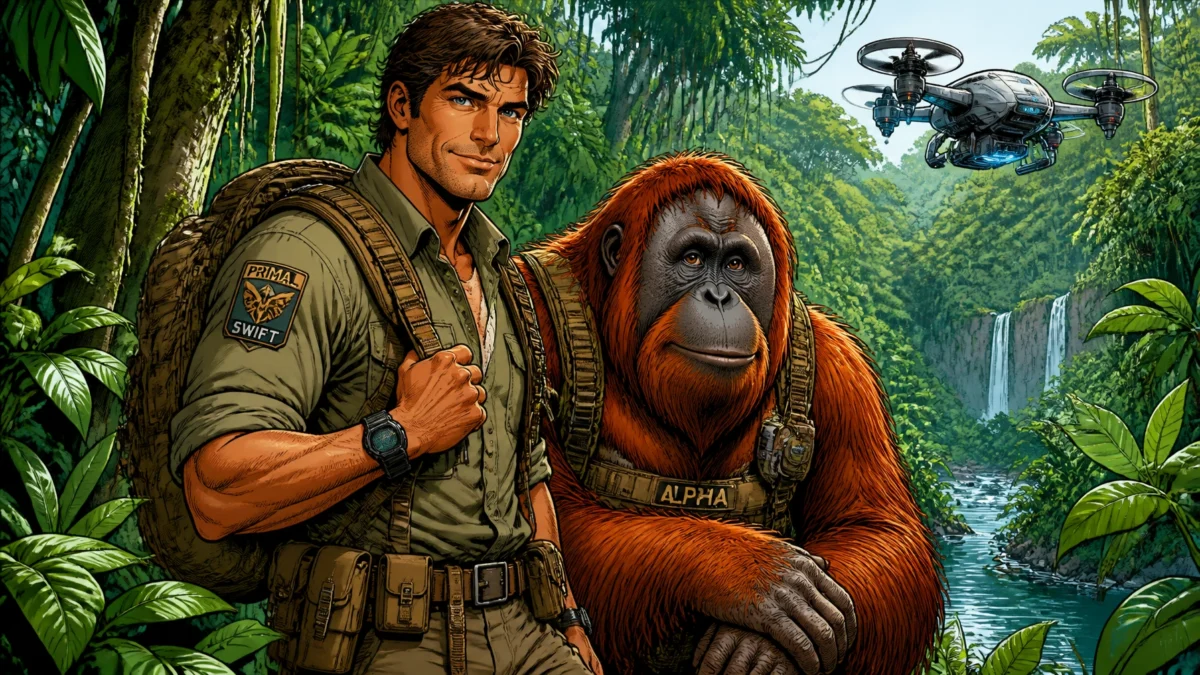
- Tom "Primal" Swift: He’s got the strength, but he’s not a superhero in the traditional sense. He’s a protector whose powers are tied directly to the very environment he’s trying to save.
- Alpha: Possibly the most popular member of the team. He’s an orangutan with a genius-level intellect. Why? Because the animals have the most to lose, so why shouldn't they have a seat at the tactical table?
- Dr. Mubari: The brains of the operation. She reminds us that science is the foundation of every rescue mission. Without her data, Primal is just a guy in the woods.
This team-up approach mirrors how we’re tackling environmental issues in 2026: through radical collaboration across disciplines and species.
[FIELD NOTES: TRANSMISSION FROM SUNBYTE]
"Listen, if I have to recalibrate the drone sensors one more time because Alpha 'accidentally' used them to find the best fruit trees, I’m quitting. Just kidding. Mostly. But seriously, the data coming off the Spirit Tree is off the charts. Something is waking up down there, and it’s not just the mosquitoes."
High-Tech, High-Stakes: Red Mercury and German Engineering
Standard environmentalism focuses on the now. Science fiction environmentalism looks at the hidden.
In The Rainsavers series, the threat isn't just a chainsaw; it's a bioweapon designed to mutate rainforest life. We’re talking about Red Mercury crystals and salvaged German technology from the 1940s.

Why include "old" tech in a story about the future? Because the history of the Amazon is layered. By chasing Leonard West across the globe to stop him from using ancient formulas, the series connects our past mistakes with our future survival. This blend of historical mystery and futuristic tech (like the red mercury fusion reactor under the Giza Pyramid in Book Four: Shadow of the Moon) keeps the environmental message from feeling stale. It’s not just about "saving trees": it’s about preventing a total planetary reboot.
The Villain Problem: Bossman vs. Mortalis
Every good story needs a face for the "bad guys." In the world of 2026 environmentalism, the villain isn't just "pollution." It’s specific, driven, and dangerous.
- Bossman: Represents the corporate greed that views the Amazon as a resource to be harvested until it’s a desert.
- Mortalis (formerly Leonard West): The darker side of science. He’s what happens when you try to harness the power of nature (and Primal’s DNA) for personal godhood.

When Mortalis gains control of the Spirit Tree in Book Five, the stakes are no longer just "forest vs. factory." It’s "order vs. chaos." This is where the series really changes the game. It asks the reader: What are you willing to sacrifice? In Curse of the Spirit Tree, Primal has to choose between destroying the tree: the source of life: or losing the entire rainforest to Mortalis’s corruption.
That’s a much more compelling question than "should I recycle this plastic bottle?" (Though you should still do that, obviously).
Why This Format Works for Readers in 2026
We live in a world of short attention spans and constant "doom-scrolling." Long-form adventure series like The Rainsavers offer an escape that doesn't ignore reality, but engages with it.
- Continuous Arcs: Unlike standalone novels, a six-book series allows the environmental consequences to grow. You see the forest change. You see the characters age and struggle.
- Global Scope: From the Amazon to Antarctica to an abandoned German moonbase, the story reminds us that the environment is a closed system. What happens in the rainforest affects the moon (literally, in this case).
- Action-First Philosophy: By leading with the adventure, the "message" gets into your system via osmosis. You’re cheering for Alpha and Primal, and by extension, you’re cheering for the Amazon.
5 Adventure Tips for the Modern Eco-Warrior
Thinking about heading into the brush yourself? Take some advice from the team:
- Trust the Local Experts: Just as the Rainsavers rely on local knowledge, real conservation starts with the people who live there.
- Pack Light, Pack Smart: Dr. Mubari recommends a solar-powered tablet and at least three backup water filters.
- Leave No Trace (Unless it’s a Trap): If you're being hunted by Mortalis's agents, ignore this rule. Otherwise, keep the trails clean.
- Listen to the Animals: If the birds stop chirping, something is wrong. If the orangutan starts pointing at a German-engineered bunker, run.
- Read Up: Knowledge is your best weapon. Start with Primal Awakening to understand the landscape.
The Fate of the Earth is in Your Hands (and Pages)

As we navigate the challenges of 2026, stories like The Rainsavers aren't just entertainment. They are blueprints for how we think about our planet. They remind us that the Amazon is worth fighting for: not just because it’s "important," but because it’s full of wonder, mystery, and maybe, just maybe, a hidden Spirit Tree that holds the key to our future.
Are you ready to join the fight? The adventure is just beginning.
Check out the full series and meet the team at Rainsavers.com.
