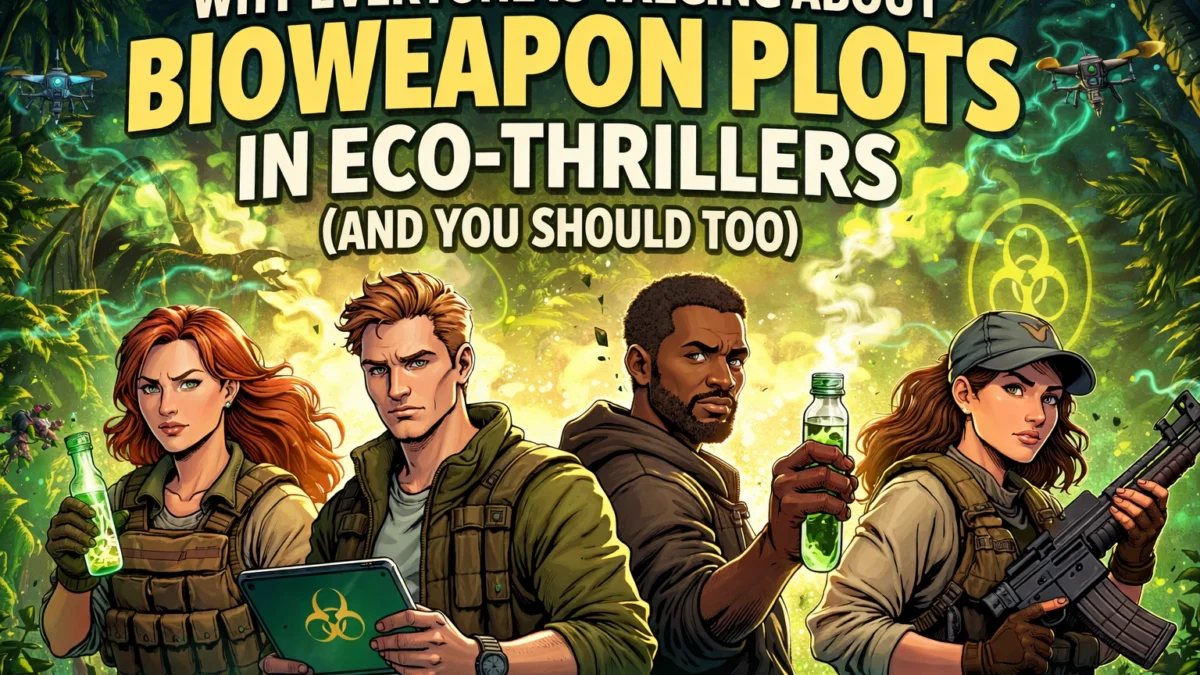
Meta description: Bioweapon plots in eco-thrillers are everywhere in 2026: and for good reason. Here's why these stories hit different now, and how The Rainsavers delivers the ultimate blend of biological chaos and environmental stakes.

Okay, But Why Is Everyone Suddenly Obsessed With Bioweapon Thrillers?
Let's be real: it's 2026, and we've all lived through some stuff.
Pandemics. Climate disasters. Headlines that read like rejected thriller plots. So when a novel drops featuring a shadowy organization engineering biological weapons that could wipe out ecosystems? Yeah. That doesn't feel like fiction anymore.
It feels like Tuesday.
And that's exactly why bioweapon plots in eco-thrillers are having their moment. They tap into something we all feel deep down: the creeping suspicion that the next big threat won't come from space or some supervillain's lair. It'll come from a lab, a jungle, or somewhere in between.
The Perfect Storm: Biology Meets Ecology
Here's the thing about traditional thrillers: they give you a bomb to defuse, a killer to catch, or a conspiracy to unravel. Classic stuff. Solid entertainment.
But bioweapon eco-thrillers? They raise the stakes to planetary levels.
We're not just talking about saving a building or a city. We're talking about:
- Organisms that could destroy entire food chains
- Engineered pathogens targeting specific ecosystems
- Weapons designed to make the Earth uninhabitable
When the threat is biological AND ecological, suddenly everything feels more urgent. More real. More terrifying.
And honestly? More relevant to 2026 than ever before.

What Makes These Plots Hit Different Now
Let's break down why bioweapon eco-thrillers are dominating reading lists right now:
1. We've Seen How Fast Things Can Spread
Remember when "exponential growth" was just a math term? Now we all have visceral memories of watching infection numbers climb. Bioweapon plots leverage that collective trauma: and channel it into stories where the heroes actually fight back.
2. Climate Anxiety Is Real (And We Need Heroes)
Every day brings another headline about environmental collapse. Eco-thrillers give us something climate doom-scrolling can't: hope wrapped in action. Characters who punch back against the forces destroying the planet.
3. The Villains Feel Plausible
The scariest villains aren't the ones with world domination monologues. They're the ones who could actually exist. Corporate interests willing to weaponize nature for profit? Fringe groups convinced ecological destruction is the answer? These antagonists hit home because we've seen echoes of them in real news.
4. The Science Is (Terrifyingly) Catching Up
Gene editing. Synthetic biology. Engineered organisms. The stuff that used to be pure sci-fi is now in research papers. When a thriller describes a bioweapon that targets specific plant species or manipulates weather patterns through biological agents, we can't dismiss it as fantasy anymore.
Meet Tom "Primal" Swift: When Bioweapons Get Personal
Speaking of heroes who fight back: let's talk about someone who knows a thing or two about surviving biological nightmares.
Tom Swift, callsign Primal, didn't ask to become the powerhouse of The Rainsavers. A catastrophic crash in the Amazon changed everything. Exposure to experimental compounds. Genetic alterations he never consented to. The kind of origin story that makes bioweapon plots feel very, very personal.
Now Tom channels that trauma into protecting the ecosystems that almost killed him: and stopping anyone who tries to weaponize nature for their own twisted goals.
You can read his full story here.
What makes Primal compelling isn't just his enhanced abilities. It's that he is the bioweapon plot. He's living proof of what happens when science goes too far: and he's chosen to use that nightmare to protect the world instead of destroy it.
That's the kind of character complexity that elevates eco-thrillers from "fun beach read" to "can't stop thinking about it at 2 AM."

The Anatomy of a Great Bioweapon Eco-Thriller
So what separates the unforgettable bioweapon plots from the forgettable ones? Here's the formula:
| Element | Why It Works |
|---|---|
| Stakes that matter | Not just "save the world": save the living world. Ecosystems. Species. The things that can't defend themselves. |
| Science that feels real | Rooted in actual biology, not magic disguised as science. When the threat is plausible, the tension multiplies. |
| Heroes with skin in the game | Characters personally affected by bioweapons or environmental destruction fight harder. Their motivation is survival, not just duty. |
| Villains with logic | The best antagonists have reasons that make terrible sense. Eco-terrorists who think they're saving the planet. Corporations who think profit justifies extinction. |
| A race against biology | Unlike bombs with countdown timers, biological threats spread, mutate, and adapt. The enemy keeps evolving. |
Why The Rainsavers Nails This Genre
Here's where we get a little biased (but honestly, we've earned it).
The Rainsavers doesn't just feature bioweapon plots as background noise. The entire series is built around the intersection of biological threats and ecological stakes.
You've got:
- A team with diverse expertise: from tech geniuses to enhanced operatives: tackling threats that require more than just firepower
- Villains who weaponize nature itself: ancient technologies, engineered organisms, and threats that make climate change look like a warm-up act
- Personal stakes for every character: these aren't generic heroes. They're people transformed by the very forces they fight against
- 2026-relevant storytelling: because let's face it, fiction that ignores the world we actually live in feels hollow now
And unlike grimdark eco-fiction that leaves you hopeless, The Rainsavers delivers something radical: the belief that we can actually fight back.
The Bioweapon Thriller Checklist: Is Your Current Read Missing Something?
Quick gut-check for whatever eco-thriller you're reading (or considering):
✅ Does the biological threat feel scientifically grounded?
✅ Are the ecological stakes clear and meaningful?
✅ Do the heroes have personal connections to the threat?
✅ Is the villain's motivation more than "because evil"?
✅ Does it leave you feeling energized instead of defeated?
If you're missing checkmarks, you might need a better book.
So… Should You Jump Into Bioweapon Eco-Thrillers?
Look, we get it. The real world is already stressful enough. Why would you want to read about bioweapons and ecological collapse for fun?
Here's the secret: these stories aren't about fear. They're about agency.
Every bioweapon eco-thriller with heroes worth rooting for sends the same message: We're not helpless. We can fight. We can win.
And in 2026? That message hits different.
Ready to See What All the Hype Is About?
The Rainsavers blends bioweapon conspiracies, ecological stakes, and characters who've been personally transformed by the threats they face. It's the kind of series that makes you flip pages at 1 AM and think about climate action the next morning.
Read Book One now and see how we blend both.
Because the best bioweapon plots don't just scare you.
They make you want to join the fight.
Want to meet more of the team? Check out the full character roster and discover who's standing between humanity and extinction.
