
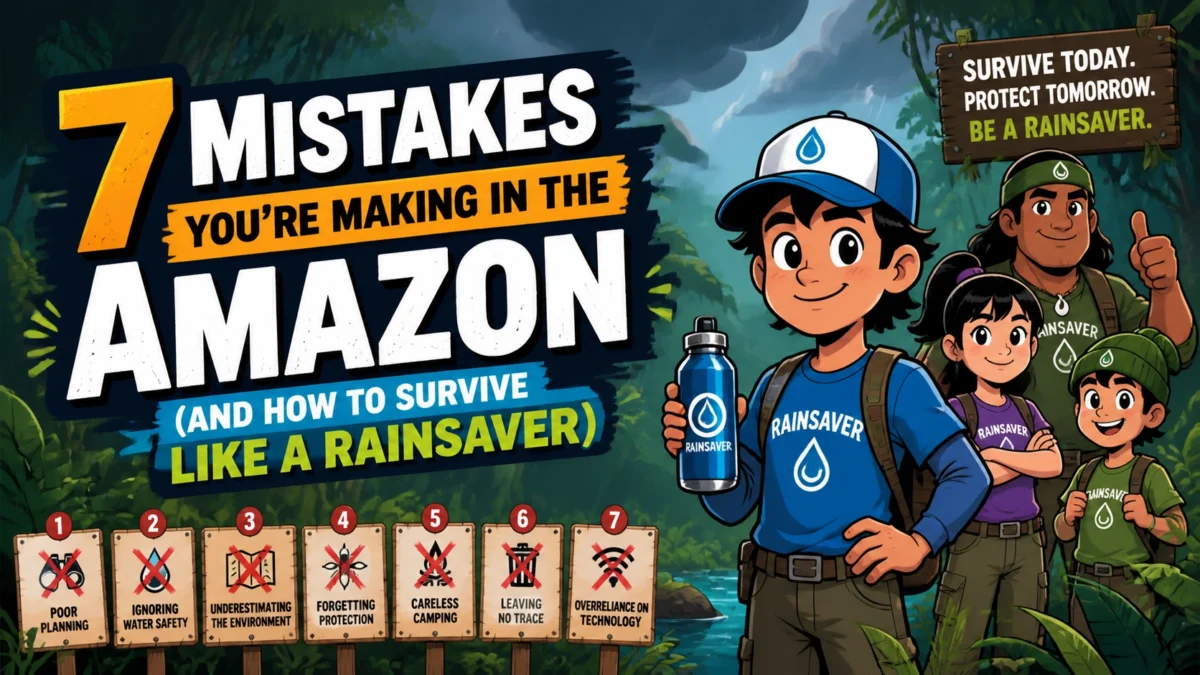
Meta Description: Planning a trip to the deep green? Don’t get lost in the canopy. Avoid these 7 common Amazon mistakes with survival tips straight from Leonard West and the Rainsavers team.
FIELD NOTES: May 13, 2026
FROM: Leonard West (Encrypted Transmission)
TO: Rainsavers HQ
Listen, I’ve spent more time under the triple-canopy of the Amazon than I have in my own living room back home. Every year, I see "adventurers" fly into Manaus with shiny new gear and zero clue about what the jungle actually wants from them. They treat the rainforest like a backdrop for a selfie, but the Amazon isn't a studio: it’s a living, breathing, and often hungry entity.
If you want to survive out here: especially now that things are getting weird with the energy spikes we’ve been tracking: you need to stop acting like a tourist and start acting like a Rainsaver.
Here are the seven biggest mistakes I see people making in the Amazon, and how you can avoid becoming a cautionary tale in my next mission report.
1. Thinking "Clear" Water is Safe Water
This is the rookie mistake that ends expeditions before they even hit the deep brush. You see a beautiful, crystal-clear stream bubbling over some rocks and think, "Nature’s filtered it for me!"
Wrong. In 2026, with the runoff from illegal mining and the strange chemical shifts we’ve been seeing near the ancient sites, that water is a cocktail of parasites and worse. Even if it looks like bottled spring water, it could be carrying things that will turn your insides into a slip-and-slide.
How to survive like a Rainsaver:
We don’t just boil; we use advanced filtration. But more importantly, we save the rain. It’s in our name, guys. Setting up a proper catchment system with a non-porous tarp is the cleanest way to get hydration without the heavy metal aftertaste. If you’re desperate, look for the Vitis vines: but you better know which ones are which, or you’ll be drinking toxic sap.

2. Overestimating Your High-Tech GPS
I love tech. Red mercury-powered scanners? Fantastic. But relying solely on a handheld GPS unit under the Amazon canopy is a death wish. The "Green Wall" is thick. Between the dense foliage and the occasional localized electromagnetic interference (which Primal insists is "ancient echoes," though I’m still skeptical), your signal is going to drop exactly when you need it most.
How to survive like a Rainsaver:
Learn to read the forest, not just the screen. Watch the moss, sure, but also watch the light. In the Amazon, the sun is your best friend until 4:00 PM when the daily deluge hits. We always carry a physical compass and a topographic map that doesn't need a battery. If the tech fails, your brain shouldn't.
3. Wearing "Action Hero" Boots
You’ve seen the movies: the hero walks through the jungle in heavy, leather combat boots that look great on camera. In reality? Those boots are moisture traps. Once they get wet (and they will get wet within the first twenty minutes), they stay wet. That leads to trench foot, blisters, and a very slow, painful crawl back to civilization.
How to survive like a Rainsaver:
Lightweight, synthetic, and fast-drying. That’s the secret. You want boots that drain. Some of our team members even prefer specialized trail shoes that allow water to move through them. And socks? Bring three times as many as you think you need. Keep a pair in a waterproof dry-bag that never gets wet. That’s your "sleeping pair." Trust me, there is no greater luxury in the jungle than dry wool on your feet at 2:00 AM.
4. Ignoring the "Small" Wildlife
Everyone is terrified of the jaguars or the anacondas. Don't get me wrong, Mortalis had a run-in with a black caiman last month that I wouldn’t wish on anyone, but the big predators usually want to stay away from you. It’s the things you can’t see: or the things you think are harmless: that get you.
Bullet ants, botflies, and the dreaded "wait-a-bit" vines (which have thorns that hook into your skin and don't let go) are the real daily villains.
How to survive like a Rainsaver:
Situational awareness is key. Don't just grab a tree trunk to steady yourself; you might be grabbing a handful of fire ants. Check your boots every morning for scorpions. We treat our clothes with permethrin before we even step off the plane. Respect the small stuff, and the big stuff is a lot easier to manage.

5. Chasing the "Red Mercury" Glow
This one is specific to 2026. We’ve been seeing a lot of "treasure hunters" lately, drawn by rumors of Red Mercury deposits or "unlimited energy" sources hidden in the old German outposts from the 40s. They see a strange shimmer in the distance or a reading on a cheap sensor and they run off-trail.
How to survive like a Rainsaver:
Curiosity killed the cat, and it definitely kills the unequipped explorer. If you see an atmospheric distortion or a strange red hue in the mist, that’s not a payday: it’s a hazard. The Rainsavers approach these anomalies with containment gear and a tactical plan. If you find something that looks like ancient tech humming in the dirt, back away. You aren't ready for that kind of "adventure" yet.
6. Packing Like You’re Moving In
I’ve seen packs that weigh 70 pounds. In the humidity of the Amazon, that 70 pounds feels like 150 by noon. People pack massive tents, heavy stoves, and enough canned food to survive a nuclear winter. You’ll be exhausted in two miles, and exhaustion leads to mistakes.
How to survive like a Rainsaver:
Go minimalist. A high-quality hammock with a mosquito net and a rain fly is half the weight of a tent and keeps you off the ground (where the snakes and bugs live). We use concentrated rations and, again, we rely on our knowledge of the environment to supplement what we carry. If you can't carry your pack at a jog for a mile, it’s too heavy.

7. The "Solo Hero" Delusion
This is the biggest mistake of all. People think they can be the lone survivor, the one who conquers the jungle through sheer will. But the Amazon is a team sport. Even Mortalis, as tough as he is, knows that he needs eyes in the back of his head: and usually, those eyes belong to the rest of the Rainsavers.
How to survive like a Rainsaver:
Never go alone. You need someone to help with navigation, someone to handle the tech, and someone to keep morale up when the rain hasn't stopped for three days and your skin feels like it's melting. The Rainsavers work because we have different specialties: science, survival, and strength.
Why It Matters
The Amazon isn't just a place to test your mettle. It’s the lungs of our planet, and in 2026, it’s also the front line of a battle for the future of energy and ancient secrets. We don’t just go in to survive; we go in to protect.
If you’re making these seven mistakes, you’re not just a danger to yourself; you’re a liability to the forest. The jungle deserves respect, not just survival.
Are you ready to join the mission?
We’re looking for people who care about the planet and aren't afraid of a little mud (or a lot of it). Whether you're here for the environmental science or the thrill of uncovering the world's hidden mysteries, there’s a place for you in the Rainsavers community.
Don't just read about the adventure: be part of it. Check out our latest dossiers on the Amazon anomalies and see how we’re fighting to keep the world’s most vital ecosystem safe.
Join the Rainsavers Journey at rainsavers.com
Stay dry (if you can),
Leonard West
Lead Field Operative, The Rainsavers
