
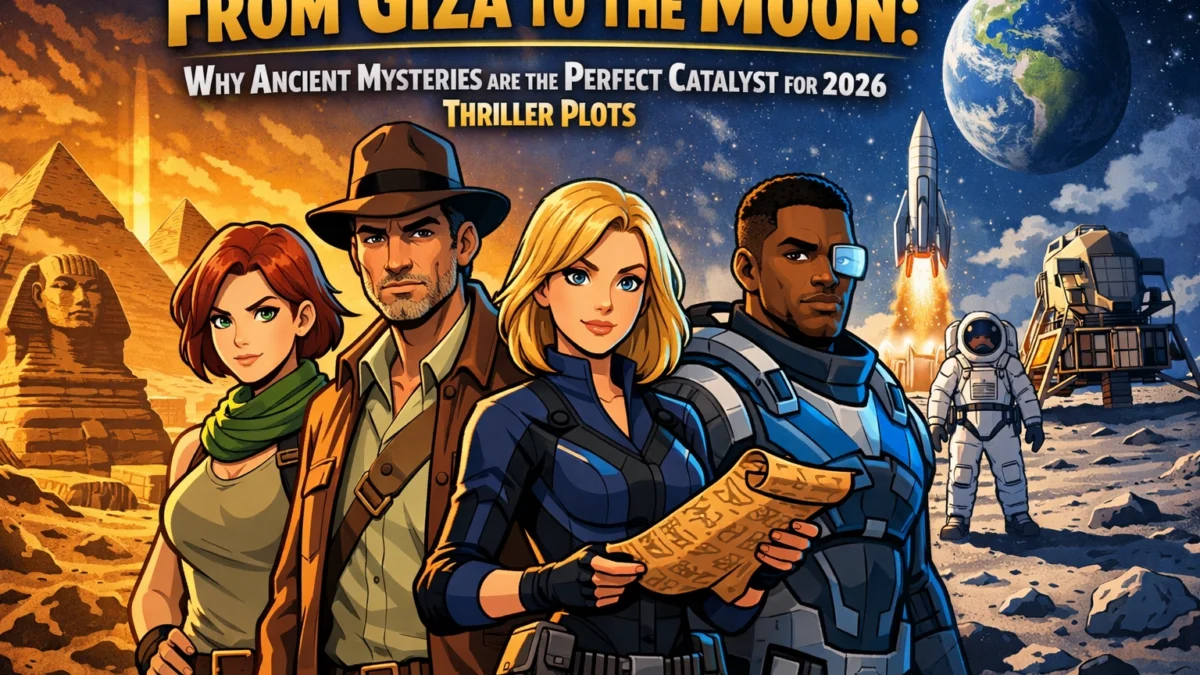
Welcome to 2026, friends! It’s Steven G. Samuels here. If you’re reading this, you’ve probably noticed that the world feels a little faster, a little more high-tech, and: if I’m being honest: a little weirder than it did a few years ago. Here at The Rainsavers, we spend a lot of time thinking about what makes a story stick. Why is it that in an age of AI, commercial moon flights, and climate-conscious tech, we are still obsessed with the Great Pyramid of Giza?
The answer is simple: the more we look forward, the more we realize the past was way ahead of us.
In the 2026 thriller landscape, "digging for the past" has taken on a whole new meaning. We aren't just looking for gold coins or dusty scrolls anymore. We’re looking for the keys to our survival. Today, I want to dive into why the connection between Giza and the Moon is the ultimate catalyst for the high-stakes plots we’re seeing in fiction right now.
The Giza-Lunar Connection: It’s Not Just for Conspiracy Theorists Anymore
For decades, people joked about "ancient aliens" or secret lunar bases. But in 2026, fiction writers (and a few adventurous scientists) are looking at the math. The Great Pyramid isn't just a feat of engineering; it’s a celestial clock.
Imagine a thriller where a modern-day eco-hero discovers that the shafts in the Great Pyramid aren't pointing to stars for religious reasons, but are actually part of a synchronized communication array linked to a specific crater on the Moon. When we start linking the Giza Plateau to the lunar surface, the stakes for a thriller plot go from "local mystery" to "interplanetary crisis" in about two seconds.

ALT: A high-tech lunar research station positioned inside a crater that reveals perfectly symmetrical, ancient stone foundations beneath the moon's surface.
This is the kind of stuff we love exploring. It merges the grounded, "dirt under your fingernails" feeling of archaeology with the "cold, dark vacuum" tension of a space thriller. It’s the perfect recipe for a page-turner that keeps you up until 3:00 AM.
Why 2026 is the Year of the "Ancient Tech" Thriller
The world has changed. We’re all a bit more aware of our footprint on the planet, and we’re all looking for solutions to the climate crisis. In 2026, the hottest thriller plots aren't about international spies stealing briefcases; they’re about teams like The Rainsavers racing to find ancient technology that might help us fix the mess we’ve made of the environment.
When you combine an ancient mystery (like a hidden chamber in Giza) with a modern threat (like an ecological collapse), you get a narrative engine that won’t quit. We call this the "Eco-Ancient Hybrid."
The logic goes like this:
- The ancients had a power source we don't understand.
- Evidence suggests they moved that tech to the Moon to keep it safe.
- German WWII researchers almost found it in 1944.
- Now, in 2026, a greedy corporation is about to dig it up and use it for the wrong reasons.
- Enter our heroes.
See? That’s a plot that moves. If you want to see how we handle these kinds of high-stakes scenarios, you should definitely check out our Characters page to see the team we’ve put together to handle these threats.
The "German WWII" Factor: Adding Historical Weight
You can't have a great thriller without a layer of historical conspiracy. One of the most compelling tropes in 2026 fiction is the discovery of lost German WWII research. History tells us that during the 1940s, German researchers were obsessed with the occult and ancient technology.
In a modern thriller, finding a logbook from a 1943 expedition to Egypt can serve as the "treasure map" to the Moon. It grounds the sci-fi elements in a historical reality that feels chillingly possible. When our characters find a hidden bunker in the Sahara containing lunar coordinates calculated eighty years ago using German WWII tech, the mystery feels earned. It’s not just magic; it’s a secret history coming to light.

ALT: A weathered, sepia-toned document from the 1940s showing a sketch of the Giza pyramids with mathematical notations pointing toward the Moon, sitting next to a modern 2026 tablet.
Why the Moon?
Why is the Moon the perfect "Part B" to the Giza mystery? Because it’s the ultimate "locked room."
In a classic mystery, the detective is stuck in a mansion. In a 2026 thriller, the mystery is locked on a celestial body that only a few people can reach. Linking Giza to the Moon creates a sense of scale. It makes the reader feel like the world is much bigger and more mysterious than their morning commute would suggest.
Plus, it allows us to play with ancient technology vs. modern threats. How does a team of eco-adventurers deal with a villain who has a lunar-based energy weapon derived from a design found inside a pyramid? That’s the kind of conflict that defines the 2026 reading list.
Short, Skimmable Why-It-Works List:
- Scale: It moves the story from a dusty tomb to the vastness of space.
- Urgency: If the tech is "activated" at Giza, what happens on the Moon?
- Relatability: We all know the pyramids, and we all see the Moon. It’s a mystery hiding in plain sight.
- Eco-Themes: Many of these plots revolve around "clean energy" the ancients supposedly mastered. It’s why eco-fiction is changing the way we think about adventure.

ALT: A panoramic shot of the Giza Plateau at night, with the Moon appearing unnaturally large and glowing with a faint, geometric pattern that mirrors the layout of the pyramids.
The Rainsavers Approach
At The Rainsavers, we don’t just write about lone wolves. We believe in the power of the team. In our stories, solving a mystery that spans from Cairo to the Mare Tranquillitatis requires a diverse set of skills: engineers, historians, and environmentalists working together.
We’ve found that team-based adventure series are taking over because they reflect the real world. Nobody saves the planet alone, and nobody uncovers a lunar conspiracy without a few friends and a lot of specialized gear.
If you’re struggling with a bit of "climate anxiety" or just feeling like the world is getting a bit too heavy, these stories are the perfect escape. They remind us that there are still wonders to be found and that, even in 2026, the human spirit of discovery is alive and well. You can find more about how we tackle these themes in our ultimate guide to climate fiction.
Final Thoughts: The Mystery is Just Beginning
The transition from the Great Pyramid to the Moon represents our own transition as a species. We are looking back to learn how to move forward. As a publisher, there is nothing more exciting than a plot that makes you look at a 4,500-year-old monument and then look at the night sky and wonder… what if?
Whether it’s secret German WWII files, high-tech sensors in the King’s Chamber, or a mysterious signal from the lunar dark side, these catalysts are what make 2026 the golden age of the thriller.

ALT: A character in a sleek, modern eco-adventure suit standing in the desert, holding a fragment of glowing ancient stone while looking up at a lunar lander descending in the distance.
Are you ready to see where the clues lead? We’ve got plenty of secrets waiting for you in our latest releases.
Discover the mystery at The Rainsavers.
Stay curious, stay green, and keep reading!
: Steven G. Samuels
CEO, The Rainsavers
