
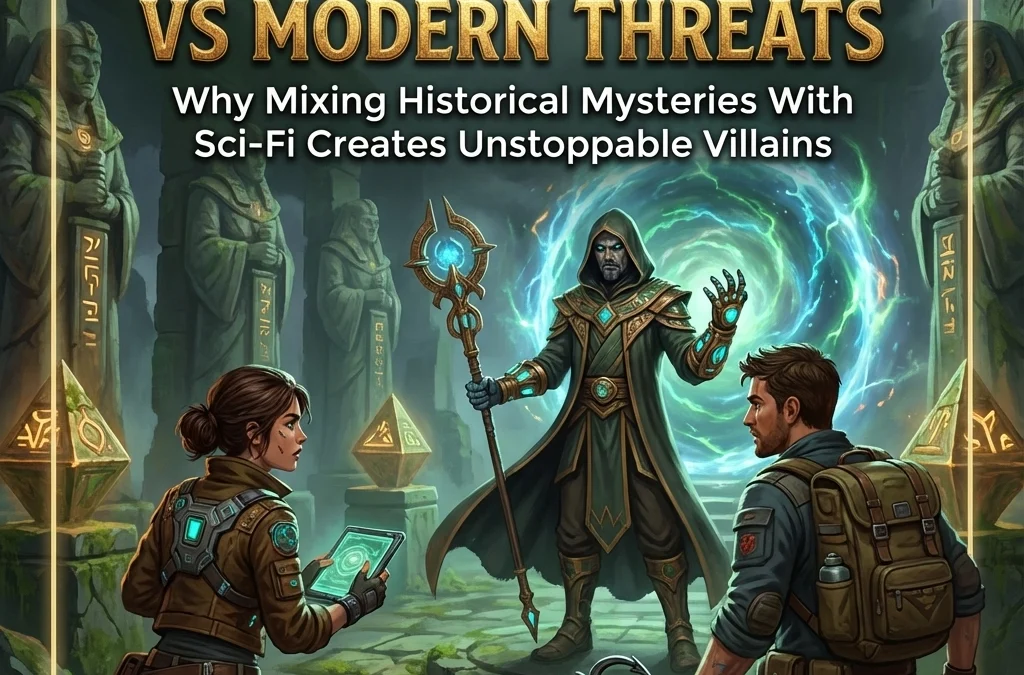
Ever notice how the most terrifying villains aren't just powerful: they're incomprehensible? There's something uniquely unsettling about antagonists who wield ancient mysteries alongside cutting-edge threats. It's like watching someone fire a laser cannon powered by forgotten magic. Your brain can't quite process it, which makes it infinitely more dangerous.
This blend of historical enigma and modern menace has become one of 2026's most compelling storytelling devices, and The Rainsavers series demonstrates exactly why this combination creates villains that feel truly unstoppable.
The Power of the Unknown
Ancient technology carries an inherent advantage that modern gadgets simply can't match: mystery. When your hero faces an AI-powered drone, they understand the basic principles. Cameras, sensors, programmed responses: scary, but familiar. But when that same drone is powered by a 3,000-year-old crystal that shouldn't even exist? Now you're in uncharted territory.

In The Rainsavers, our protagonists regularly encounter this exact dilemma. Ancient Amazonian technologies that modern science can barely comprehend get weaponized by contemporary villains who understand just enough to be dangerous. The result? Threats that operate outside known parameters, making traditional countermeasures useless.
Think about it: how do you hack a control system that predates electricity? How do you trace the digital footprint of something that was carved in stone? This fundamental disconnect between old and new creates a unique form of technological terror.
Why Ancient Beats Modern Every Time
There's a reason ancient structures like the Pyramids still baffle engineers today. Our ancestors weren't less intelligent: they were working with completely different principles. While modern technology prioritizes efficiency and mass production, ancient builders focused on permanence and purpose.
When fictional villains tap into these forgotten principles, they gain access to solutions that modern thinking can't anticipate. Ancient technology wasn't designed to be updated, patched, or replaced: it was built to endure. That makes it incredibly difficult to counter with conventional modern approaches.

The Rainsavers explores this concept through antagonists who've discovered how to merge rainforest preservation techniques that sustained civilizations for millennia with today's environmental monitoring systems. The villains aren't just using old tools: they're applying ancient thinking to modern problems, creating solutions that feel both primitive and impossibly advanced.
The Amplification Effect
Here's where things get really interesting. Ancient technology alone is mysterious, but not necessarily threatening. Modern threats alone are scary, but ultimately comprehensible. Combine them, though, and you get something far more dangerous than the sum of its parts.
Modern technology amplifies ancient mysteries by giving them contemporary reach and precision. Imagine a villain who discovers how ancient civilizations managed to predict and control weather patterns, then scales that knowledge using satellite networks and climate modeling software. Suddenly, you're not facing a storm: you're facing a targeted storm that can follow you anywhere on Earth.
This is exactly the kind of escalation that makes The Rainsavers villains so compelling. They're not content to use ancient knowledge in ancient ways. They're taking wisdom that once protected entire ecosystems and weaponizing it with modern distribution systems, global communication networks, and real-time data processing.
The Psychology of Impossible Threats
What makes these hybrid villains truly unstoppable isn't just their capabilities: it's how they break their opponents psychologically. Heroes are trained to face known threats. Military protocols, scientific analysis, technological countermeasures: all of these assume you're dealing with familiar principles.

But when someone attacks you with methods that shouldn't exist, using tools that predate your entire understanding of how things work, your standard responses become liability. Every assumption becomes questionable. Every solution feels inadequate.
In The Rainsavers, this psychological advantage plays out repeatedly. The heroes aren't just fighting to stop environmental destruction: they're fighting to understand threats that operate on principles their training never covered. Ancient Amazonian biotechnology enhanced with modern genetic modification techniques. Traditional water management systems hijacked by quantum computing algorithms. It's not just difficult to counter: it's difficult to even comprehend.
The Perfect Storm for Storytelling
This combination creates perfect conditions for compelling antagonists because it addresses both intellectual and primal fears. On an intellectual level, we fear the unknown: technologies and principles we can't understand or predict. On a primal level, we fear the ancient: things that existed before us and might outlast us.
Ancient-meets-modern villains embody both fears simultaneously. They represent knowledge we've lost (ancient fear) applied through methods we barely control (modern fear). It's like being hunted by something that knows secrets you've forgotten, using tools you invented but can no longer fully understand.
The Rainsavers capitalizes on this psychological double-hit by creating villains who feel both impossibly old and terrifyingly current. They're not trying to return to the past or escape to the future: they're trying to merge past and future in ways that eliminate the present entirely.
Why 2026 Is the Perfect Time
This storytelling approach feels especially relevant right now. We're living through a period where ancient wisdom about environmental stewardship is colliding with cutting-edge climate technology. Traditional knowledge about sustainable living is being validated by modern scientific research. Indigenous practices are being combined with contemporary conservation techniques.

This real-world convergence makes fictional villains who exploit similar combinations feel unnervingly plausible. When The Rainsavers presents antagonists who've weaponized ancient rainforest management techniques using modern surveillance systems, it doesn't feel like fantasy: it feels like tomorrow's headlines.
The Unstoppable Advantage
What makes these villains truly unstoppable is their hybrid nature. You can't defeat them using purely modern approaches because half their toolkit predates your countermeasures. You can't rely on ancient wisdom alone because they've amplified their capabilities beyond traditional limits.
Heroes facing such threats must essentially become hybrids themselves: combining historical knowledge with contemporary skills, traditional wisdom with modern technology. In The Rainsavers, this forces character growth that goes beyond typical skill development. The protagonists must literally expand their entire framework for understanding how the world works.
The villains aren't just obstacles to overcome: they're puzzles that require fundamentally new approaches to solve. They force heroes to bridge gaps between different ways of thinking, different eras of human knowledge, and different relationships with the natural world.
This creates storytelling opportunities that purely modern or purely ancient threats simply can't match. The heroes' journey becomes not just about stopping the bad guys, but about evolving beyond their current limitations to meet threats that shouldn't be possible but definitely are.
Ready to See How Ancient Mysteries and Modern Threats Collide?
The fusion of historical enigmas with contemporary dangers creates villains that feel genuinely unstoppable because they operate outside conventional understanding. They represent the perfect storm of unknown capabilities and familiar applications, making them both incomprehensible and immediately threatening.
