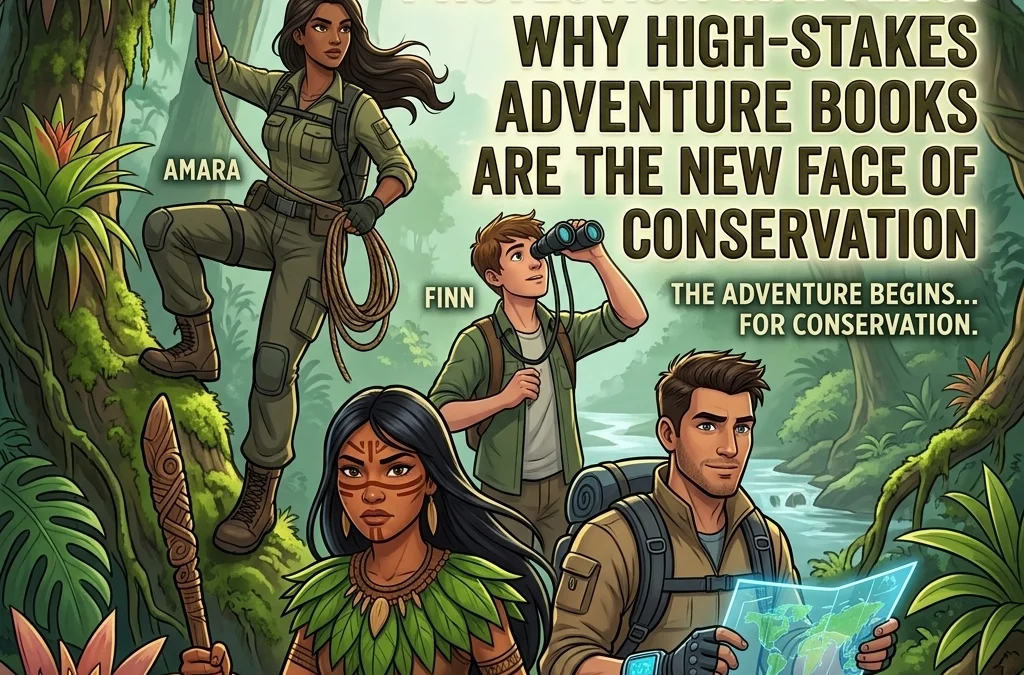
Meta description: Protecting the Amazon rainforest is urgent, but doomscrolling doesn’t inspire action. Here’s why high-stakes adventure books make conservation feel real, memorable, and worth fighting for.
Scheduled: May 14, 2026 , 9:00 AM ET
Leaked document source: “Leonard West’s Private Notes (Definitely Not For Posting)”
Recovered from: a backpack that smelled like river water, sunscreen, and bad decisions.
Dispatch Log: Why We’re Talking About the Amazon Like It’s a Thriller (Because It Kind of Is)
TIME: 06:12
LOCATION: “Somewhere humid” (Leonard’s exact words)
STATUS: Serious topic. Casual tone. No panicking. (Some panicking.)
Here’s the thing: the Amazon rainforest is often introduced to people like a textbook chapter. Tons of facts, tons of fear, and then… a gentle fade into the next piece of content.
But if you want people to care, they need more than information. They need:
- stakes they can feel
- characters they can follow
- a reason to keep turning pages instead of tabbing away
That’s where high-stakes adventure stories come in, not as a replacement for real conservation work, but as a powerful way to translate it into something human and unforgettable.
And yes: Amazon rainforest protection matters. A lot. Not “nice-to-have” a lot, more like “this changes everything” a lot.
Quick Reality Check: What Actually Protects the Amazon (Not the Fiction Part)
Before we get into stories, let’s ground this in what’s real. The most effective Amazon conservation approaches people are working on right now include:
- Indigenous guardianship: Indigenous communities are widely recognized as some of the strongest protectors of intact forests.
- Monitoring tech: Satellites, drones, and AI help detect illegal clearing faster.
- Legal protections: Protected areas and enforceable policies can slow deforestation when backed by real enforcement.
- International funding: Large-scale funds support protection efforts, restoration, and sustainable development.
- Restoration and reforestation: Replanting and rebuilding degraded areas can bring forest back (when done well, with local knowledge).
- Sustainable agriculture & land use: Improving practices reduces pressure to clear more forest.
That’s the real-world toolkit. Stories don’t replace any of it.
But stories can do something conservation strategies struggle with: make the Amazon feel close enough to matter.
Exhibit A: Why Your Brain Remembers a Chase Scene Better Than a Statistic
If you’ve ever remembered a fictional moment for years, one line, one betrayal, one “oh no they did not”, you already know the secret:
Narrative sticks.
Adventure stories work especially well because they naturally include the same elements conservation needs people to understand:
- cause and effect
- risk and consequence
- time pressure
- moral choices under stress
- systems that feel too big… until someone pushes back
When a rainforest is the setting, it stops being a green blur and starts being a place with:
- rivers you can picture
- night sounds you can almost hear
- communities with names and stakes
- threats that aren’t abstract
Stories don’t just tell readers the Amazon is important. They make readers feel what’s at risk.
The “High-Stakes Adventure” Advantage: Conservation Without the Lecture Vibes
A lot of eco-content accidentally lands in one of two buckets:
- Guilt content (“Look what humans did. Feel bad forever.”)
- Hopeless content (“It’s too late, but thanks for reading.”)
High-stakes adventure has a different energy:
- Urgency without paralysis
- Emotion without doom
- Complexity without confusion
- Action without pretending it’s simple
That’s why adventure is such a strong delivery system for conservation themes. It lets you build a world where:
- hard choices are visible
- tradeoffs aren’t hidden
- consequences aren’t theoretical
- heroes aren’t flawless (because nobody is)
Also: it’s fun. And fun is not the enemy of impact.
Field Note (Leonard): “The Amazon Doesn’t Need Another Poster. It Needs Attention That Lasts.”
LOG ENTRY: 07:03
I used to think awareness was the finish line. Like: “If people know, they’ll fix it.”
Then I met “people.”
People are busy. People are tired. People are drowning in content. Most of us aren’t ignoring the Amazon because we’re heartless,
we’re ignoring it because we don’t know what to do with the information.
That’s why adventure stories help. They turn awareness into:
- curiosity (“Wait, what’s actually happening out there?”)
- empathy (“Oh. That would wreck someone’s life.”)
- momentum (“I need to know how they get out of this.”)
Momentum is underrated. Momentum keeps people in the conversation long enough to learn something real.
The Amazon as a Character (Not Just a Backdrop)
In the best rainforest adventures, the Amazon isn’t scenery. It’s a living force that changes everything:
- routes aren’t lines on a map; they’re decisions with consequences
- weather isn’t “setting”; it’s an obstacle and a warning
- silence isn’t calm; it’s suspense
That shift matters because many people picture “rainforest” as one generic green place. Adventure stories can show the Amazon as:
- diverse ecosystems
- distinct regions
- interconnected river systems
- communities and cultures with history and agency
In other words: the Amazon becomes specific.
And specific is where care begins.
Conservation Has Villains (Just… Not the Cartoon Kind)
Let’s be careful here. Real conservation is complicated, and it’s rarely a neat “good vs evil” situation.
But it does have antagonistic forces:
- illegal operations that profit from destruction
- systems that reward short-term gain
- corruption and weak enforcement
- pressure to clear land fast
Adventure stories can handle this complexity better than a slogan can. A great thriller can show:
- why bad outcomes happen even when nobody feels “evil”
- how incentives and desperation drive decisions
- how tough it is to protect a place that big
And you can do it without turning real communities into stereotypes or flattening real issues into a single mustache-twirling bad guy.
High-stakes doesn’t mean low-nuance.
A Reader’s Guide: What Adventure Stories Can Teach (Without Feeling Like Homework)
Here are conservation truths that adventure fiction can deliver smoothly, because they appear as plot, not lecture:
1) Time matters
In stories, delays cost characters dearly. Same with forests: waiting has consequences.
2) Local knowledge matters
In fiction, the team that listens survives. In real conservation, local and Indigenous knowledge is essential.
3) Tech helps, but isn’t magic
Satellites and drones can reveal problems. They don’t automatically solve them.
4) Protection needs enforcement
A “protected area” on paper isn’t the same as safety on the ground.
5) One action can trigger a chain
Story logic mirrors ecosystem logic: pull one thread, and things shift.
That’s the sneaky brilliance of adventure: it teaches systems thinking by making systems dramatic.
Visual: “Adventure Plot” vs “Conservation Reality” (They’re Weirdly Similar)

ALT text: A simple diagram comparing common adventure story beats (threat, chase, setback, discovery, teamwork, narrow escape) with real conservation steps (risk detection, monitoring, enforcement, community leadership, restoration, funding).
“Okay, But Does This Actually Help the Amazon?” (Fair Question.)
Stories don’t sign legislation. Stories don’t fund ranger programs. Stories don’t run satellites.
What stories do is shape:
- what people talk about
- what people remember
- what people share
- what people feel motivated to learn more about
If enough readers care, more people:
- support conservation organizations and community-led initiatives
- vote for policies that protect forests
- pressure companies and leaders
- donate, volunteer, or simply keep the topic alive
Cultural attention isn’t the whole solution. But it’s a real ingredient.
And frankly, the Amazon deserves a bigger place in our imaginations than “a faraway place that’s sadly burning again.”
How We Do It at The Rainsavers (Without Preaching)
We’re an entertainment/publishing company. Our job is to tell stories people actually want to read.
So our approach is simple:
- Make the adventure irresistible
- Make the stakes meaningful
- Make the setting vivid
- Make the choices hard
- Make teamwork matter
- Make the reader care what happens next
If you’re curious about the people at the center of our adventures, you can meet the team here:
https://rainsavers.com/characters
And if you prefer to binge story content in episode form, that exists too:
https://rainsavers.com/episodes
(Sparing links. You’re welcome, internet.)
Leonard’s “Three Rules” for Eco-Adventure That Doesn’t Feel Like a Lecture
RULE 1: Put the “save the rainforest” theme inside a personal goal.
A character protecting a friend, a family, or a home pulls readers in faster than a monologue about global systems.
RULE 2: Make nature active.
The forest should do things: mislead, hide, protect, threaten, reveal.
RULE 3: Never solve it with one genius moment.
Real conservation is collective. Your story should be, too.
If you’re into team-based adventure energy, you might also like this related read:
https://rainsavers.com/are-solo-hero-stories-dead-why-team-based-adventure-series-are-taking-over
Mini “Choose-Your-Own-Adventure” Moment (Because We Can)
You’re in a canoe at dusk. The river is wider than it looked on the map. The guide says the current is changing.
You have three options:
- Keep going fast (you might beat the storm, you might not)
- Pull to shore and wait (safer now, riskier later)
- Ask locals upstream for a route (slower, smarter)
If you chose 3, congrats: you just picked the option that also maps onto real conservation thinking: slow down, listen, work with people who know the place.
If you chose 1, also congrats: you are Leonard, spiritually. He is wet constantly.
What You Can Do Next (Low Effort, High Impact Energy)
No guilt trip. Just options:
- Read an Amazon-set adventure and share it with one friend who doesn’t normally read eco-content
- Learn from Indigenous-led perspectives when you see them highlighted: amplify them
- Support rainforest protection work when you’re able (time, money, attention all count)
And if you want to step into our world: where the rainforest isn’t just a headline, it’s a high-stakes setting: start here:
Explore The Rainsavers: https://rainsavers.com
One Last Note from Leonard (Mostly Smudged)
LOG ENTRY: 08:41
If a story can make someone feel like the Amazon is real, then they might treat it like it’s real.
And it is.
