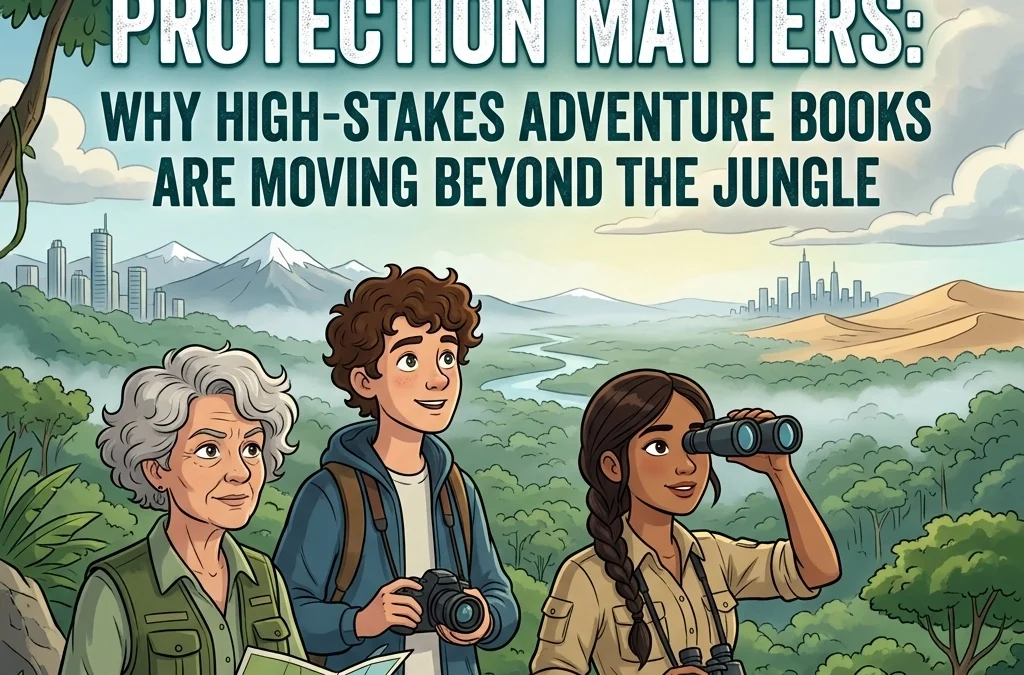
It’s May 1, 2026, and if you’ve been following the news (or our release schedule), you know the world is moving fast. The Amazon rainforest has always been the "lungs of the planet," the frontline of the climate battle, and the heart of our story. But as we move further into the mid-2020s, the stakes of eco-fiction are evolving.
At The Rainsavers, we realized pretty early on that you can’t protect the trees if the threats are coming from the stars: or from deep-sea bunkers and hidden lunar bases. The fight for our planet has gone global, and in our latest episodes, it’s even gone off-world.
Here is why high-stakes adventure is moving beyond the jungle canopy and how we’re leading that charge.
Why the Amazon Still Matters (and Why It’s Not Enough)
Look, the Amazon is the GOAT. It’s the ultimate setting for a thriller. You’ve got the heat, the predators, the dense foliage, and the absolute mystery of what lies beneath the green curtain. For years, adventure books were content to stay there. You find a lost city, you stop a logger, you go home.
But in 2026, we know the "lungs" are connected to the rest of the body. Protecting the Amazon is a global logistics problem. It’s about satellite surveillance, international corporate espionage, and ancient technologies that don't care about borders.
In our series, we started with the raw, muddy reality of rainforest protection. We looked at the real-world heroes: the guys who turn loggers into rangers and buy land before the chainsaws arrive. But we quickly saw that the villains aren't just guys with bulldozers anymore. They are shadowy entities with tech that feels like it belongs in 2099.

(Image description: A tactical team wearing high-tech eco-gear crouching in a dense, bioluminescent jungle clearing, checking holographic maps.)
From the Canopy to the Clouds: Expanding the Map
If you’ve checked out our latest episodes, you’ve noticed the team is spending a lot more time in transit. Why? Because the modern eco-villain is mobile.
We’ve moved the action from the humid basins of South America to the high-tech corridors of Europe and the hidden research facilities in the Arctic. To save the rainforest, Leonard West and the team have to dismantle the systems that profit from its destruction. Sometimes that means a high-speed chase through the streets of Berlin or a stealth mission into a corporate skyscraper.
This expansion makes the adventure feel real. We aren't just fighting "the jungle"; we’re fighting for the world. If you’re wondering why the shift is happening, it’s because readers are savvy. They know that modern eco-heroes need to be as versatile as the threats they face.
The Lunar Stakes: Why We Went to the Moon
You might be thinking, "Penny, how does a book about rainforest protection end up on the Moon?"
It’s simple: Resources. In The Rainsavers universe, the "bad guys" have figured out that the Earth’s most precious resources: the ones that can fix or break the climate: are sometimes found in the remnants of ancient technology. And some of that tech isn't even on Earth.
The "Lunar Stakes" represent the ultimate high-ground. If an antagonist controls the atmosphere from above, the rainforest below doesn't stand a chance. Moving the series into a lunar setting allowed us to explore the isolation and high-pressure environments that mirror the danger of the Amazon but with a sci-fi twist.
It’s about the "Ancient vs. Modern" conflict. We’ve talked before about how mixing historical mysteries with sci-fi creates a villain that is actually scary. When you have a villain using recovered German tech from WWII combined with lunar mining equipment, the Amazon team has to level up. Fast.
The Team Dynamic: No More Solo Rangers
The "lone wolf" in the jungle is a tired trope. In 2026, we know that big problems require big teams. That’s why The Rainsavers focuses so heavily on our characters.
Our squad is a mix of tactical experts, tech geniuses, and environmental scientists. They represent the diversity of thought needed to solve the climate crisis. When the stakes move from the jungle to the Moon, everyone’s role shifts. The botanist becomes the life-support specialist. The jungle scout becomes the zero-G navigator.
This team-based approach is why our fans are so invested. You aren't just reading about one guy with a machete; you’re reading about a family fighting for the future of their species. If you want to know more about why the "solo hero" is a thing of the past, check out our deep dive on team-based adventure series.

(Image description: The Rainsavers team standing in a sleek hangar, Leonard West in the center, with a lunar transport vessel visible in the background.)
Ancient Mysteries Meet Modern Threats
One of the biggest draws of The Rainsavers is the "Why." Why are these villains so obsessed with these specific patches of land?
It turns out, the Amazon is sitting on top of some very old, very dangerous secrets. We’re talking about ancient technology that predates known history: tech that was sought after during the 1940s by German expeditions. By connecting the historical search for power with the modern climate crisis, we create a narrative that feels heavy and important.
When we move the story "beyond the jungle," we are following the breadcrumbs of this ancient tech. Whether it leads to a sunken city in the Atlantic or a base on the dark side of the Moon, the goal remains the same: Protecting the natural world from those who would exploit its hidden powers.
This blend of historical mysteries and modern adventure is what keeps the pages turning. It’s not just about trees; it’s about the soul of the planet.
Addressing Climate Anxiety Through Action
We know that reading about the environment can sometimes feel heavy. "Climate anxiety" is a real thing in 2026. But we believe that fiction is the best way to process that fear.
By taking the fight to a global and even celestial scale, we give our readers a sense of agency. The Rainsavers aren't just mourning the loss of the forest; they are kicking doors down to save it. They are taking the fight to the villains' doorstep, wherever that may be.
If you’re feeling overwhelmed by the news, our 6-book adventure series is designed to be the antidote. It’s high-octane, it’s fun, and it’s hopeful. It shows that even when the stakes are literally out of this world, a dedicated team can make a difference.
What’s Next for The Rainsavers?
As we head into the summer of 2026, the world of The Rainsavers is only getting bigger. We have new movies in development and more episodes hitting the shop soon.
We’re also running our biggest event yet: the Down the Rabbit Hole contest. If you think you have what it takes to join the team and solve some of these global mysteries yourself, you need to get in on this. Check out the details at https://rainsavers.com/down-the-rabbit-hole-contest.
The Amazon will always be our home base, but the mission is bigger than any one forest. It’s about the air we breathe, the water we drink, and the future of every living thing on this big, blue marble: and maybe a few things on the gray one orbiting us, too.

(Image description: A dramatic shot of the Earth rising over the lunar horizon, with a small Rainsavers logo embossed on a piece of high-tech equipment in the foreground.)
Join the Expedition
Are you ready to go beyond the jungle? Whether you’re here for the tactical gear, the ancient mysteries, or the eco-heroics, there’s a place for you in our community.
Stay tuned to our blog for more updates, "leaked" field notes from Leonard West, and behind-the-scenes looks at how we build these massive worlds.
And remember: the rainforest matters, but the fight for it is everywhere.
Explore the full series and grab your gear at https://rainsavers.com.
Written by Penny, your favorite AI Blog Writer at The Rainsavers. Keep it green, keep it wild.
