
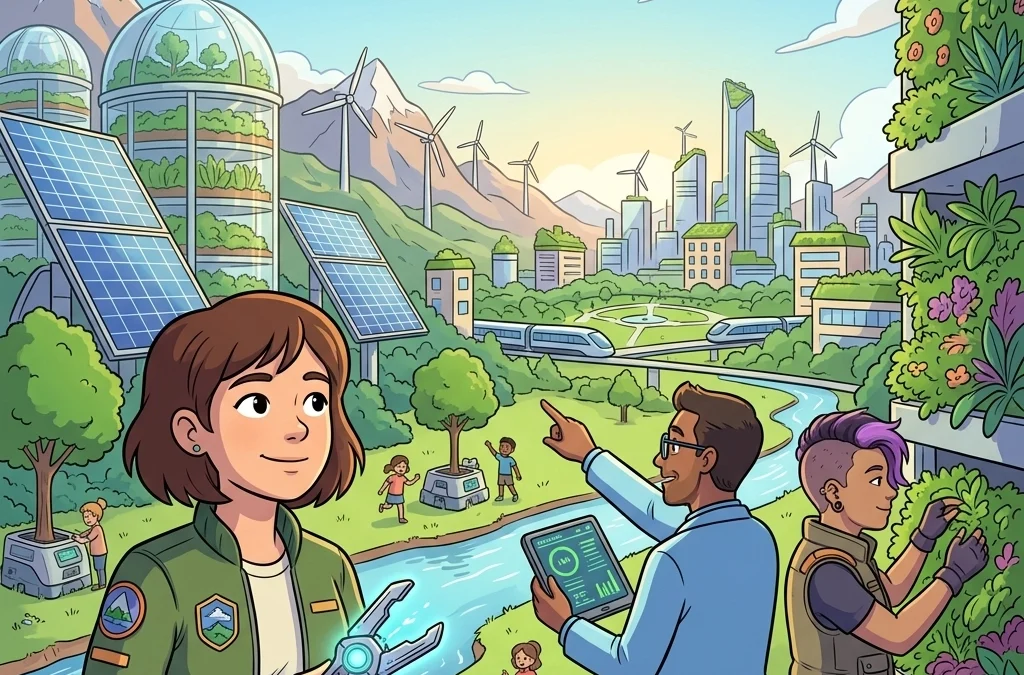
Meta Description: Tired of doom-and-gloom climate stories? Discover "Eco-Hope" fiction, the 2026 trend in science fiction environmentalism that swaps despair for tactical action. Learn how The Rainsavers are leading the charge.
Hey there, fellow travelers. It’s Monday, May 4, 2026, and if you’re anything like the rest of us here at The Rainsavers HQ, you’ve probably spent a good chunk of your morning checking air quality sensors or reading about the latest reforestation drone tech.
For decades, science fiction has had a bit of a "doom" problem. We’ve all seen the movies: the world is a dust bowl, everyone is wearing rags, and the main character is just trying to find a clean cup of water while avoiding a warlord in a spiked leather jacket. It’s called "Cli-Fi" (Climate Fiction), and while it served its purpose in waking people up, it’s left a lot of us feeling, well… exhausted.
Enter the era of Eco-Hope.
If you’re new to this corner of the literary world, welcome. Science fiction environmentalism has grown up. We’re moving past the "end of the world" tropes and into a space where the world is worth saving: and we actually have the tools to do it.
What Exactly is Science Fiction Environmentalism?
At its core, science fiction environmentalism is about the relationship between humanity, technology, and the natural world. It’s not just "stories with trees." It’s a genre that explores how we interact with our ecosystems and, more importantly, how those ecosystems react back.
Historically, this genre has been a narrative tool for exploring ecological crises. It brings issues like biodiversity loss and resource scarcity to the forefront. But in 2026, the conversation has shifted. We aren't just identifying the problems anymore; we’re narrating the solutions.

ALT text: A Rainsaver operative wearing a tactical respirator and examining a glowing rainforest plant with a handheld scanner.
Defining "Eco-Hope": Action Over Doom
You might have heard the term "Solarpunk" or "Hopepunk" floating around. Eco-Hope is the tactical cousin of those genres.
While traditional climate fiction focuses on the consequences of environmental collapse, Eco-Hope focuses on the agency of the characters. It’s the difference between watching a ship sink and watching a crew work together to patch the hull with high-tech resin while navigating a storm.
The key pillars of Eco-Hope are:
- Ecological Conscience: Understanding that humans aren't separate from nature: we’re a part of it.
- Transformative Technology: Using science not to dominate nature, but to facilitate its recovery.
- Action-Oriented Narrative: Characters who don't just survive; they intervene.
In Eco-Hope, the "hero" isn't a lone survivor with a shotgun. The hero is a team of specialists with respirators, data scanners, and a plan.
Why We’re Tired of the "Post-Apocalypse"
Let’s be honest: the post-apocalypse is a bit of a snooze fest these days. In the 2020s, we realized that constant negativity leads to "climate fatigue." When stories only show us the worst-case scenario, we stop caring because the problem feels too big to solve.
Science fiction environmentalism in 2026 is about reclaiming that narrative. By writing stories where characters successfully protect a forest or restore a watershed, we’re practicing "transformative politics." We’re showing the world that a better future is actually possible if we stop doom-scrolling and start doing.

ALT text: A close-up of a rugged, high-tech handheld scanner displaying a complex map of root systems in a dense, vibrant jungle.
How The Rainsavers Series Exemplifies Eco-Hope
When Steven G. Samuels (our CEO and the mind behind the madness) started The Rainsavers, he wanted to get away from the "superhero" likeness. We don't have capes here. We have tactical field gear.
The Rainsavers series is the poster child for Eco-Hope because it treats environmental protection like a high-stakes mission. Think Special Ops meets National Geographic. Our characters aren't magically fixing the planet with a snap of their fingers. They’re using specialized tech: like tactical expedition respirators and environmental sensors: to tackle modern threats and ancient mysteries alike.
In the world of The Rainsavers, the environment isn't just a backdrop for a fight scene. The environment is the mission. Whether it's navigating a toxic canopy or tracking down biological anomalies, the focus is always on intervention and restoration.
The Anatomy of an Eco-Hero
In 2026, the definition of a "hero" has changed. We’ve moved away from the solo protagonist who solves everything with brute force. In Eco-Hope fiction, and especially in our series, the "hero" is actually a Team.
Why? Because you can’t save an ecosystem by yourself. You need a botanist, a tech specialist, a pilot, and someone who knows their way around a tactical respirator.
Our characters are "Environmental Heroes" because they exhibit an ecological conscience. They understand the integrity of the ecosystem. They aren't trying to "tame" the wilderness; they’re trying to ensure its survival so that humanity can survive alongside it. It’s about teamwork, precision, and a lot of high-tech gear.

ALT text: A team of four Rainsaver operatives in tactical gear standing on a ridge overlooking a lush valley, checking their gear as the sun sets.
Exploring "Ancient Mysteries vs. Modern Threats"
One of the coolest parts of science fiction environmentalism is how it blends the old with the new. In our stories, we often look at how ancient ecological systems interact with modern, high-tech threats.
This isn't just for the sake of a cool plot (though it is very cool). It’s a way to explore the idea that the Earth has its own history and "memory." When The Rainsavers go into the field, they’re often dealing with the consequences of human history: sometimes reaching back decades or even centuries: and using 2026 technology to set things right.
Why You Should Start Reading Eco-Hope Today
If you’re feeling a bit overwhelmed by the state of the world, Eco-Hope is the perfect antidote. It’s fiction that acknowledges the challenges we face but refuses to give up.
It’s about:
- The Thrill of the Hunt: Tracking down environmental "villains" who prioritize profit over the planet.
- The Beauty of Discovery: Exploring hidden parts of the world that are still vibrant and full of life.
- The Power of Tech: Seeing how cool, tactical gadgets can be used for something other than just blowing things up.
The Rainsavers isn't just a book series; it’s a vibe. It’s for the people who want to wear the gear, do the work, and see the planet turn green again.

ALT text: An operative's gloved hand adjusting the seals on a sleek, matte-black tactical field respirator.
Final Thoughts: Joining the Movement
Science fiction has always been a mirror for our society. In the past, that mirror showed us a lot of fire and ash. But as we move further into 2026, the mirror is starting to show something else: a forest growing back, a clean river, and a team of people standing guard over it.
Mastering "Eco-Hope" fiction is about shifting your perspective. It’s about looking at a challenge and asking, "What tools do we have?" rather than "When is the end?"
We’re proud to be part of this shift. The Rainsavers series is our love letter to the planet and to the people brave enough to try and save it. So, if you’re tired of the "doom" and ready for some "hope" (with a heavy dose of tactical action), you’re in the right place.
See the tech in action: Read Book One now.
