
It’s May 2026, and if you haven’t noticed, the world is leaning harder into adventure than ever before. We’re all looking for stories that don’t just give us a "hero’s journey" but actually give us a reason to root for the world itself. But let’s be honest: science fiction has a bit of an "environmentalism" problem.
Too often, writers fall into the same old traps: cliches that make the story feel more like a lecture and less like an edge-of-your-seat thriller. If you’re tired of "message-first" stories that forget to be fun, or if you're trying to write your own eco-epic, you need to see where most people go wrong.
At The Rainsavers, we spent six books figuring out how to balance high-stakes sci-fi with a genuine love for our planet. Here are the seven biggest mistakes people make with science fiction environmentalism: and how we (and you) can fix them.
1. The "Nature Good, Tech Bad" Flat Binary
This is the oldest mistake in the book. You’ve seen it: the heroes live in the trees and use spears, while the villains have all the cool gadgets, glowing screens, and "evil" industrial machines. It sets up a world where progress is the enemy and the only way to save the planet is to go back to the Stone Age.
The Fix: High-Tech Eco-Defense
In the real world (especially here in 2026), saving the environment requires science. It requires data. In The Rainsavers, we don’t ditch the tech; we reclaim it.
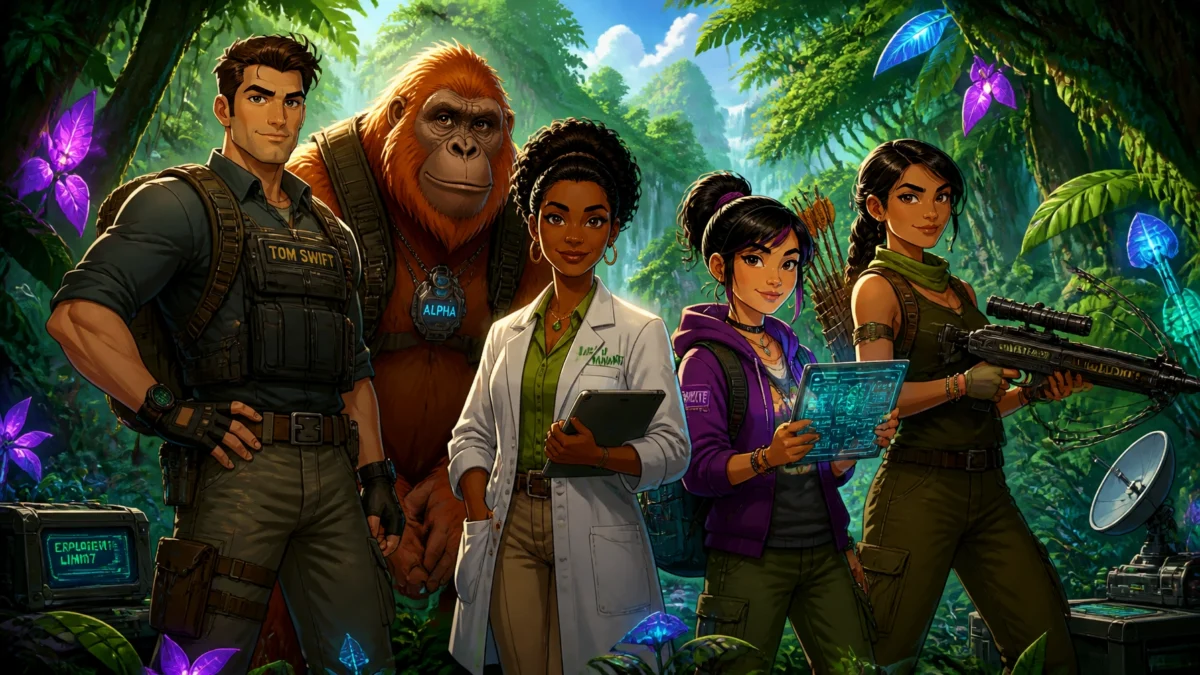
Take Sunbyte, our hacker-nurse. She isn’t fighting the machines; she’s using her skills to take over the machines that are causing deforestation. Or look at Alpha, an orangutan who isn't just a "wild animal": he’s a genius-level teammate who uses high-tech interfaces to coordinate the team. Technology is a tool, and in the right hands, it’s the greatest weapon the rainforest has.

2. The "Chosen One" Loner Trope
A lot of sci-fi environmentalism relies on a single hero who has a mystical connection to the earth. They go off into the woods, talk to the trees, and save the world by themselves. While that makes for a nice solo journey, it’s not how real environmental protection works: and it’s not nearly as fun as a team dynamic.
The Fix: Build a Specialist Crew
Environmentalism is a team sport. Tom "Primal" Swift might have superhuman strength, but he’d be lost without Dr. Mubari’s scientific expertise or Jungle Dart’s deep knowledge of the terrain. When you create a squad where everyone has a specific role: science, muscle, tech, and tactical: the stakes feel higher because they have to rely on each other to survive. Meet the full team here to see how these dynamics play out in Primal Awakening.
3. Creating "Cartoon" Corporate Villains
We get it: Bossman is a great name for a villain. But if your antagonist is just a guy in a suit who wants to "destroy the world because money," the story can feel a bit thin. Real-world threats are more complex than just "I love pollution."
The Fix: Complex Motivation and Legacy Threats
In The Rainsavers, the threat isn't just one greedy CEO. It’s a legacy of power that stretches back decades. When we talk about the villains in our series, we look at characters like Leonard West. He isn't just looking for a paycheck; he's hunting for ancient German technology and lost weapons from the WWII era.
By tying modern environmental threats to historical mysteries and exotic science (like the pursuit of bioweapons designed to mutate life), the conflict becomes a chess match of ideologies rather than just a bank heist. It makes the fight for the Amazon feel like a fight for the soul of history itself.
4. Forgetting the "Science" in Sci-Fi (The Magic Fix)
Mistake number four is the "Gaia Ex Machina." This is when the planet suddenly grows arms and legs (metaphorically) and solves the problem for the heroes. A magical tree or a planetary consciousness just "fixes" the climate in the final chapter, and everyone goes home happy.
The Fix: Grounded (But Awesome) Science
In The Rainsavers: Curse of the Spirit Tree, the Spirit Tree is powerful, but it’s not a magic wand. It’s linked to Red Mercury, a rare and volatile substance that powers ancient weapons and fusion reactors.
When the science has rules, the heroes have to make harder choices. If the tree starts causing chaos, Primal has to decide: do I destroy the very thing I’m trying to protect to save the rest of the forest? That’s not a magic fix; that’s a gut-wrenching dilemma.

5. Limiting the Scope to a Single Forest
Environmentalism in fiction often gets "stuck in the woods." The story takes place in one forest, and if that forest is saved, the book ends. But environmental issues are global (and sometimes even galactic).
The Fix: The Global (and Lunar) Expedition
If you want your readers to feel the stakes, you have to show how the environment affects everything. The Rainsavers don’t just sit in the Amazon. Their journey takes them to:
- Antarctica to stop bioweapons in Tempest of the Crimson Skies.
- The Giza Pyramids to stop a fusion reactor.
- An abandoned German moonbase in Shadow of the Moon.
When you show that a threat to the rainforest is actually a threat to the entire planet: and even our lunar outposts: the "environmental" part of the story feels as epic as any space opera.
6. Misanthropy: "Humans Are the Virus"
There’s a trend in some sci-fi to suggest that the only way to save the Earth is to get rid of the humans. It’s a pretty dark and, frankly, depressing way to tell a story. If the reader is human, they probably want a reason to believe that humanity is worth saving.
The Fix: Focus on Stewardship and Action
The Rainsavers isn't about humanity being the problem; it’s about humanity being the solution. Tom Swift and his team are proof that when humans (and one very smart orangutan) step up, they can stop the destruction. We focus on the "save the Earth" theme as an adventure: an act of heroism rather than a source of guilt.
Our readers enjoy the pulp adventure style because it’s about taking action. Whether it’s fighting off a mutated bioweapon or stopping Mortalis from seizing power, the message is always: We can fix this.

7. Ignoring the "Oops" Moments
Perfect heroes are boring. If your eco-warriors never make a mistake, never break a piece of equipment, or never accidentally cause a mini-disaster while trying to stop a big one, they don't feel real.
The Fix: The "Field Notes" Approach
We love "oops" moments. Whether it’s Alpha accidentally hacking into a satellite he wasn’t supposed to, or Primal underestimating his own strength and breaking a vital piece of Dr. Mubari’s equipment, these moments humanize the mission. Environmental protection is messy, and your story should reflect that. It’s about the "Field Notes": the lessons learned through trial, error, and a whole lot of explosions.
Ready to Join the Adventure?
Science fiction environmentalism doesn't have to be preachy or predictable. It can be a high-octane, six-book saga that takes you from the canopy of the Amazon to the craters of the moon. It can have ancient mysteries, German technology, and a hero with the strength to punch through corporate greed.
If you’re ready to see how we fixed these mistakes and built an epic world where the planet fights back alongside its protectors, it’s time to start the journey.
Grab Book One, Primal Awakening, and join the Rainsavers today.
Explore the Series at Rainsavers.com

