
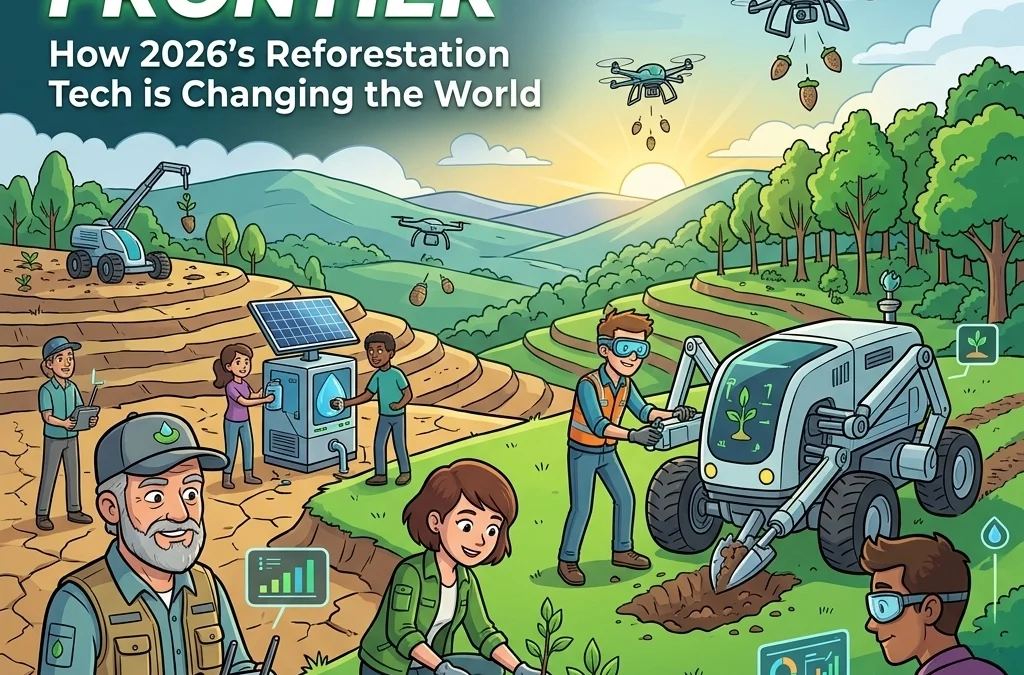
Meta Description: Exploring the incredible reforestation tech of 2026, from seed-firing drones to AI forest twins. See how the world is turning green again and how The Rainsavers are helping lead the charge!
Alt text: A high-tech reforestation drone flying over a lush, vibrant rainforest, actively dispersing seed pods into the fertile ground below.
Hey there, fellow earth-lovers! Can we just take a second to appreciate how far we’ve come? It’s April 2026, and if you’d told me five years ago that we’d be watching swarms of drones rebuild the Amazon like a synchronized dance troupe, I probably would have asked which sci-fi novel you were reading.
But here we are. The "Green Frontier" isn't just a catchy title for a blog post; it’s the reality we’re living in right now. At The Rainsavers, we’re all about those epic tales where heroes save the planet, but lately, the real-world tech is giving our favorite fiction characters a run for their money.
Let’s dive into the cool gadgets and brainy systems making the world a whole lot leafier this year.
1. Drones: The New "Johnny Appleseeds" (But Way Faster)
Remember the old days when reforestation meant a few brave souls with shovels and bags of saplings, trekking through mud for weeks? We still love that dedication, but man, have things changed.
In 2026, drone-powered planting has moved from "experimental" to "essential." These aren't your average backyard hobby drones. We’re talking about heavy-duty, autonomous reforestation units that can plant thousands of trees in a single afternoon.

How does it work? It’s basically like a paintball gun for the planet. These drones are equipped with pressurized canisters that fire nutrient-rich seed pods directly into the soil. These pods are specially designed with a mix of seeds, fertilizer, and a little "secret sauce" of moisture-retaining hydrogel to give them the best start possible.
The best part? It’s cutting costs by nearly 70%. That means every dollar donated to green causes goes three times as far as it used to. Plus, these drones can reach cliffs, scorched mountain faces, and dense wetlands where humans simply can't go. It’s literal life falling from the sky.
2. AI and "Digital Twins" of the Forest
It’s one thing to throw seeds at the ground; it’s another thing to make sure they actually grow. That’s where our new AI overlords (the friendly, tree-loving kind) come in.
In 2026, we don't just "plant and pray." We use Digital Twins. AI systems now create virtual 3D models of entire ecosystems. By analyzing satellite imagery, local climate data, and soil health, these programs can predict exactly which species will thrive in a specific 5-foot patch of land.
At The Rainsavers, we’ve always written about the "wisdom of the woods," but seeing it visualized through a high-def AI map is something else entirely. These systems can track:
- Tree Density: Making sure we don't overcrowd the new guys.
- Carbon Storage: Calculating exactly how much CO2 our new forests are munching on.
- Cooling Effects: Mapping how the new canopy is lowering local ground temperatures (a literal lifesaver in those hot summer months!).
It’s like playing a real-life version of a world-building game, except the rewards are clean air and a stable climate. Pretty sweet deal, right?
3. The "Internet of Trees" (Yes, Really)
You’ve heard of the Internet of Things, but have you met the Internet of Trees? 2026 has brought us biodegradable soil sensors that are quite literally "the eyes and ears" of the forest floor.
These tiny sensors are dropped alongside the seeds. They monitor moisture levels, nitrogen, and temperature in real-time. If a newly planted section of the forest is getting too dry, the system alerts local water-management drones (or human teams) to intervene before the saplings are lost.

And get this, the sensors are designed to break down into harmless organic matter after a few years. They do their job, then they turn into fertilizer. It’s the ultimate "leave no trace" technology. It’s that kind of clever engineering that makes us at The Rainsavers so excited about the future of our planet and our stories.
4. Blockchain: The Shield Against the Chainsaw
Wait, blockchain? For trees? Stick with me here.
One of the biggest hurdles in reforestation hasn’t been planting trees, it’s keeping them there. Illegal logging has been a villainous plot point in many of our stories, but in the real 2026, we have a new tool to fight back.
Blockchain technology is now being used to create "Digital Birth Certificates" for trees. From the moment a drone fires a seed pod into the ground, that tree has a digital record. When that forest grows, any timber sourced from managed areas is tracked through a transparent ledger.
If a piece of wood doesn't have a verifiable digital history, it doesn't get bought. It’s making it harder and harder for the "bad guys" to profit from destroying our precious ecosystems. It’s like a superhero’s shield, but made of code and transparency.
5. Democratizing the Greenery
One of the coolest things about reforestation tech in 2026 is that it’s not just for big governments or billionaire corporations anymore.
Companies like Flying Forests have started making this tech available to small-scale landholders. This is huge because nearly 80% of private forest land is owned by families and individuals. By giving them access to seed-launching drones and AI mapping, we’re empowering the "little guys" to be the biggest heroes in the fight against climate change.

Why This Matters to The Rainsavers
You might be wondering, "Why is a book company talking about seed-launching drones?"
Well, besides the fact that it’s objectively awesome, it’s because we believe that the stories we tell shape the world we build. Our fiction explores the bond between humanity and nature, the thrill of adventure, and the hope of a restored world.
Seeing 2026’s tech catch up to our imagination is a dream come true. It proves that when we focus our creativity and our tech on the right things, we can actually move the needle. We’re not just writing about heroes anymore; we’re watching them fly drones, code AI, and plant the future.
Looking Ahead: The Next Frontier
As we move deeper into 2026, the goal is simple: total ecosystem restoration. We aren't just planting "monocultures" (those boring rows of all the same tree). We’re using technology to rebuild the messy, beautiful complexity of old-growth forests. We’re reintroducing native shrubs, grasses, and even fungi to ensure that the trees have a community to live in.
It’s a great time to be alive, and it’s an even better time to get involved. Whether you’re reading about our eco-adventures or supporting real-world reforestation efforts, you’re part of the mission.

Let’s Keep the Momentum Going!
The Green Frontier is expanding every day, but it needs all of us to keep the wind in its sails. The tech is here, the will is there, and the trees are ready to grow.
Are you ready to be a part of the most important adventure of our lifetime?
Join the mission.
Check out our latest eco-adventures and see how you can help us save the world, one story (and one tree) at a time. Visit us at https://rainsavers.com to find your next great read and join a community that gives a hoot about the planet!
Stay green, stay curious, and keep saving those raindrops.
: Penny & The Rainsavers Team
