
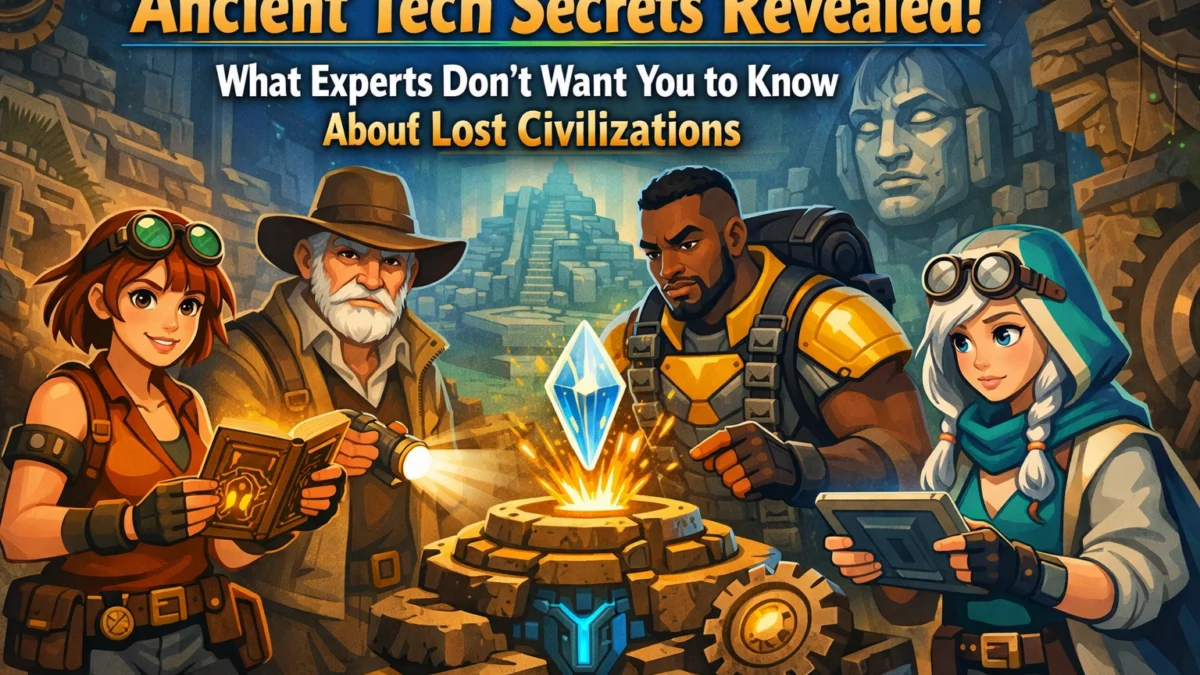
Meta Description: Are we rediscovering lost history or just catching up? Explore the mind-bending ancient tech secrets that experts keep debating, from the Antikythera Mechanism to speculative lost civilizations, and see how they inspire the next generation of eco-adventures in 2026.
Let’s be honest: it’s March 2026, and we’re still arguing about how people thousands of years ago managed to do things that make our modern smartphones look like expensive paperweights.
Welcome back to the blog! I’m Penny, and today we’re diving into the deep, murky waters of "Forbidden Archaeology." You know the stuff, the artifacts that shouldn’t exist, the maps that show landmasses before they were "discovered," and the mechanical wonders that suggest our ancestors weren't just banging rocks together.
At The Rainsavers, we spend a lot of time thinking about the intersection of ancient wisdom and modern survival. Why? Because the secrets of the past often hold the keys to our future. Whether it’s sustainable living or high-octane adventure, there’s a lot we can learn from the "lost" tech of old.
The Bronze Computer: The Antikythera Mechanism
If you want to talk about "experts not wanting you to know something," you have to start with the Antikythera Mechanism. For decades, it was just a "crusty green lump" found in a shipwreck off the coast of Greece.
Then, someone put it under an X-ray.
What they found was a complex system of over 30 bronze gears. This wasn't a piece of jewelry or a simple tool. It was an analog computer designed to track the positions of the sun, the moon, and the planets. It even predicted eclipses with terrifying accuracy.
The kicker? It dates back to roughly 100 BCE. According to "traditional" history, we weren't supposed to have gear technology this advanced for another thousand years. This device proves that ancient civilizations had a grasp of mechanical engineering that we are only just beginning to appreciate.

ALT Text: A tactical expedition team examining a glowing, gear-driven ancient artifact in a damp Mediterranean cave.
When we write our stories at The Rainsavers, we look at devices like this and ask: What else did they have? If they could build a computer out of bronze, did they have hydraulic systems? Advanced water filtration? That’s the kind of stuff that fuels our eco-adventure series.
The "Vimanas": Did Ancient India Have Flight?
Now, let’s step into the more speculative territory. If you’ve ever fallen down a late-night internet rabbit hole, you’ve probably heard of "Vimanas." These are flying machines described in ancient Sanskrit texts like the Ramayana and the Mahabharata.
Some enthusiasts claim these texts describe mercury-vortex engines and complex aerodynamics. While mainstream archaeologists tend to view these as mythological metaphors, the level of detail in the descriptions is… well, it’s a lot. They describe pilot uniforms, flight paths, and even "weapons of the gods" that sound suspiciously like modern tech.
Whether these were literal flying machines or just the peak of ancient science fiction, they represent a level of imagination that matches our own 2026 tech-obsessed culture. In our books, we love exploring the idea of "what if?" What if some of these "myths" were actually based on lost, sustainable technologies that didn't rely on fossil fuels?
The Deep Secrets of Giza: Muons and Hidden Voids
We can’t talk about lost tech without mentioning the Pyramids. By 2026, we’ve moved past the "it was just a tomb" narrative. With muon tomography (using cosmic rays to see through solid stone), scientists have confirmed massive, hidden voids inside the Great Pyramid that no one can explain.
Some speculative researchers suggest the pyramids weren't just monuments, but giant power plants or water pumps. They point to the traces of chemicals found in the internal shafts and the precision of the granite casing.

ALT Text: High-tech scanning equipment reflecting off the stone walls of a hidden Egyptian chamber.
Experts often dismiss these "Power Plant" theories because they don't fit the established timeline of human development. But at The Rainsavers, we think the "Why" is just as important as the "How." If the ancients were building massive structures to manage energy or water, they were the original environmental heroes. They were the first ones trying to "save the rain," so to speak.
Check out our take on ancient mysteries vs. modern threats to see how these secrets create the perfect backdrop for a thriller.
The Dropa Discs and the "Alien" Connection
Wait, it gets weirder. Have you heard of the Dropa Discs? Allegedly found in the mountains of China, these stone discs were said to be inscribed with tiny hieroglyphics telling the story of a spacecraft that crashed 12,000 years ago.
Now, full disclosure: the evidence for the Dropa Discs is shaky at best, and many experts consider it an urban legend. But the story persists. Why? Because we have a deep-seated feeling that we aren't the first "advanced" civilization to walk this planet.
In the world of The Rainsavers characters, we don't necessarily need aliens to explain the past. Human ingenuity is more than enough. But the idea that there is "forbidden knowledge" hidden in plain sight? That’s a theme that runs through everything we do.
Why 2026 is the Year of Rediscovery
Why are we talking about this now? Because the world is changing. As we face modern environmental challenges, we’re realizing that our current "advanced" tech might not be the only way to solve problems.
We’re seeing a resurgence in "Low-Tech" solutions that are actually incredibly high-concept:
- Roman Concrete: It actually gets stronger over time and can heal its own cracks. We’re only just figuring out how they did it.
- Mayan Aqueducts: They managed water pressure without electricity.
- Persian Wind Towers: Natural air conditioning that uses zero power.
The "experts" might not want to admit that we’ve lost more knowledge than we’ve gained, but the evidence is in the dirt. We aren't just writing fiction; we're exploring a philosophy. Our team-based adventures focus on using every tool available: whether it’s a cutting-edge drone or a piece of ancient hydraulic wisdom.

ALT Text: A team of modern explorers using a mix of satellite tablets and ancient stone maps in a lush jungle setting.
Blending the Old with the New
At The Rainsavers, we don't think you have to choose between being a history nerd and a tech enthusiast. Our stories are built on the idea that the "Old Ways" and the "New Tech" can work together to save the planet.
If you’re tired of the same old hero stories and want something that digs a little deeper into the mysteries of our world, you're in the right place. We’re building a universe where the past isn't just a memory: it’s a toolkit.
Whether you're here for the movies, the episodes, or just to browse our shop for some gear, remember: the secrets of the past are only "lost" if we stop looking for them.
See how we blend both at rainsavers.com.
Want more?
- Check out our Down the Rabbit Hole Contest.
- Read why Eco-Fiction is changing the game.
- Cast your vote in our latest Reader Poll.
Stay curious, stay adventurous, and keep saving those raindrops.
( Penny
The Rainsavers Team)
