Meta Description: Deciding between a quick standalone thriller and a massive action-adventure series? In 2026, the "binge" is king. We break down why series like The Rainsavers offer the character growth and world-building you crave.
ALT text: A Rainsaver operative in tactical gear checking a digital map in the Amazon rainforest.
Hey there, fellow adventurers. Steven G. Samuels here, CEO of The Rainsavers.
It’s May 2026, and if you’re like me, your "to-read" pile is probably taller than a jungle canopy right now. We’re living in a golden age of storytelling where we can devour an entire narrative arc in a weekend. But that brings us to the ultimate reader’s dilemma: Do you go for the quick, one-and-done standalone thriller, or do you commit to the multi-book epic?
As someone who spends my days (and way too many nights) thinking about how to craft the perfect pulse-pounding experience, I’ve got some thoughts on this. While a standalone can be a fun sprint, there’s something about a deep-dive series that just hits different in 2026.
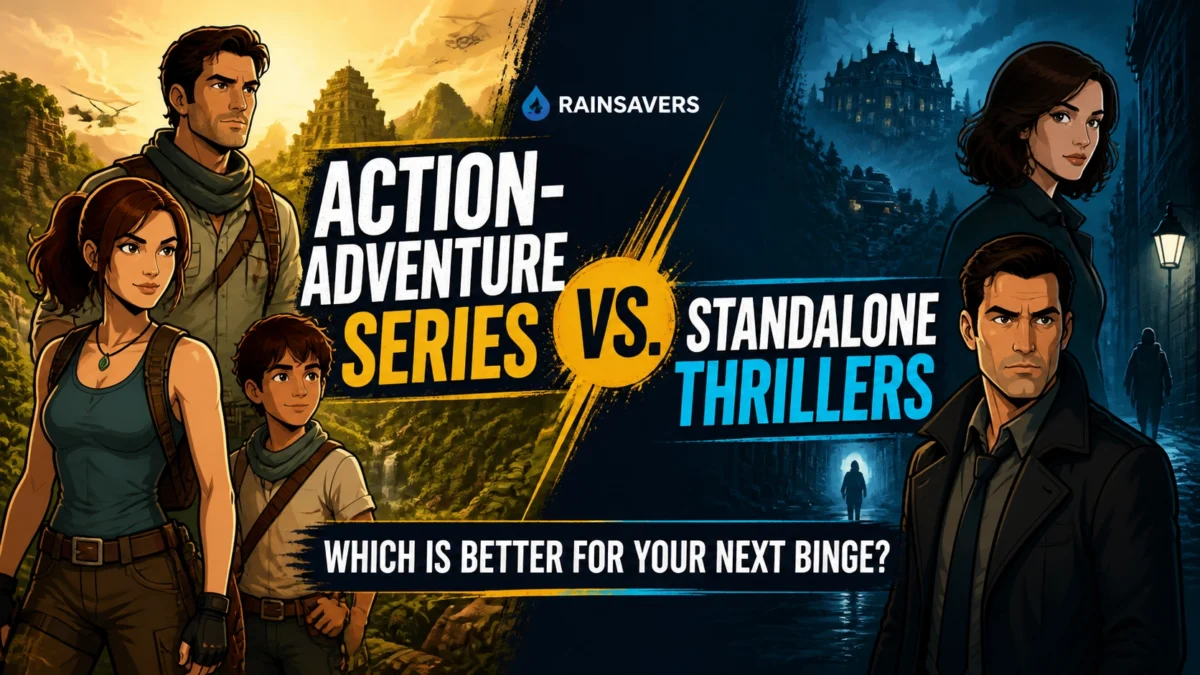
Let’s break down the "Series vs. Standalone" showdown and see which one deserves your next precious weekend binge.
The Standalone Thriller: The "One-Night Stand" of Fiction
Don’t get me wrong: I love a good standalone. It’s like a high-octane movie. You meet a protagonist, they have a really bad day (usually involving a ticking clock and a shadowy villain), and by page 350, the world is saved, the bad guy is in handcuffs, and everyone goes home.
Standalone thrillers are great for:
- A quick flight across the country.
- Cleansing your palate between longer series.
- Getting a fast resolution without having to remember what happened three books ago.
But here’s the rub: once it’s over, it’s over. You spend ten hours getting to know a hero, finally start to care about their weird coffee habits and their tragic backstory, and then… poof. They vanish. You’re left standing on the curb, wondering what they did the next day. In 2026, when we’re looking for deeper connection and escapism, that can feel a little hollow.
The Action-Adventure Series: The Full Immersion
Now, let’s talk about the series experience: specifically the kind of "multi-book epic" we’re building here at The Rainsavers.
When you pick up a series, you aren't just reading a book; you’re moving into a new neighborhood. You’re signing up for a tour of duty with a team you’ll eventually know as well as your own friends. In an action-adventure series, the stakes don't just reset at the end of every volume. They compound.
1. Character Growth That Actually Matters
In a standalone, characters usually have a "flat arc" or a very quick realization. But in a series like ours, you get to watch operatives evolve. You see them fail in Book One, carry the scars (physical and mental) through Book Two, and finally find redemption in Book Three.
Think about our team. When you first meet them, they might be specialists who don’t quite trust each other. By the time you’re deep into the episodes, they’re a lethal, synchronized unit. You’ve seen their arguments, their close calls, and the moments they almost gave up. That kind of emotional payoff only happens when you have thousands of pages to let the story breathe.

Placeholder: A close-up of high-tech tactical gear, focusing on a rugged, scuffed field respirator used by an operative.
2. World-Building You Can Get Lost In
World-building isn't just for sci-fi or fantasy. In modern action-adventure, the "world" is the intersection of our reality and the mysteries hidden just beneath the surface.
When we write The Rainsavers, we aren't just throwing a dart at a map. We’re building a persistent universe. If an operative uses a specific piece of tech: like those high-tech field respirators designed for the oxygen-thin altitudes of the Andes or the toxic depths of an ancient German bunker: that tech exists for a reason. You’ll see it improved, see it fail, and see it become a staple of the team’s kit.
In a series, the setting becomes a character itself. Whether it’s the humid, dangerous beauty of the Amazon or the cold, calculated hallways of a corporate villain's lair, you get to explore every nook and cranny. You start to understand the geopolitics, the environmental stakes, and the ancient mysteries that tie everything together.
Why the "Field Operative" Vibe Wins in 2026
We’ve noticed a shift in what readers want lately. People are moving away from the "invincible solo superhero" and gravitating toward the "tactical team." There’s something incredibly satisfying about reading a story where the heroes win because of their gear, their training, and their coordination: not because they have magic powers.

Placeholder: A team of four Rainsaver operatives moving through a dense jungle at dusk, their silhouettes defined by the glowing HUDs on their wrist-mounted computers.
That’s why we lean so hard into the tactical expedition look. We want you to feel the weight of the backpack. We want you to smell the ozone after a piece of tech short-circuits. When you binge a series, that immersion becomes second nature. You start thinking like a field operative. You start wondering how you would handle a breach or an environmental collapse.
If you’re feeling the weight of the world lately: and let’s face it, climate anxiety is a real thing in 2026: a series allows you to process those themes over a long period. It’s not just a "jump scare" of a plot point; it’s an exploration of how we survive and thrive in a changing world.
The "Binge" Factor: Why You Can't Stop at One
There is a specific physiological high that comes from finishing Book Two and knowing Book Three is already waiting on your nightstand. It’s the "just one more chapter" syndrome, multiplied by an entire library.
With a series, the cliffhangers aren't just about "who survived the explosion?" They’re about "how does this change the mission?" Every book is a building block in a much larger, more complex puzzle. For those of us who love puzzles: especially ones involving ancient technology and modern threats: a standalone thriller can feel like getting only one piece of a 1,000-piece set.

Placeholder: A digital map overlay showing a secret base hidden within a mountain range, with tactical icons indicating a planned infiltration route.
The Verdict
So, which is better for your next binge?
If you want a quick hit of adrenaline and a clean slate by Monday morning, go for a standalone. There’s no shame in a fast-paced thriller that does exactly what it says on the tin.
But if you want to lose yourself. If you want to care about the people on the page as if they were your own team. If you want to see a world where heroes use real tech and real grit to solve the biggest problems of 2026… then you need a series.
You need something that scales. You need a story that grows as you read it.
We’ve put everything we have into making The Rainsavers the kind of series that makes you forget to check your phone. From the tactical gear to the deep-seated mysteries of the Amazon and beyond, it’s built for the long-haul reader.
Are you ready to join the mission? The gear is prepped, the team is waiting, and the first mystery is just a page-turn away. Don't settle for a story that ends before it really begins.
Read Book One now and start your 2026 adventure.
Want to dive deeper into the world? Check out our Characters page to meet the team you’ll be binging with, or see why team-based adventures are taking over the fiction world this year.
