
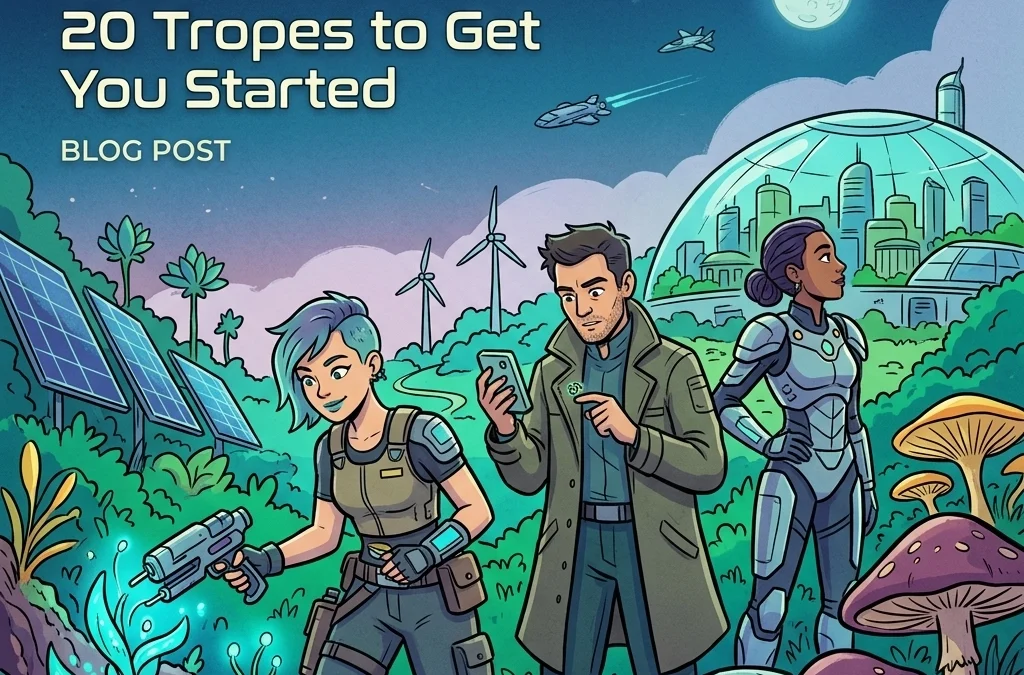
Meta Description: Dive into the world of eco-sci-fi! From holographic canopies to bio-integrated tech, here are 20 essential science fiction environmentalism tropes and how The Rainsavers brings them to life in the heart of the Amazon.
ALT text: A Rainsaver operative in tactical gear and a high-tech respirator surveying a bioluminescent jungle.
Hey there, Rainsaver fans! Steven G. Samuels here, CEO and your resident guide through the wild world of 2026 fiction.
We’ve all seen the news lately: the world is changing fast, and the way we tell stories is changing with it. "Climate Fiction" or "Eco-Sci-Fi" isn't just a niche category anymore; it’s the pulse of modern adventure. People are tired of solo superheroes punching their way through problems that require a team and a scientific solution. They want something that feels real, even when it’s set in the future.
At The Rainsavers, we pride ourselves on building a world that respects the science while keeping the adrenaline at max capacity. Whether you're a writer looking for inspiration or a reader trying to spot the gears turning in your favorite series, here are 20 tropes of science fiction environmentalism to get you started: and a look at how we use them in our own backyard (the Amazon).
1. Holographic Canopies
This is a classic for a reason. Imagine walking into a lush jungle, only to realize the "leaves" are pixels. In sci-fi, these are often used to hide the scars of industry or provide a psychological "mask" for a dying planet.
The Rainsavers Spin: In our world, we use tactical holographic projectors to hide our base of operations from corporate drones. It’s not about faking nature; it’s about using nature’s image as the ultimate camouflage.
2. Bio-integrated Tech
Why carry a heavy battery when your suit can photosynthesize? Bio-integrated tech blurs the line between organism and machine.
The Rainsavers Spin: Our team uses gear that feeds off the humidity and bio-energy of the jungle. Check out the high-tech respirators our field agents wear: they don’t just filter air; they refine it using moss-based filtration systems.

Caption: A close-up of a Rainsaver field respirator showing the organic moss-core filtration system glowing softly.
3. Ancient Eco-Reactors
Found technology is a staple of sci-fi. These are power sources left behind by ancient civilizations (or secret research groups) that run on clean, planetary energy.
The Rainsavers Spin: We love a good mystery. In Primal Awakening, Leonard West stumbles upon technology that looks suspiciously like 1940s German engineering, but modified to work with the Amazon’s natural rhythms. It’s a mix of history and futuristic mystery. Read more about ancient tech vs modern threats here.
4. The "Green Aesop"
This is the central moral of the story: nature is worth saving, and if we don't, it will fight back.
The Rainsavers Spin: We try to avoid being preachy. Instead of just telling you "pollution is bad," we show you the tactical reality of what happens when a team of heroes has to survive a jungle that’s been pushed to its breaking point.
5. The Ecocidal Antagonist
Think of the corporate CEO who wants to pave paradise. These villains view the planet as a resource to be extracted, not a home to be protected.
The Rainsavers Spin: Our villains aren't just mustache-twirling polluters. They are calculated, high-tech conglomerates who believe they are "optimizing" the Earth. This makes the fight much more dangerous for Leonard and the crew.
6. Atmospheric Scrubbing Drones
In many eco-sci-fi futures, the air is unbreathable without massive fleets of drones cleaning the CO2 out of the sky.
The Rainsavers Spin: We keep it ground-level. Our "scrubbers" are tactical devices deployed during missions to neutralize chemical toxins released by illegal mining operations.
7. The Sentient Jungle
The idea that the forest is "watching" or "thinking." It’s not magic: it’s a complex network of fungal signals and chemical triggers.
The Rainsavers Spin: We lean into the science of the "Wood Wide Web." The Amazon in The Rainsavers reacts to our team. Sometimes it helps; sometimes it’s an obstacle they have to navigate with surgical precision.
8. Domed Cities
The classic image of humanity huddled under glass while the world outside burns.
The Rainsavers Spin: We flip this. The Rainsavers leave the safety of the hubs to enter the "Wild Zones." We believe the real story happens where the dome ends and the dirt begins.
9. Genetic Seed Vaults
High-stakes repositories of Earth’s DNA. In sci-fi, these are often the "MacGuffin" that everyone is fighting over.
The Rainsavers Spin: In our series, the "vault" isn't a building; it’s the Amazon itself. Protecting the biodiversity of the rainforest is the ultimate mission.
10. Weather-Warfare
Using the environment as a weapon. Changing rain patterns or creating storms to destabilize a region.
The Rainsavers Spin: Our team has to deal with localized "climate spikes" caused by illegal atmospheric tech. It’s hard to stay in a tactical formation when a flash flood appears out of nowhere in 2026.

Caption: A Rainsaver operative using a handheld sensor to track an incoming artificial storm cell.
11. Fungal Data Networks
Using the mycelium in the soil to transmit data across long distances without satellites.
The Rainsavers Spin: When the corporate villains jam our radio signals, Leonard and the team have to find older, more "organic" ways to communicate. It’s low-tech meets high-tech in the best way possible.
12. Carbon-Negative Infrastructure
Buildings and gear that actually clean the environment just by existing.
The Rainsavers Spin: The Rainsaver HQ is a marvel of field-ready engineering. It’s designed to leave zero footprint, literally. We leave the jungle exactly as we found it, which is harder than it looks when you're fighting off mercenaries.
13. Reclaimed Ruins
Nature growing over the bones of the "old world."
The Rainsavers Spin: We love exploring abandoned research labs from the mid-20th century. Seeing a state-of-the-art 1940s German computer terminal covered in bioluminescent vines? That’s our aesthetic.
14. Bioluminescent Navigation
Using glowing plants or fungi to mark trails in the dark.
The Rainsavers Spin: Our operatives use specialized goggles that pick up the UV signatures of specific jungle mosses. It’s like a natural GPS that can’t be hacked.
15. Hydro-Conservation Suits
Suits designed to recycle every drop of moisture. Essential for water-scarce futures.
The Rainsavers Spin: In the Amazon, we have the opposite problem: too much water. Our "Rainsaver" suits are designed to manage the torrential downpours, turning the rain into a tactical advantage rather than a hindrance.
16. Nano-Remediation
Microscopic robots designed to eat plastic or oil spills.
The Rainsavers Spin: Sometimes the "tech" goes wrong. Our team often has to clean up "rogue" nano-experiments that were supposed to help the environment but started eating the native flora instead.
17. Synthetic DNA Restoration
Bringing back extinct species to balance an ecosystem.
The Rainsavers Spin: We deal with the consequences of "De-Extinction." Imagine facing off against a predator that hasn't been seen in the Amazon for a thousand years, all because a corporation wanted a "living asset."
18. Solar-Powered Tactical Gear
Silencing the battlefield by removing the need for loud generators.
The Rainsavers Spin: Stealth is everything. Our team’s reliance on solar and kinetic energy makes them the ghosts of the forest. Learn more about our "field ready" philosophy here.
19. The "Oxygen Bar" / Air Scarcity
A world where you pay for every breath.
The Rainsavers Spin: While the rest of the world might be gasping, the Amazon is the lungs of the planet. Protecting that air supply is why the Rainsavers exist. It’s the ultimate high-stakes resource war.
20. Bio-Sourced Weaponry
Moving away from lead and gunpowder toward enzymes, pheromones, or pressurized water.
The Rainsavers Spin: We prefer non-lethal, eco-friendly tactical solutions. Paralyzing a villain with a dart derived from a local frog is much more "Rainsaver" than a grenade.

Caption: Leonard West checking his tactical HUD, which displays the chemical composition of the surrounding air.
Why Does This Matter in 2026?
Look, we know the "solo hero" trope is dying. People don't want to see one guy save the world anymore; they want to see a team of experts: scientists, soldiers, and strategists: working together to solve global problems. That’s why The Rainsavers focuses on the group dynamic. Whether it's Leonard's leadership or the technical genius of the support staff, it takes a village to save a jungle.
If you’re feeling a bit overwhelmed by the state of the world (we call it "climate anxiety" in the biz), fiction is a great way to process those feelings. It turns the "big scary problem" into a "big exciting adventure." If you're struggling with climate anxiety, check out our guide on how adventure stories can help.
The Amazon is a big place, and we’re just getting started exploring it. These 20 tropes are the foundation, but the real story is in the dirt, the rain, and the pulse of the jungle.
Are you ready to join the expedition?
Read Book One: Primal Awakening now
https://rainsavers.com
Stay field-ready,
Steven G. Samuels
CEO, The Rainsavers
