
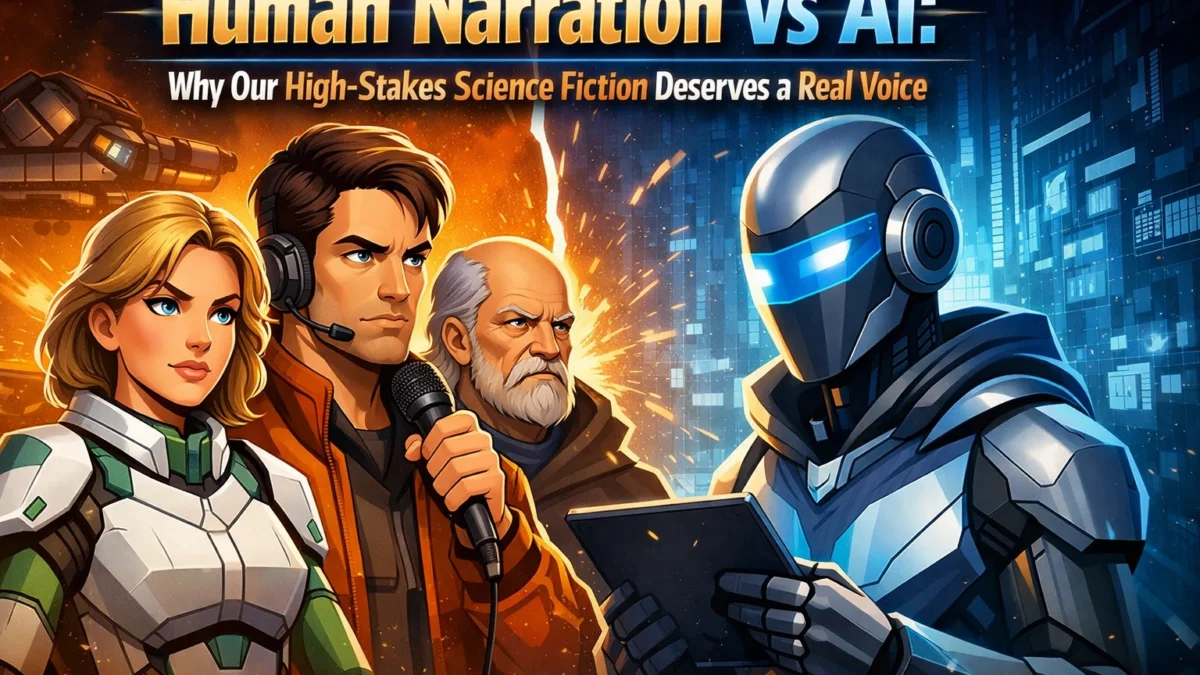
Meta Description: In 2026, AI voices are everywhere, but can they truly capture the soul of high-stakes science fiction? Explore why The Rainsavers prioritizes human narration for the emotional depth of characters like Dr. Mubari and Alpha.
Alt text: A thoughtful female scientist with grey-streaked hair looking intensely at a complex data visualization, her expression a mix of concern and hope, representing the human emotional core of science fiction.
Hey everyone, Steven G. Samuels here.
It’s July 2026, and if you’d told me five years ago that I’d be having a coffee while my fridge "read" me the morning news in a voice indistinguishable from a seasoned broadcaster, I’d have called you a sci-fi writer. Yet, here we are. AI is everywhere. It’s efficient, it’s fast, and it never needs a lozenge or a glass of water.
But at The Rainsavers, we’re in the business of stories. Not just "content," but stories that make your heart race and your palms sweat. When we talk about our high-stakes science fiction, the kind that involves time-bending missions and the literal fate of the planet, we have to ask ourselves: Is an algorithm enough to carry that weight?
The short answer? Not even close. Here is why we’re still doubling down on human soul in a world of silicon voices.
The Dr. Mubari Factor: More Than Just Data
If you’ve been following our character bios at rainsavers.com/characters, you’ve met Dr. Mubari. She isn't just a collection of tropes. She is a brilliant scientist who carries the weight of the world on her shoulders. When she discovers a breakthrough that could stop a climate catastrophe, or when she realizes a mission has gone sideways, that moment isn't just "information." It’s an explosion of human feeling.
AI narration, as of 2026, is incredible at being consistent. It can read a technical manual without a single stutter. But when Dr. Mubari’s voice needs to crack, just a tiny bit, because she’s thinking about the future of her children while facing a shadow from the past, the AI misses it.
A human narrator understands the subtext. They know that sometimes, a silence says more than the words themselves. When Dr. Mubari is navigating a high-stakes encounter with historical forces, like the remnants of German WWII military technology hidden in a secret bunker, the narrator needs to convey the visceral terror and the historical gravity of that moment. An AI gives you the words; a human gives you the shiver down your spine.

Alt text: Dr. Mubari standing in a dimly lit laboratory, holding a glowing ancient artifact, with a look of intense focus and determination on her face.
The "Oops" Moments and Alpha’s Wisdom
Speaking of humans (and those who act quite a bit like them), let’s talk about Alpha. If you haven’t met our favorite highly intelligent orangutan yet, you really should. Alpha is a core member of The Rainsavers team, and let’s be honest, he’s probably smarter than most of us.
We recently did a test run where we fed a high-tension scene featuring Alpha into a top-tier 2026 AI voice generator. In the scene, Alpha has to perform a delicate override on a terminal while the facility is flooding. It’s frantic. It’s "oops" territory where every second counts.
The AI read it like he was describing a trip to the grocery store. It was sterile. It was detached.
When our human narrator took a crack at it, you could hear the heavy breathing, the frantic tapping of Alpha’s fingers, and that specific guttural sound he makes when he’s frustrated. You felt like you were in the room, getting your boots wet. That sensory immersion is the difference between being told a story and living it.
Human narrators instinctively know how to hit the emotional beats that transform a plot description into an experience. They understand the stakes because they are, well, human. (Or at least, they share a planet with orangutans).
Gravity and the German WWII Context
In our "Down the Rabbit Hole" series, we often deal with some pretty heavy historical elements. We explore alternative histories and the lingering shadows of German WWII technology and ideologies.
Writing about these topics requires a certain level of sensitivity and narrative weight. These aren't just "villains of the week"; they represent real-world trauma and massive historical shifts. When a narrator speaks about the horrors of that era or the high stakes of preventing those ideologies from resurfacing, the tone needs to be perfect.
AI often struggles with complex themes and humor. It can render a joke flat or, worse, make a serious historical reflection sound like a robotic Wikipedia entry. To respect the history and the gravity of the science fiction we write, we need a voice that understands the context. A voice that can convey the somber reality of a German WWII bunker while maintaining the fast-paced energy of a modern eco-adventure.

Alt text: An old, rusted iron door in a concrete bunker, partially reclaimed by jungle vines, hinting at a hidden German WWII history.
The 2026 Reality: Why We Blend
Now, don't get me wrong. I’m not a Luddite. I’m the CEO of a company that loves tech! We use AI for all sorts of things behind the scenes: it helps us organize timelines, check for continuity errors in our massive lore bibles, and even helps us brainstorm the technical specs of a futuristic rain-saving device.
But when it comes to the final product that reaches your ears? That’s where we draw the line.
We believe that the future of entertainment isn't about AI replacing humans; it’s about humans using the best tools to tell better stories. For us, that means human voices at the forefront, supported by the best production tech 2026 has to offer.
Our fans have told us time and again: they want to feel connected to the characters. They want to feel like they’re part of the team, standing right there with Dr. Mubari and Alpha. You can’t build that connection with a voice that doesn't have a heartbeat.
What’s Next for The Rainsavers?
As we move toward the end of the year, we’re amping up our production. We’re looking for new ways to bring you into the world of The Rainsavers, whether through our episodes or our upcoming projects.
We’re also keeping the fun alive. If you haven't checked out our Down the Rabbit Hole Contest, you’re missing out. It’s a chance to dive deep into the lore and maybe even win something cool.
Look, we know the world is changing fast. By 2027, AI voices might be even better. But there will always be something special about the human voice: the way it trembles, the way it speeds up during an action sequence, and the way it brings a character like Alpha to life in a way that feels real.
We’re committed to that "realness." We’re committed to the shivers, the laughs, and the high-stakes thrills that only a human can truly deliver.

Alt text: Alpha the orangutan wearing a small headset and looking curiously at a professional microphone in a recording studio.
Thanks for being on this journey with us. Whether you’re here for the eco-adventure, the historical mysteries, or just to see what Alpha gets into next, we’re glad you’re part of the team.
See how we blend both at https://rainsavers.com.
Stay adventurous,
Steven G. Samuels
CEO, The Rainsavers
Quick Links for the Curious:
- Meet the full cast: Characters
- Catch up on the story: Episodes
- Shop the gear: Shop
- Read more about our mission: Why Eco-Fiction Matters

Alt text: A lush, green rainforest canopy with a futuristic, sleek aircraft flying low over the trees, representing the blend of nature and technology.
