
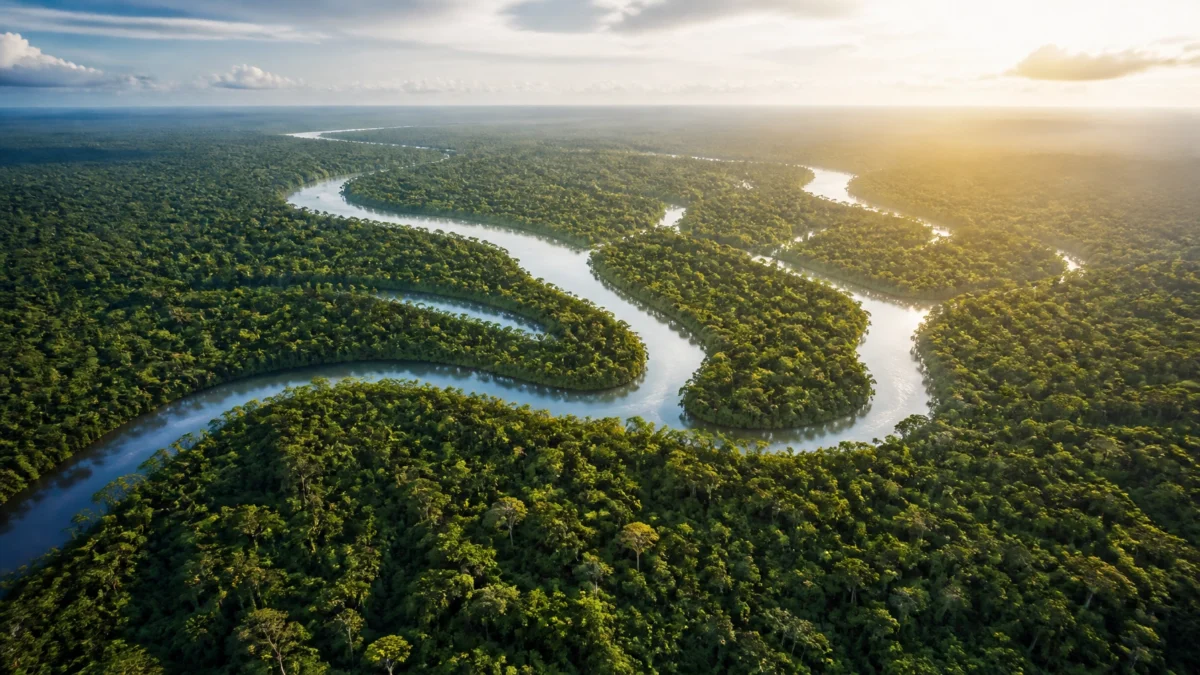
If you’ve been following the adventures of Tom "Primal" Swift and his crew in The Rainsavers series, you know that the stakes are usually "end-of-the-world" high. Between ancient German technology, red mercury crystals, and moonbase-dwelling villains like Mortalis, the Amazon rainforest in our books is a place where every acre is a battlefield.
But this week, reality decided to give our fiction a run for its money.
Ecuador has just officially recognized a massive 173,000-hectare rainforest connectivity corridor. For those of us who spend our days writing about heroes fighting to save the "Spirit Tree," this news feels like a literal plot twist in the best possible way. While our characters are out there dodging bioweapons and stopping corporate greed led by the likes of Bossman, real-world conservationists, Indigenous leaders, and governments are pulling off victories that look like they were ripped straight from a final chapter.
In 2026, the battle for the planet is heating up, but for the first time in a long time, the good guys are putting points on the board. Here are five massive conservation wins from this year that prove life is currently beating fiction.
1. The Yasuní-Limoncocha-Cuyabeno Corridor
Imagine three massive, protected islands of life. On their own, they are incredible. But when they are separated by "islands" of deforestation, the animals inside, like the pink river dolphins or the harpy eagles, become trapped. In The Rainsavers, we talk a lot about the "Spirit Tree" and how everything in the forest is connected.
Ecuador’s new corridor is the physical embodiment of that connection. By linking the Yasuní National Park, the Limoncocha Biological Reserve, and the Cuyabeno Wildlife Production Reserve, they’ve created a 173,000-hectare highway for biodiversity. This isn’t just about land; it’s about "ecological connectivity." It means the jaguar can roam, the plants can migrate as the climate shifts, and the entire ecosystem gains a "Primal" level of strength.

2. Brazil’s Deforestation Hits a Decade Low (July 2026)
In our second book, Black Rain, our team has to chase down bioweapons designed to mutate rainforest life. In the real world, the "bioweapon" we’ve been fighting for decades is simply the chainsaw.
As of July 2026, Brazil has reported that Amazon deforestation has hit its lowest point in over a decade. This didn't happen by accident. It happened because of a massive crackdown on illegal logging and a renewed focus on Indigenous land rights. Seeing these numbers come out this month feels like watching Tom Primal finally land a punch on Bossman’s corporate empire. It’s a moment of relief that proves when humans actually decide to protect the Earth, the Earth responds with incredible resilience.
3. Colombia Banning Oil Drilling in the Amazon
If there’s one thing Bossman loves in our series, it’s extracting resources at the cost of the environment. In the real world, Colombia has just taken a massive stand against that "Bossman mindset" by officially banning new oil drilling contracts within its portion of the Amazon.
This is a move that echoes the themes of Primal Awakening. It’s a choice between short-term corporate greed and long-term planetary survival. By choosing the forest over the oil, Colombia is ensuring that the lungs of our planet can keep breathing. It’s the kind of brave, high-stakes decision that usually requires a superhero to enforce, but in 2026, it’s being done through policy and the power of the people.
4. Indigenous AI Fire Detection Systems
In The Rainsavers, we have Sunbyte, our brilliant hacker and tech genius. She’s the one who turns the villains' own technology against them. Well, real life has its own Sunbytes now.
Indigenous communities across the Amazon are now utilizing advanced AI fire detection systems. Using a combination of satellite imagery and acoustic sensors hidden deep in the canopy, these systems can "hear" a chainsaw or "see" a heat signature long before a human patrol could. This tech is then fed directly to Indigenous monitors on the ground.

It’s a beautiful blend of ancient territorial knowledge and cutting-edge science. Just like when Sunbyte hacks into a rogue agent's network to save the team, these AI systems are giving the protectors of the forest a much-needed edge. You can read more about our tech-savvy characters here.
5. Brazil and Peru: A Transboundary Alliance
In Wrath of Mortalis, the final book in our series, the battle for the Spirit Tree becomes a global affair. It’s no longer just one country’s problem. Real-world conservation has reached that same realization.
Brazil and Peru have recently signed a historic agreement to cooperate on protecting Indigenous lands that straddle their shared border. These areas are home to some of the last peoples living in voluntary isolation. By working together, these two nations are creating a massive, cross-border shield of protection. It’s a level of international cooperation that we usually only see when the world is ending in a sci-fi thriller, but here it is: happening right now for the sake of the trees and the people who call them home.
Why Eco-Fiction Matters More Than Ever
You might wonder why we write about ancient German mysteries and moonbases when the real world is so full of drama.
The truth is, stories like The Rainsavers are designed to make us feel like we can win. When you read about Tom "Primal" Swift or Jungle Dart, you aren't just reading about a guy with superhuman strength or a girl who can talk to the forest. You’re reading about the spirit of conservation. You’re reading about the "why" behind the "how."
Fiction allows us to imagine the stakes of losing: like in Curse of the Spirit Tree, where Primal has to choose between the tree and the forest itself. It makes the real-world wins, like Ecuador's 173,000-hectare corridor, feel even more precious. It reminds us that the rainforest isn't just a collection of trees; it’s a living, breathing entity that needs its heroes.

Join the Adventure
We are living in a time where the headlines are starting to look a lot more hopeful. But the fight isn't over. Bossman is still out there (in many forms), and the Spirit Tree still needs its defenders.
If you want to dive deeper into a world where the environment is the ultimate prize, check out the full Rainsavers six-book series. Whether you’re a fan of high-octane action, science fiction, or deep environmental themes, there’s a seat for you on the team.
Real life is doing some incredible things in 2026. Let's keep that momentum going: both in our reading lists and in our backyard.
What do you think of Ecuador's new corridor? Do you think tech like AI is the key to saving our forests? Let us know in the comments!
