

It’s Friday, March 13, 2026, and if you’ve been keeping up with the latest trends in the fiction world, you know that villains are having a major "identity crisis": in the best way possible. Gone are the days of cardboard-cutout bad guys who want to take over the world "just because." Today’s readers, especially those of us following The Rainsavers, want something more complex, more grounded in historical "what-ifs," and significantly more terrifying.
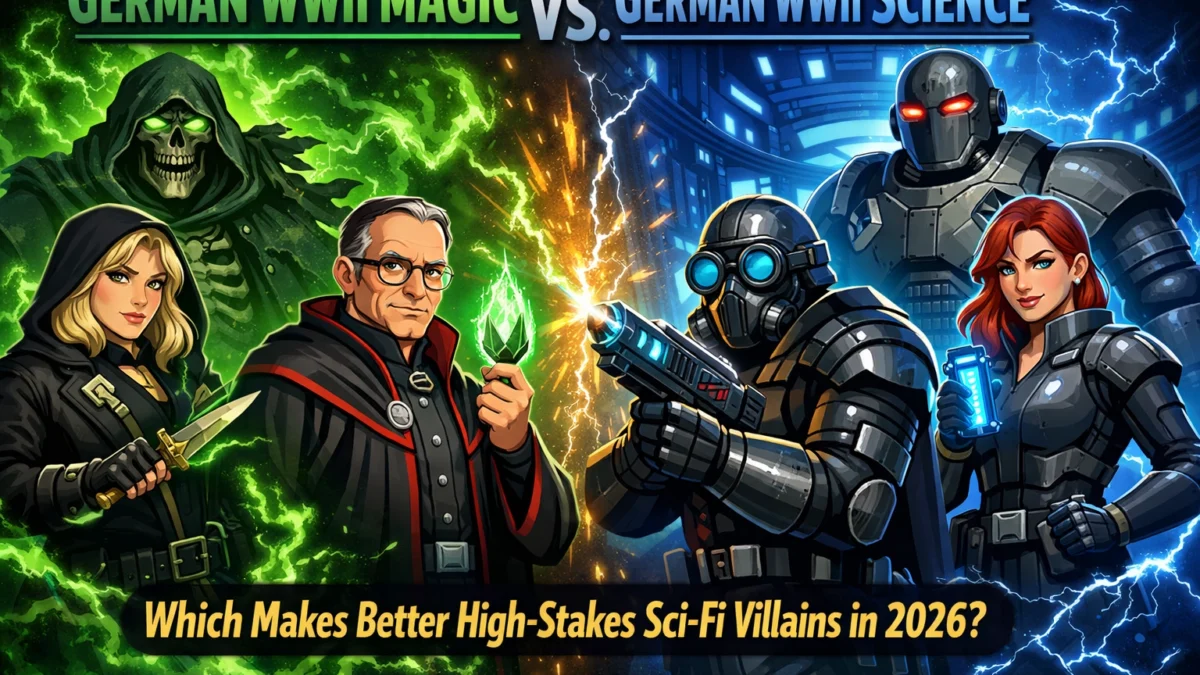
One of the hottest debates in our writers' room (and across the sci-fi community this year) is the battle of the tropes: German WWII Magic vs. German WWII Science.
When we look back at history to find the ultimate high-stakes antagonist, which path creates the most chilling 2026 sci-fi villain? Is it the sorcerer pulling strings from the shadows of the Black Forest, or the cold-blooded engineer perfecting a "World Ice Theory" weapon? Let’s break it down.
The Case for Magic: The "Supernatural Imaginary"
In 2026, we’ve seen a massive resurgence in what scholars call the "supernatural imaginary." Historically, some German WWII leaders were obsessed with blending folklore, mythology, and spiritualism into their political identity. For a fiction writer, this is a goldmine.
Why does magic work so well for high-stakes villains? Because it’s unpredictable. When you have a villain who believes they are backed by ancient Aryan gods or lost Atlantean powers, their logic isn’t bound by the laws of physics. They aren't just trying to win a war; they are trying to rewrite the soul of the planet.

ALT: A mysterious figure in a heavy wool coat standing before an ancient stone monolith glowing with faint, ethereal blue runes in a snowy landscape.
In sci-fi, "magic" is often just "ancient technology we don't understand yet." By framing a German WWII villain through this lens, you create a sense of cosmic horror. It’s not just a man with a gun; it’s a man who thinks he can command the elements. We’ve explored some of these themes in our look at ancient mysteries vs. modern threats, where the motivation becomes much more personal and visceral than simple political conquest.
The Case for Science: The Terror of "Wunderwaffen"
On the other side of the coin, we have the "mad scientist" trope, but with a historical twist. German WWII science wasn't just about rockets and jet engines; it was about "border science." We’re talking about things like "World Ice Theory" (Welteislehre), which suggested that ice was the basic substance of all cosmic processes.
Imagine a 2026 sci-fi villain who has spent decades in a hidden bunker (or a space station) refining this pseudo-science. They aren't using spells; they are using cold, hard, terrifyingly efficient machinery.

ALT: A close-up of a high-tech tactical visor reflecting a blueprint of a massive, futuristic machine powered by glowing canisters.
The horror here comes from the institutionalized nature of the threat. Science-based villains are organized. They have supply chains, research papers, and a terrifyingly logical reason for why they are doing something horrific. In our own stories at The Rainsavers, we often find that the most "unstoppable" villains are the ones who mix this historical mystery with modern sci-fi tech.
Why 2026 Readers Demand Both
So, which is better? As we move deeper into the mid-2020s, the answer seems to be: The Hybrid.
Today’s readers are savvy. They know that historical German WWII occultism was often just a way to justify the horrific experiments they were already doing. The line between "magic" and "science" in that era was incredibly blurry.
Think about it:
- The Magic: Provides the why (the ideological justification).
- The Science: Provides the how (the operational framework).
When you combine a villain who believes in mystical destiny with the technological means to enforce it, you get a high-stakes antagonist that feels truly dangerous. This is exactly why team-based adventure series are dominating lately: you need a whole team of experts just to understand the multi-layered threat of a villain who uses both ancient artifacts and futuristic drones.
The Rainsavers Perspective: Eco-Adventures and History
At The Rainsavers, we lean heavily into the idea that history isn't just in the past: it’s a blueprint for the future. Our heroes often find themselves up against threats that feel like they’ve stepped out of a "border science" lab from 1944, updated with 2026 technology.

ALT: A group of environmental heroes in high-tech field gear standing on a cliffside overlooking a massive, hidden industrial complex in a lush valley.
Whether it’s a villain trying to manipulate the weather using forgotten German WWII theories or an ancient mystery that threatens our current climate, the stakes are always high. We’ve found that the "science" of German WWII makes for a great physical threat, but the "magic" (the occult obsession) makes for a terrifying psychological one.
If you're wondering how we handle these high-stakes clashes, you really need to dive into the books. We don't just write stories; we build worlds where the past is always knocking on the door.
Quick Comparison: Who Wins the Villain Throne?
| Feature | German WWII Magic | German WWII Science |
|---|---|---|
| Aesthetic | Dark forests, runes, artifacts | Bunkers, blueprints, chrome |
| Threat Level | Existential / Spiritual | Physical / Global |
| Weakness | Hubris, specific rituals | Logic, sabotage, technology |
| 2026 Vibe | "Creepy & Mysterious" | "Terrifyingly Efficient" |
In 2026, the "Science" villain often feels more grounded, which makes them scarier in a "this could actually happen" kind of way. But the "Magic" villain adds that layer of "what if there’s something else out there?" that keeps us turning pages late into the night.
The Verdict
If you want a villain that feels like a force of nature, go with magic. If you want a villain that feels like an unstoppable machine, go with science. But if you want a villain that will keep your readers awake at 3:00 AM wondering if the "World Ice Theory" was actually onto something… you have to use both.
At the end of the day, high-stakes sci-fi in 2026 is all about the blend. It’s about taking those weird, dark corners of history and shining a high-tech flashlight on them.

ALT: A sleek, modern handheld scanner projecting a 3D hologram of an ancient, ornate compass.
If you love stories where history, tech, and environmental stakes collide, you’re in the right place. We are obsessed with finding that perfect balance between the mystery of the past and the reality of the future.
Ready to see how we handle the ultimate high-stakes threats?
Read Book One now and join the adventure. The world isn't going to save itself, and these villains aren't waiting for the history books to catch up!
Want more deep dives into the world of eco-fiction and historical mysteries? Check out our blog for more weekly insights from Penny and the team at The Rainsavers.
