
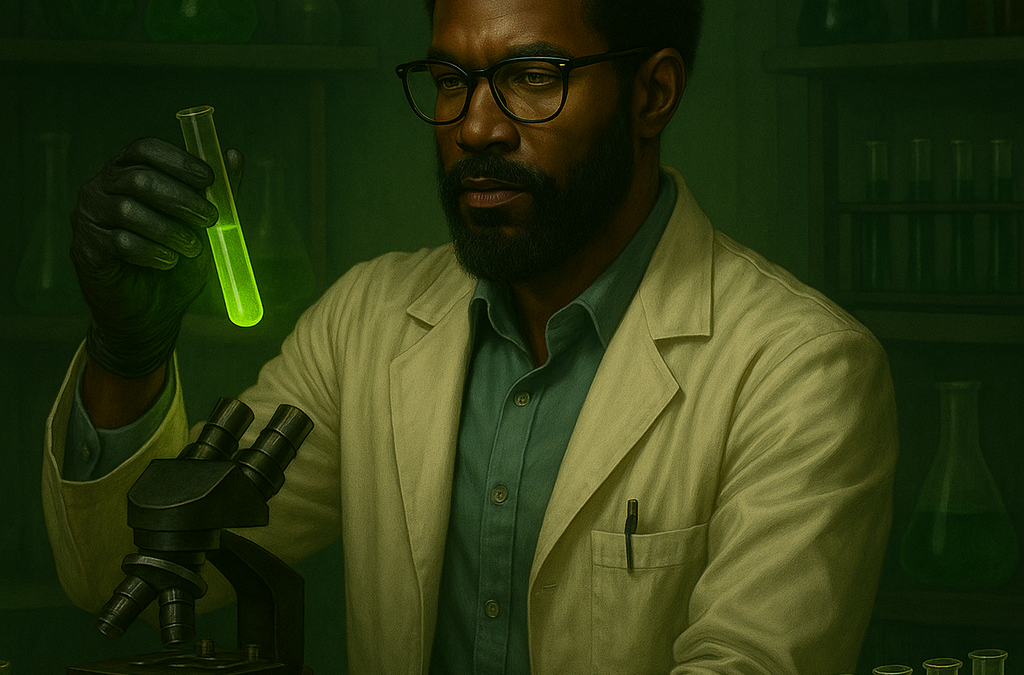
Meta description: Enter the Rainsavers Recruitment File on Dr. Mubari, the ethical scientist protecting the Amazon with biology, field medicine, conservation science, and one extremely patient orangutan.
THE RAINSAVERS // RECRUITMENT FILE
Clearance: Green-Level Operational
Subject: Dr. Manelo Mubari
Field Name: Dr. Manaus
Status: Active, brilliant, under-caffeinated
Primary Risk: Will interrupt a villain to correct their inaccurate botany
File Opening: Identify the Scientist
Dr. Manelo Mubari is the scientific backbone of The Rainsavers, a biogeneticist, researcher, field medic, and rainforest protector who can move from a laboratory analysis to a jungle rescue mission without changing his expression.
That calm expression is important. The rest of the team has plenty of dramatic entrances, daring escapes, and last-second leaps over suspiciously explosive objects. Dr. Mubari brings something different: the ability to look at an impossible situation and ask, “What are the variables?”
Then he solves it.
Usually while someone else is shouting.
Dr. Mubari’s official field name is Dr. Manaus, a nod to the Amazonian city that connects much of his work to the wider world. His expertise includes bio-genetics, biochemistry, pharmacology, natural cures, and life-extension research. But his most valuable skill may be knowing when science needs to slow down, listen, and show some respect.
That is why he belongs in the Rainsavers.
Background Check: Genius With a Conscience
Dr. Mubari earned his PhD in bio-genetics at the astonishing age of 22. Naturally, this made him the kind of person who could walk into a research facility and make everyone else quietly reconsider their career choices.
He began his professional life at BioChem Technologies in New Mexico. The job offered resources, status, and access to advanced research. It also exposed him to unethical animal experiments, including the work being done on Alpha, the highly intelligent orangutan who would become one of Dr. Mubari’s closest friends and most important teammates.
Dr. Mubari made a choice.
He left the company, rescued Alpha, and abandoned the comfortable version of success. Instead, he moved to the Brazilian Amazon, where he began working alongside local and Indigenous communities while studying the rainforest’s extraordinary biodiversity.
This decision is central to his character. Dr. Mubari is not interested in treating the Amazon as a warehouse of ingredients waiting to be patented. He sees it as a living system filled with relationships, history, knowledge, and communities whose voices matter.
In other words, he does not simply ask what the forest can provide.
He asks what the forest needs.

Field Assessment: The Portable Lab Problem
Every Rainsavers recruitment file includes a practical question:
Can the candidate function in the field?
Dr. Mubari’s answer is an enthusiastic yes, although his definition of “function” includes carrying a solar-powered spectrometer through mud while explaining molecular structures to Tom “Primal” Swift.
His mobile laboratory is one of the most useful pieces of equipment in the entire Rainsavers operation. It allows him to study samples, analyze water, identify plant compounds, monitor biological changes, and develop emergency treatments far from conventional medical facilities.
The lab is compact, efficient, and designed to minimize damage to the surrounding environment. It relies on renewable energy systems, careful sampling, and equipment that can be packed up before the jungle has time to judge the team’s parking arrangements.
The standard field kit includes:
- A portable microscope for analyzing soil, water, plants, and suspicious residue
- A compact DNA sequencing unit for rapid biological identification
- Solar-powered testing equipment
- Water purification technology
- Field medicine supplies
- An offline database of rainforest species and medicinal research
- Environmental sensors for tracking changes in air, soil, and water quality
And yes, there have been accidents.
During one early expedition, Dr. Mubari placed a sample tray beside a heater, forgot about it, and spent twenty minutes searching for a “mysterious chemical anomaly.” The anomaly was soup.
A very scientific soup, but still soup.
Psychological Profile: Calm, Precise, and Secretly Funny
Dr. Mubari is analytical, compassionate, and intensely focused. He is also not immune to the occasional field mishap.
His colleagues know that a long silence from the doctor can mean one of three things:
- He has discovered something important.
- He is calculating the team’s chances of survival.
- Alpha has moved one of his instruments again.
Dr. Mubari does not seek attention. He is not the loudest member of the team, and he rarely announces his own importance. Instead, he keeps everyone alive by noticing details others miss.
A strange smell in a river? He investigates.
A patch of plants growing differently from the surrounding forest? He investigates.
Bossman’s operation suddenly buying thousands of filtration units? He definitely investigates.
His approach to science is practical rather than decorative. Research is not something that stays behind glass. It becomes a clean water system, a treatment for an injury, a way to detect contamination, or evidence that an area of rainforest is being damaged before the destruction becomes impossible to reverse.
That matters in a world facing deforestation and climate change. The rainforest is not just scenery for an adventure. It stores carbon, supports extraordinary biodiversity, influences rainfall, and provides homes and livelihoods for millions of people. Damage to one part of the system can create consequences far beyond the original clearing.
Dr. Mubari understands that. He also understands that a lecture about ecosystem collapse is less effective when delivered while running from armed corporate contractors.
Timing is part of field science.
Environmental Mission: Protect the System, Not Just the Symptom
Dr. Mubari’s conservation philosophy can be summarized in one sentence:
A forest is not saved by protecting a few trees while ignoring everything connected to them.
Deforestation is not only the removal of trees. It can damage soil, disrupt water cycles, displace wildlife, threaten Indigenous communities, increase carbon emissions, and make the remaining forest more vulnerable to fire and extreme weather.
That is why Dr. Mubari looks for patterns.
He studies what is happening underground, in the canopy, along the rivers, and inside the communities that depend on the forest. He considers how sustainable living, responsible resource use, conservation funding, and scientific research can work together.
He also knows that technology is not automatically good simply because it is advanced. A sensor can help detect illegal clearing: or it can be used to track people. Genetic research can support healing: or it can become another tool for exploitation.
For Dr. Mubari, the question is never only Can we do this?
It is also:
Who benefits? Who could be harmed? What knowledge are we using? And did we ask permission?
That moral clarity makes him a direct threat to anyone treating the Amazon as a business opportunity with leaves.
Relationship File: Mubari and Alpha
Dr. Mubari’s bond with Alpha began with a rescue and developed into a partnership built on trust.
Alpha is not a mascot, a laboratory curiosity, or a convenient source of comic relief. He is an intelligent individual with his own judgment, skills, and ability to challenge the team’s assumptions. Dr. Mubari understands that better than anyone.
The two work together constantly. Dr. Mubari brings scientific training and medical knowledge. Alpha brings pattern recognition, memory, physical ability, and a perspective shaped by his connection to the natural world.
They also argue.
Not ordinary arguments, either. Dr. Mubari may explain that an experiment requires controlled conditions. Alpha may respond by taking the equipment into the jungle and producing better results before lunch.
On one memorable occasion, Alpha rearranged the doctor’s research notes according to what he considered “logical importance.” The notes were technically organized. They were also upside down, sorted by banana stains, and impossible for everyone except Alpha to understand.
Dr. Mubari called it “an unacceptable breach of documentation protocol.”
He then used the system.

The Spirit Tree Connection
The Spirit Tree represents one of the greatest scientific and ethical challenges in the Rainsavers saga.
To Dr. Mubari, it is not simply a source of mysterious energy. It is part of a complex ecological network involving plants, fungi, insects, animals, soil, water, and generations of cultural knowledge.
His research suggests that the tree may influence the surrounding ecosystem in ways modern science is only beginning to understand. But he refuses to treat that mystery as an invitation to take whatever can be extracted.
The Spirit Tree must be protected because it is alive, valuable, and deeply significant: not because it might power a machine.
That distinction becomes increasingly important as enemies attempt to exploit the tree’s energy for control. Dr. Mubari’s role is to understand what is happening without allowing curiosity to override responsibility.
His research is not about conquering nature.
It is about learning how to stand beside it without breaking anything.

Recruitment Decision: Approved
Final assessment: Essential team member.
Dr. Mubari brings scientific expertise, medical skill, conservation knowledge, ethical judgment, and the patience required to work with Primal, Sunbyte, Jungle Dart, and Alpha during a high-pressure rainforest mission.
He is proof that an adventure hero does not need superhuman strength to change the outcome. Sometimes the decisive move is identifying contamination before it spreads. Sometimes it is protecting local knowledge from exploitation. Sometimes it is developing a water filter, finding a safe route, or stopping the team from drinking something that glows.
And sometimes it is arguing with the jungle until the jungle reveals what it knows.
Want to meet the rest of the crew? Explore the full Rainsavers character files, then visit The Rainsavers to discover the six-book adventure series.
Before you go, leave a comment with one science fact Dr. Mubari should know: or ask him a question. Just be prepared for a detailed answer, three supporting studies, and possibly Alpha correcting your punctuation.
Recruitment status: Open. Conservation mission: Active.
