
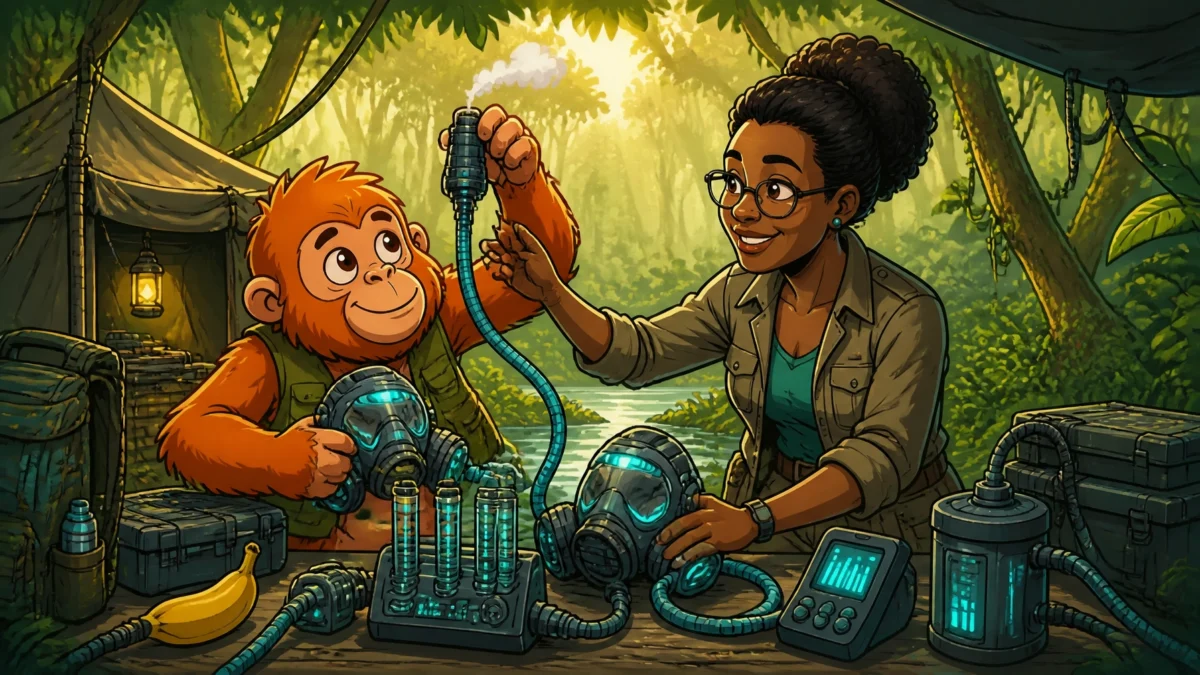
Meta description: Dr. Mubari logs Alpha’s hilariously chaotic respirator calibration attempt during a 2026 rainforest conservation mission. Oops, science, and Amazon rainforest protection included.
06:10 , Camp is awake. The equipment is not.
Field log, Amazon basin, August 28, 2026.
The rainforest has been awake for hours. The cicadas are conducting what I can only describe as a full-volume emergency meeting, the river is moving steadily east, and someone, probably Jungle Dart, has hidden my coffee again.
Alpha is also awake.
This is usually fine.
Today, however, Alpha has announced that he is “ready to assist with respirator calibration.”
I would like the record to show that I did not ask for assistance.
The Rainsavers’ field respirators are essential equipment when we are working near smoke, industrial haze, chemical residue, or the unpleasant leftovers of illegal mining activity. They help protect our team while we document deforestation and gather evidence for rainforest conservation missions.
They are also delicate pieces of high-tech equipment.
Alpha is wearing one as a hat.
Correction: He says it is a “temporary cranial storage position.”
06:18 , The briefing
I place the respirator components on the workbench:
- Two clean facepieces
- Fresh filter cartridges
- Airflow tubing
- A portable calibration meter
- A diagnostic tablet
- Three labeled equipment cases
- One banana, which was not part of the official inventory
Alpha studies the arrangement with deep concentration.
He is brilliant. Truly brilliant. His ability to recognize patterns in ecosystems, machinery, and team behavior has saved us more times than I can count.
But Alpha also has a habit of improving systems that were already working.
I explain the process carefully.
“First, we inspect the seals. Then we connect the tubing. Then we check the airflow. After that, we run the diagnostic sequence.”
Alpha nods.
He picks up the banana.
“No,” I say.
He puts down the banana.
Then he picks up the banana again.
“Still no.”
He looks offended by the limitations of modern science.

06:27 , Alpha discovers the mystery connector
The first problem begins with a small gray connector.
It has two ends. One end attaches to the airflow meter. The other attaches to the respirator tubing.
This is not a trick.
Alpha rotates it twice, examines it from every possible angle, and holds it up to the morning light.
Then he connects it backward.
The calibration meter chirps.
Alpha looks at me.
I look at the meter.
The meter chirps again, now with the unmistakable confidence of a device that has decided we are all making poor choices.
“Disconnect it,” I say.
Alpha disconnects the correct end.
The tubing makes a noise like a startled duck.
From somewhere behind us, Sunbyte says, “I’m adding that sound to the team alert system.”
“No,” I say.
Sunbyte says, “Too late.”
This is why our mission reports take so long.
06:35 , The airflow test, featuring one very determined orangutan
The next stage is straightforward: connect the equipment correctly, activate the blower, and confirm that the airflow reaches the required operating range.
I perform the first test myself. The reading is stable.
Alpha watches closely.
“Your turn,” I tell him.
He takes the respirator, checks the tubing, and attaches the meter. This time, everything looks right.
I allow myself a small, cautious smile.
Alpha presses the activation button.
Nothing happens.
He presses it again.
Still nothing.
He presses it a third time with the force usually reserved for opening stubborn fruit.
The blower starts at maximum power.
A harmless puff of air blasts my field notes off the table.
Page one lands in the soup.
Page two lands on Alpha.
Page three disappears into a nearby fern.
Alpha freezes.
I retrieve the pages while he attempts to look innocent. This is difficult because he is holding the respirator upside down and wearing the portable meter on one arm like a bracelet.
Oops count: 4.
For clarity:
- Respirator used as hat
- Banana identified as technical equipment
- Connector attached backward
- Field notes launched into soup
The mission has not technically failed.
The soup, however, has entered a new phase of scientific uncertainty.
06:49 , A proper seal check
Before any field deployment, every wearer must check that the respirator fits correctly and forms a proper seal. Calibration is only useful if the equipment fits the person using it.
This is one of those important details that adventure stories sometimes skip because it is less dramatic than jumping from a helicopter.
It is still important.
A poor seal can allow contaminated air around the facepiece, which defeats the purpose of wearing one. In real-world work, respirator selection, fit testing, inspection, and training should follow the manufacturer’s instructions and applicable workplace safety guidance. For practical information, the CDC’s respirator fit-testing guidance is a useful starting point.
In our camp, I demonstrate the check.
Alpha copies me.
I inhale gently.
Alpha inhales dramatically, puffing his cheeks until he resembles an extremely serious orange balloon.
“Not like that,” I say.
He deflates.
We try again.
This time, he follows the procedure correctly. The seal holds.
The diagnostic meter gives a soft green pulse.
Alpha raises both arms in victory and catches one of the hanging vines.
The vine holds.
The equipment case does not.
The case slides off the table, opens, and releases six spare filters into a basket of clean laundry.
Oops count: 5.
The good news: the filters are still sealed.
The other good news: Alpha is now banned from celebrating near tables.

07:05 , Why this matters beyond our camp
It would be easy to treat this morning as a comedy of errors involving one genius orangutan and several pieces of equipment that clearly lack a sense of humor.
But the work itself is serious.
Smoke from forest fires can affect air quality across large areas. Industrial activity, burning, fuel, and dust can create additional risks for communities and field teams. During conservation work, reliable equipment helps researchers and responders work more safely while monitoring conditions.
Respirators do not stop deforestation. They do not reverse climate change. They cannot, by themselves, protect the Amazon.
People do that through sustained action:
- Supporting responsible rainforest conservation programs
- Reducing waste and choosing more sustainable living practices
- Learning how supply chains affect forests
- Supporting communities protecting their land
- Reporting environmental crimes through appropriate local channels
- Paying attention to policies that address fires, emissions, and habitat loss
Our equipment gives us a safer way to enter difficult environments. It does not give us permission to be careless.
I explain this to Alpha.
He listens.
Then he carefully places the banana beside the calibration meter.
“Snack break,” he says.
At least he is using words now.
07:22 , Field-ready, mostly
The final calibration sequence runs without incident.
This is a suspicious development.
The meters confirm stable airflow. The seals are checked. The cartridges are secured. Each respirator is packed in its own protective case.
Alpha performs an inspection using a checklist I wrote specifically for him.
It contains five questions:
- Is the respirator clean?
- Is the tubing connected correctly?
- Is the meter attached to the correct port?
- Is the equipment case closed?
- Is the banana somewhere else?
Alpha answers all five correctly.
I am proud.
He is proud.
The rainforest continues being magnificent and loud.

07:40 , Lessons learned
Today’s calibration exercise produced several useful findings.
Finding one: Alpha can absolutely help
His pattern recognition identified a minor airflow irregularity before the diagnostic system flagged it. He also noticed that one filter case had not been fully sealed.
That was excellent work.
Finding two: Alpha should not rewrite the checklist
His proposed additions included:
- “Does the respirator feel emotionally supported?”
- “Has the operator eaten enough fruit?”
- “Can the equipment climb a tree if necessary?”
I rejected all three.
Finding three: Never place field notes near soup
This one is for me.
Finding four: Conservation work requires patience
Protecting the Amazon is not one dramatic moment followed by triumphant music. It is inspection after inspection, report after report, careful measurement, difficult conversations, and showing up again tomorrow.
Sometimes it is also rescuing a filter cartridge from a laundry basket.
That counts too.
08:00 , Final status report
Respirators: calibrated.
Team: safe.
Field notes: mostly dry.
Banana: consumed.
Alpha: promoted to Assistant Calibration Specialist, Probationary.
He has requested a uniform.
I have requested that the uniform include no pockets.
Our next task is to survey an area threatened by illegal clearing and document changes along the river edge. That work connects directly to the larger mission of amazon rainforest protection: defending living ecosystems from greed, pollution, and careless destruction.
If you enjoy action-adventure stories where science, teamwork, environmental stakes, and the occasional equipment-related oops collide, explore The Rainsavers. The six-book saga begins in the Amazon and keeps expanding, from rainforest threats to global conspiracies, ancient mysteries, and dangers far beyond Earth.
And yes, Alpha gets to help.
Eventually.
08:12 , Addendum written in a different handwriting
Dr. Mubari,
I calibrated very good.
The banana was not a mistake. It was morale equipment.
Please approve pockets.
: Alpha
Recommendation: Approve morale equipment. Deny pockets.
Read Book One now and join The Rainsavers on their first rainforest mission.
