
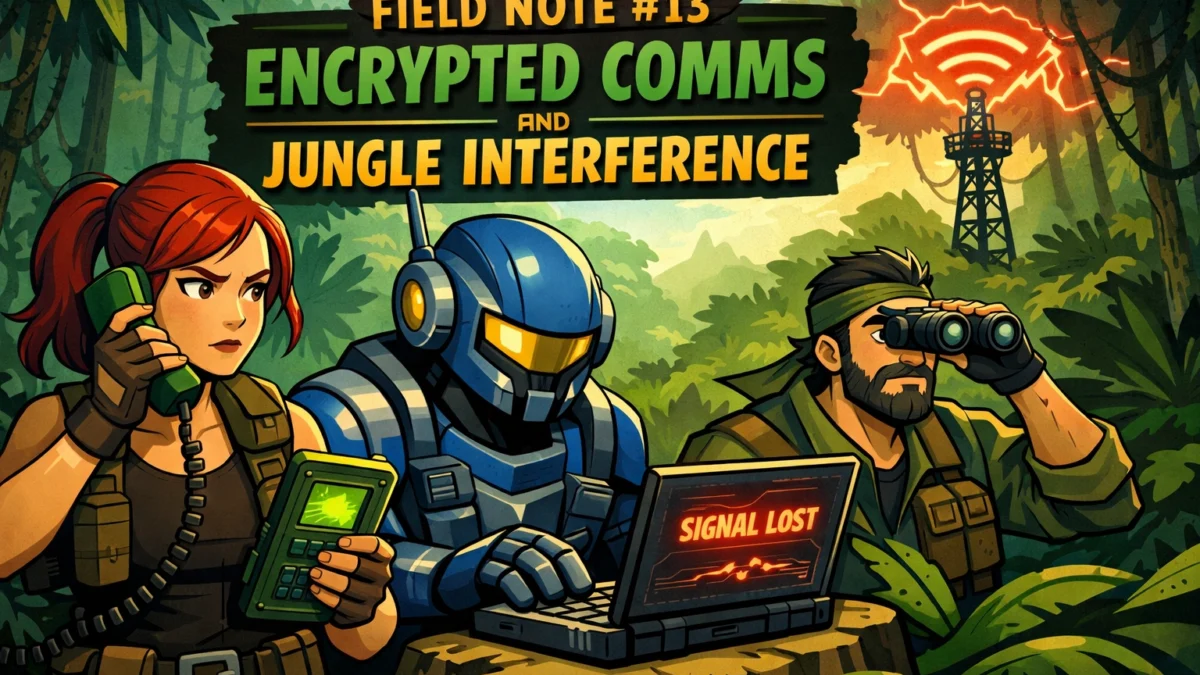
Meta Description: Ever wondered why mission comms always fail at the worst moment? Join The Rainsavers for Field Note #13 as we dive into the glitchy, sweaty world of encrypted radio interference in the deep jungle.
ALT Text: A distorted digital radio wave visual superimposed over a dark, misty, neon-lit tropical jungle background.
TIMESTAMP: 14:22 Zulu
LOCATION: Somewhere in the Xingu Basin (Humidity: 110%, Morale: Moist)
SUBJECT: Why my $5,000 radio is currently a very expensive paperweight.
The Tactical Briefing (That No One Listened To)
Listen, being a hero in a The Rainsavers adventure sounds glamorous in the pitch deck. You get the cool gear, the noble mission, and the chance to save the planet. But nobody tells you about the "Green Wall." No, I’m not talking about an eco-friendly fence. I’m talking about the sheer, unadulterated signal-killing power of the jungle.
If you’ve been following our missions (and if you haven’t, head over to our episodes page to catch up), you know that coordination is everything. But in Field Note #13, we’re pulling back the curtain on the biggest villain we face: Electromagnetic Interference vs. The Canopy.
The Science of "Can You Hear Me Now?"
Here’s the deal. We use high-end Digital Mobile Radio (DMR) technology. It’s supposed to be crisp. It’s supposed to be secure. It’s supposed to work through solid concrete. But put a DMR unit in a tropical rainforest, and suddenly you’re playing a very high-stakes game of "Telephone" where the losing team gets chased by a caiman.
The jungle isn't just trees; it’s a giant, wet, pulsating sponge. Every single leaf is coated in moisture. In physics terms, that’s "signal attenuation." In "Rain-Saver" terms, that means your 400MHz signal is being swallowed by a fern before it even clears your shoulder strap.

ALT Text: A close-up of a tactical radio receiver covered in raindrops and mud, sitting on a giant tropical leaf.
Encryption: The Secret Language of Static
Now, let’s talk about encryption. Because we’re dealing with some pretty nasty villains (check out our thoughts on ancient vs. modern villains for the context), we can’t just talk on an open channel. We use 256-bit AES encryption. It’s unhackable. It’s also incredibly "heavy."
When you encrypt a voice signal, you’re adding layers of data. In a clear environment, that’s fine. But when the jungle is already chopping your signal into bits, the encryption hardware has a hard time "stitching" the message back together on the other end.
THE RESULT:
What I said: "Advance to the extraction point near the waterfall."
What the team heard: "Dance with… an extraction… point… at the… loud farting sound."
The "Oops" Moment: The Great Banana Incident
To illustrate how frustrating this is, let’s look at a redacted log from last Tuesday. I was trying to coordinate a tactical perimeter around a sensitive site.
TEAM LEAD: "Alpha 1, do you have eyes on the target? Over."
ALPHA 1 (JAX): "Static… negative… crackle… I have… buzz… bananas."
TEAM LEAD: "Repeat, Alpha 1? You have the payload?"
ALPHA 1: "No! I said… pop… I found… whistle… giant spiders… static… eating bananas."
By the time we realized Jax wasn't being attacked by a high-tech drone but was simply staring at a bunch of arachnids having a snack, the target had moved three miles downstream. This is why we can’t have nice things. Or clear comms.

ALT Text: A stylized comic-style illustration of a confused adventurer holding a radio while a large spider hangs nearby.
Fighting the Interference: Tactics for the Desperate
When the tech fails, we have to get creative. If you're writing your own eco-fiction or just curious about how we survive these "Field Notes" disasters, here are our top-secret (and mostly failed) tactical workarounds:
- The "Antenna-on-a-Stick" Method: We literally duct-tape our radios to 20-foot bamboo poles and hoist them into the air. It looks ridiculous. It makes us a lightning rod. But hey, sometimes you get one bar of signal.
- Frequency Hopping: We try to find the "sweet spot" in the spectrum. Lower frequencies (VHF) tend to "bend" around trees better than higher ones (UHF). Unfortunately, VHF is also where every local taxi service and maritime ghost signal hangs out.
- The "Yelling" Technique: When all else fails, we resort to the 1.0 version of communication. Lung power. It’s very effective for alerting the enemy to your exact location.
Why Does This Matter for The Rainsavers?
You might be asking, "Steven, why are you telling us about radio static?" Because at The Rainsavers, we believe that real adventure is messy. In a lot of fiction, the gadgets always work perfectly. The hero presses a button on their ear, and they have a crystal-clear conversation with a satellite in orbit.
In our world, the gear breaks. The batteries die because the humidity corroded the terminals. The "encrypted comms" fail because a parrot decided to mimic the sound of the encryption key. That’s what makes the stakes real. When the radio goes silent, our characters have to rely on their wits, their training, and each other.
If you love stories where the heroes are one broken radio away from disaster, you’ll want to check out our latest guide to adventure series.

ALT Text: A diagram showing a radio signal bouncing off trees and failing to reach a satellite.
The Multi-Path Nightmare
There’s another technical demon in the jungle called "Multi-path interference." Imagine your radio signal is a tennis ball. In an open field, you throw it straight to your friend. In the jungle, the ball hits a mahogany tree, bounces off a wet rock, ricochets off a vine, and eventually hits your friend in the back of the head.
The radio receiver gets the same signal multiple times, slightly out of sync. For digital encryption, this is a nightmare. The processor tries to align these signals, gets a "headache," and just gives up. We call this the "Digital Cliff." One second you’re talking, the next: absolute silence.
Survival Tips (For Your Next Jungle Mission)
If you ever find yourself in a Rainsavers-style situation, keep these tactical comms tips in mind:
- Elevate: If you can’t see the sky, your radio can’t see your friends.
- Dry is Fly: Keep your comms in a dry bag. Even "waterproof" gear hates the 100% humidity of a tropical rainstorm.
- Simple is Better: Sometimes, a flare or a whistle is worth more than a $5,000 encrypted handset.
- Check the Battery: Seriously. Jax forgot to charge his last week because he thought "solar charging" worked under a 4-layer leaf canopy. (Spoiler: It doesn’t).
What’s Next for Field Notes?
We’re currently working on a way to use bio-luminescent moss as a backup signaling system, but so far, we’ve just ended up with glowing boots and a very confused jaguar.
In the meantime, we want to hear from you! Have you ever had a tech fail at the worst possible time? Was it as embarrassing as Jax and the banana spiders? Drop us a line on our contact page or join the conversation on our blog page.

ALT Text: A comedic "Out of Order" sign hanging on a high-tech military radio.
Join the Mission
The world of The Rainsavers is full of high-tech gadgets and low-tech disasters. Whether we’re fighting climate villains or just trying to get a signal through a rainstorm, we’re doing it with heart, humor, and a lot of spare batteries.
Ready to dive deeper?
- Check out our Characters to see who’s currently shouting into a dead radio.
- See our Shop for the latest gear (radio not included).
- Enter the Down the Rabbit Hole Contest for a chance to join the team!
Stay dry, stay loud, and for heaven's sake, don't let Jax touch the antenna.
: Steven G. Samuels
CEO, The Rainsavers
DIRECT CTA: Want to see how we handle these comms failures in action? Click here to explore the full library of Rainsavers adventures!
