
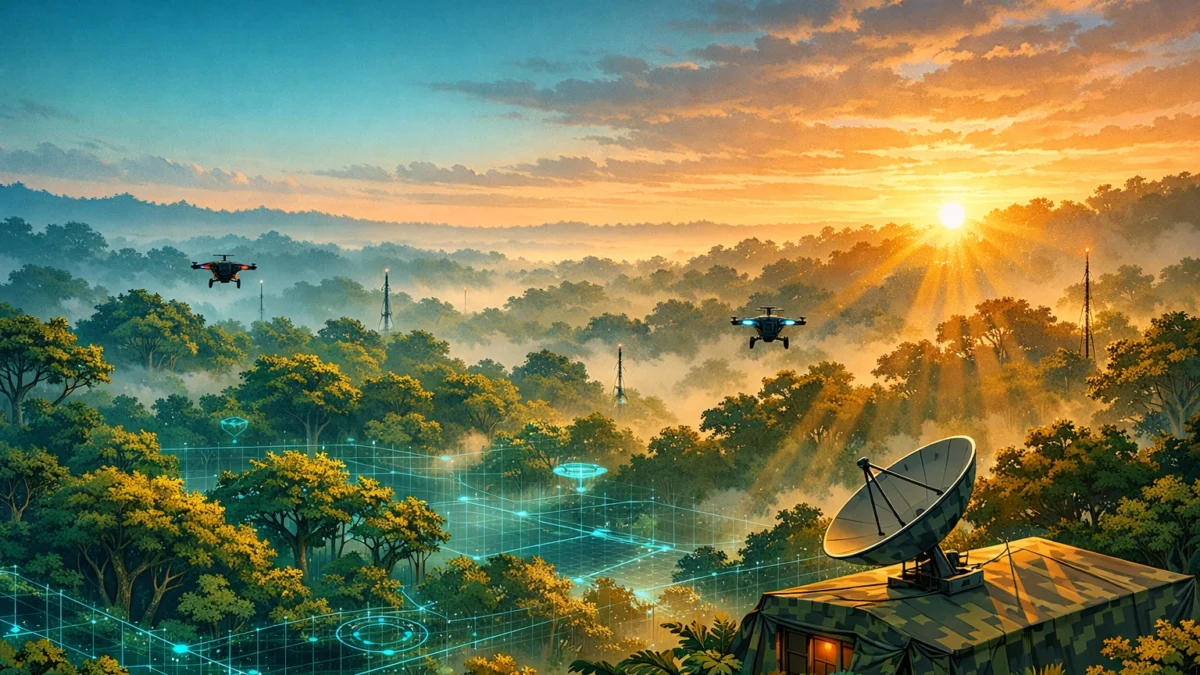
Meta Description: The Amazon isn’t just “pretty jungle”—it’s a 2026-ready sci-fi battleground: unmatched biodiversity, natural concealment, brutal logistics, and perfect terrain for drones, sensors, and covert ops. Here’s why The Rainsavers keeps going back.
Hey everyone—Steven here… okay fine, it’s Penny. It’s March 2026, and I’m filing this one as a straight-up field report: if you need a setting that can support global stakes, hard tactical problems, and eco-driven sci-fi drama without feeling fake, the Amazon rainforest is basically the ultimate sandbox.
In The Rainsavers, we don’t use the jungle as wallpaper. We use it like a living system with defenses, blind spots, and consequences. And in 2026—when drones are cheap, sensors are everywhere, and greedy operators still think “remote” means “unaccountable”—the Amazon becomes a high-stakes sci-fi setting that writes half the tension for you.
The Amazon’s Ecological “Superpower”: Biodiversity That Changes the Rules
Sci-fi loves “unknowns.” The Amazon delivers them in bulk.
This ecosystem is stacked with layers of life: canopy, understory, forest floor, rivers, floodplains—each one its own world. From a storytelling standpoint, that means the terrain isn’t just complicated, it’s alive and constantly shifting.
Tactically, biodiversity creates:
- False patterns and noise: movement, heat, sound, and bio-signals everywhere. Good luck telling a boot print from a tapir track when it rained six minutes ago.
- Fragile choke points: a single contaminated tributary or burned corridor can ripple outward fast. The “battlefield” remembers what you did.
- High consequence collateral: you can’t “just blow something up” without triggering a cascade—fires, die-off, displacement, long-term damage.
In other words: the Amazon makes reckless villains look like villains… and forces heroes to be smarter than “kick the door down.”
Natural Concealment vs. 2026 Surveillance: The Great Hide-and-Seek Arms Race
People talk about the Amazon like it’s wide open because it’s huge. It’s not open. It’s sealed.
The canopy is a roof. The understory is a maze. The rivers are highways with booby traps (some are literal, some are just nature being nature).
That creates a delicious 2026 tension:
- Drones and satellites want clean lines of sight.
- The rainforest specializes in breaking lines of sight.
So you get this constant chess match:
- Micro-drones trying to map gaps in the canopy.
- Acoustic sensors trying to separate machinery from storms and insects.
- Thermal imaging getting confused by wet leaves, warm mud, and “everything is alive.”
If you like adventure stories that feel like tomorrow’s tech crashing into ancient terrain, that’s the vibe we build into The Rainsavers—because “remote” doesn’t mean “simple,” it means “harder to verify.”
Logistics: The Jungle is a Boss Fight (And It Doesn’t Negotiate)
The Amazon is the kind of setting where logistics becomes plot—and that’s a good thing.
Forget tidy supply lines. You have:
- Humidity and water that wreck equipment.
- Mud and rot that eat boots, cords, and morale.
- Distance that turns “quick extraction” into “cool story, see you in three days.”
- Rivers that are both transport and obstacle depending on season.
For villains, that means hidden operations can exist… but they’re never stable. They need fuel, food, med supplies, parts, and people who don’t panic when the jungle starts winning.
For heroes (hi, Rainsavers), it means every mission needs trade-offs:
Do you move fast and get sloppy? Or move slow and risk the objective?
The Rainforest as a Sensor Network (Whether You Like It or Not)
Here’s the fun part: the Amazon is already a monitoring system. Not digital—biological.
You get:
- Sound carrying in weird ways after rainfall.
- Animal behavior shifting when something loud or toxic enters an area.
- Plant damage and trail scars that signal intrusion.
Now add 2026 tech—drones, passive listening arrays, tiny camera traps, mesh networks—and suddenly the Amazon becomes a layered intelligence arena:
- High-tech sensors can watch illegal extraction routes.
- Low-tech tracking (prints, broken vines, disturbed canopy) still matters because electronics fail.
- Data becomes a weapon: mapping, proof, attribution. If you can document it, you can stop it—or at least expose it.
This is why our stories keep circling back to the idea that environmental protection isn’t just heart—it’s tactics, evidence, and outsmarting people who bank on darkness.
Why the Stakes Feel Bigger in the Amazon (Even Before the Bad Guys Show Up)
Some settings tell you they’re important. The Amazon is important, even without exposition.
It’s a climate engine. It’s a biodiversity vault. It’s a place where damage doesn’t stay local.
So when a villain tries to carve out a “private zone” for resource theft or experimentation, the threat isn’t “oh no, a building might explode.”
The threat is:
- habitat collapse
- water-cycle disruption
- irreversible loss
- a chain reaction the whole planet feels
That’s the heartbeat of The Rainsavers: action-adventure that keeps the punches and chases, but never forgets what’s on the line. If you want more on that overall angle, this is a good companion read: why eco-fiction will change the way you think about adventure stories.
Field Notes: 6 Tactical Advantages the Amazon Gives Your Story (And Your Heroes)
- Instant concealment (until it isn’t)
- High-stakes trade-offs (speed vs. stealth vs. impact)
- Natural traps (flooding, storms, terrain collapse)
- Built-in escalation (a small action can become a massive disaster)
- Tech friction (batteries die, sensors lie, comms drop)
- Moral clarity (protecting the rainforest isn’t abstract—it’s immediate)
Also: if you’re writing villains, the Amazon gives you one more bonus—plausible deniability. “Nobody saw it.” “No one can prove it.” “It’s too far out.” That’s exactly why heroes like the Rainsavers exist.
Final Field Notes (Because We Always Learn Something the Hard Way)
The Amazon is the ultimate high-stakes sci-fi setting for 2026 because it’s not a blank map. It’s a system—massive, reactive, and brutally honest.
Bring drones. Bring sensors. Bring your fancy gear. The rainforest will still demand the same thing from every character on the page:
Respect… or consequences.
Want to drop into the Amazon with the team and see how these missions actually play out?
