
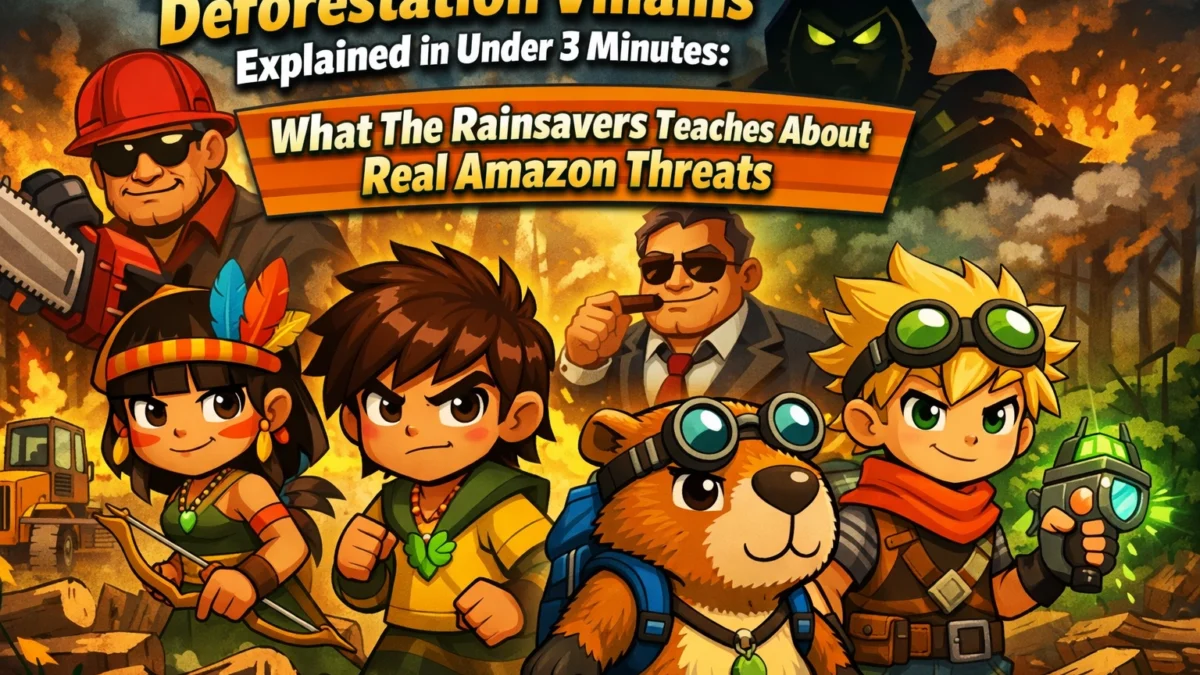
Meta Description: Real Amazon deforestation has villains just like fiction. The Rainsavers series mirrors actual threats, from illegal loggers to organized crime, making eco-adventure hit different in 2026.
Look, I'll be straight with you: when we created The Rainsavers, we didn't pull the villains out of thin air. Every antagonist, every threat facing the Amazon in our series? They're ripped from headlines that most people scroll past on their morning coffee break.
The difference? Our heroes actually fight back.
The Real Villains Aren't Wearing Masks
Here's the thing about 2026, we've watched Amazon deforestation hit crisis levels for years. Over 20% gone since 1970. Another 20% threatened right now. And the villains destroying it? They're not mysterious shadow figures. They're documented, organized, and ruthlessly efficient.
Illegal Loggers & Organized Crime: Thousands of people unlawfully invading protected lands. We're talking coordinated operations, not some lone guy with an axe. Crime syndicates orchestrating wholesale theft of forests.
Government Inaction: When the people who should be protecting these lands just… don't? That's a villain move. The Brazilian government's failure to act has allowed wildfires and deforestation to reach 15-year highs.
Economic Greed: Capitalism gone wild. Cattle ranching. Resource extraction. The almighty dollar trumping the planet's lungs. Legal and illegal operations clearing thousands of acres for profit.
Poachers: Stealing wildlife, feathers, furs, everything the canopy can't replace fast enough.
Sound familiar? If you've read The Rainsavers, it should.

How The Rainsavers Mirrors These Threats
The brilliant (and honestly terrifying) part about writing eco-fiction in 2026? We barely need to exaggerate.
Mortalis and the Corporation Model: Our villain isn't some cartoonish evil-doer. Mortalis represents that organized crime element, structured, resourced, motivated by profit over preservation. Just like real illegal logging operations that function like businesses, complete with supply chains and distribution networks.
The Tech Angle: Remember the red mercury storyline? That's us taking real resource exploitation and cranking it up. In reality, it's minerals, timber, and land. In our universe, it's exotic technology and ancient power sources. Different scale, same destructive pattern.
Primal's Perspective: Our character who understands the rainforest on a primal level? That's representing the indigenous knowledge and local communities who've been sounding the alarm for decades. The ones who actually know what's being lost while governments debate policy.
The Rainsavers team isn't just fighting generic "bad guys." They're up against systemic threats that mirror what's actually destroying the Amazon as you read this.
Why This Makes for Better Stories (And Better Awareness)
Eco-fiction hits different when it's grounded in reality.
You can't get invested in a hero fighting a threat that feels made-up. But when the villain's motivations reflect actual economic pressures? When their methods mirror real illegal logging operations? Suddenly the stakes feel real because they are real.
We're not preaching. We're showing. Through adventure, through conflict, through characters you actually care about.

The Three-Minute Breakdown: Real Threats vs. Fiction
Threat #1: Organized Illegal Operations
- Real World: Crime syndicates coordinating forest invasion
- The Rainsavers: Mortalis's structured operation and resource networks
- Why It Matters: This isn't random destruction, it's calculated theft
Threat #2: Government Failure
- Real World: Inaction allowing deforestation to soar
- The Rainsavers: Corrupt officials and bureaucratic obstacles the team faces
- Why It Matters: Sometimes the villain is who's NOT acting
Threat #3: Economic Incentives
- Real World: Cattle ranching, mining, resource extraction
- The Rainsavers: Competing interests trying to exploit rainforest resources
- Why It Matters: When profit trumps preservation, everyone loses
Threat #4: Wildlife Exploitation
- Real World: Poaching irreplaceable species and resources
- The Rainsavers: Theft of ancient artifacts and ecosystem-critical elements
- Why It Matters: Once it's gone, it's gone forever
What Makes The Rainsavers Different
Most environmental stories either go full documentary (dry) or full fantasy (disconnected). We're threading the needle.
Our villains have believable motivations. Our threats mirror actual patterns. Our heroes use both high-tech innovation and traditional knowledge, because that's what's actually needed.
And yeah, there's red mercury and sci-fi elements. Because eco-fiction can be fun AND educational. Wild concept, right?

The 2026 Reality Check
Here's where we're at right now: 15-year highs in Amazon destruction. Climate scientists increasingly worried. Indigenous communities still fighting for recognition. And most people still don't grasp the scale of what's being lost.
That's where fiction comes in.
Not to escape reality: to engage with it in a way that actually sticks. When you see Primal fighting to protect ancient forest systems, you're absorbing information about real ecosystems. When Mortalis schemes to exploit resources, you're learning about actual exploitation patterns.
Entertainment with a backbone. Adventure with a purpose.
Why Villains Matter
Look, anybody can write a story where the bad guys are "just evil." That's lazy. Real villains: both in fiction and reality: think they're justified. They have economic pressures, family obligations, societal expectations.
The illegal loggers? Many are people desperate for income in regions with few opportunities. The corporations? They're serving shareholders and quarterly reports. The corrupt officials? They're caught in systems bigger than themselves.
Understanding that complexity makes for better fiction AND better solutions. Because you can't fight what you don't understand.
The Rainsavers doesn't pretend it's simple. Our villains reflect that messy reality. And our heroes have to navigate it intelligently: not just punch their way through.
Your Three-Minute Takeaway
If you remember nothing else:
- Amazon deforestation has real, documented villains (illegal loggers, organized crime, government inaction, economic greed)
- The Rainsavers mirrors these threats through grounded storytelling with a sci-fi twist
- Fiction can spotlight reality in ways that documentaries and statistics can't
- Complex villains make better stories and help us understand real-world problems
- 2026 is a critical year for both rainforest protection and eco-conscious storytelling
Ready to Meet the Real Heroes?
We've talked about the villains. Now it's time to see how The Rainsavers team actually fights back.
Dive into the series and experience eco-adventure that actually reflects the threats our planet faces. No lectures. Just great storytelling grounded in real stakes.
Start reading The Rainsavers now →
Check out our character profiles to meet the team standing between organized exploitation and total rainforest destruction. Because in 2026, both fictional and real rainforests need all the savers they can get.
The Rainsavers: Where eco-fiction meets real-world urgency. Published daily because the Amazon can't wait.
