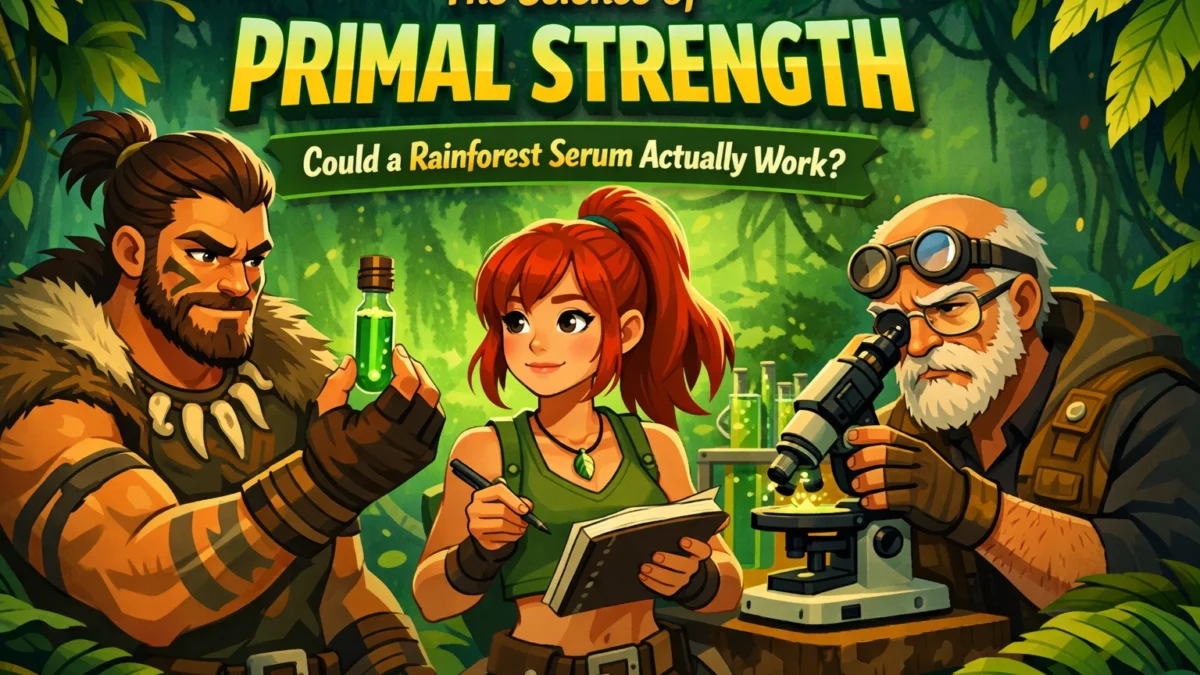
So here's a question that keeps popping up in our inbox: Could Tom Swift's primal strength serum actually exist?
You know the one. The mysterious green vial that transforms an ordinary guy into someone who can literally punch through reinforced steel. The serum that starts everything in The Rainsavers series and basically ruins Tom's entire life while simultaneously making him really, really good at breaking things.
Let's dig into the science, both real and wildly fictional, behind this plot device that won't quit.
The Real Deal: Why the Amazon Rainforest Is Basically Nature's Pharmacy
Here's what's not fiction: the Amazon rainforest contains approximately 10% of all species on Earth. That's millions of plants, insects, and microorganisms, many of which produce chemical compounds we've never even studied.
Pharmaceutical companies know this. That's why they've been bioprospecting in rainforests for decades. Roughly 25% of modern medicines are derived from rainforest plants. Quinine (malaria treatment), curare (muscle relaxant used in surgery), and even compounds that fight cancer, all came from tropical ecosystems.

The Amazon produces bioactive compounds for a simple reason: survival. In a hyper-competitive environment where everything is trying to eat everything else, plants evolve chemical defenses. Fungi develop antimicrobial strategies. Insects create venom cocktails. It's a biochemical arms race that's been running for millions of years.
So when we wrote about Leonard West's research team discovering a unique compound deep in the Amazon basin, something that could theoretically amplify human cellular regeneration, we weren't pulling it completely out of thin air. The type of discovery? Totally plausible. The effect of the discovery? That's where we took some… creative liberties.
The Fiction Part: Why Tom Can't Actually Bench Press a Jeep
Let's be honest. No serum is going to give you superhuman strength in the way Tom Swift experiences it. Here's why:
Human muscles have physical limits. Even if you could somehow optimize every muscle fiber for maximum performance, you're still constrained by the tensile strength of tendons, the density of bone, and the basic laws of leverage. Your body would literally tear itself apart before you could lift a car over your head.
Energy requirements would be absurd. Tom's enhanced strength would require a metabolic rate that would make a hummingbird look lazy. He'd need to consume somewhere in the neighborhood of 20,000+ calories daily just to maintain basic function. The series conveniently glosses over the fact that Tom should be eating entire chickens between every mission.
Cellular regeneration has hard stops. Yes, there are compounds that can promote healing and cellular growth. But the kind of rapid-fire regeneration Tom experiences (healing broken ribs in days instead of weeks) would require rewriting fundamental aspects of human biology. We're talking telomere lengthening, enhanced mitochondrial function, accelerated protein synthesis, basically everything at once.

Could science eventually get us closer to enhanced healing and performance? Maybe. CRISPR gene editing, mRNA therapies, and synthetic biology are advancing fast. But we're talking decades, possibly centuries, away from anything resembling a "super serum."
Where We Split the Difference: Making Fiction Feel Real
Here's the thing about writing The Rainsavers series: we wanted the serum to feel just plausible enough that you could suspend disbelief. Not so realistic that it becomes a biology textbook, but not so cartoonish that it breaks immersion.
So we gave it rules:
It's not unlimited. Tom's enhanced abilities come with serious drawbacks. The serum messes with his emotional regulation. It creates dependencies. It makes him a target. There's always a cost, which keeps the story grounded even when he's literally ripping doors off hinges.
It requires rare components. The serum isn't something you can just cook up in a garage. It requires specific Amazonian plant compounds, precise environmental conditions during synthesis, and equipment that most labs don't have access to. This scarcity drives the entire plot.
It's unstable and dangerous. Leonard West's version of the serum works, sort of. But it also has catastrophic failure modes. People die trying to replicate it. Side effects are brutal. Success rates are terrible. This isn't a miracle cure; it's a dangerous prototype that shouldn't exist.
By building in these limitations, the serum becomes more than a power-up. It becomes a problem that defines character choices throughout the series.
The Real Question: What Would We Actually Discover?
If a team really went into the Amazon looking for performance-enhancing compounds, what might they actually find?
Probably not super strength. But potentially:
Enhanced endurance compounds. Plants that indigenous communities have used for centuries to extend hunting stamina or reduce fatigue during long treks. Science has already validated some of these, like guarana's caffeine content being more sustained than coffee.
Accelerated healing agents. Certain tree resins and plant extracts have documented antimicrobial and anti-inflammatory properties. Nothing that would heal a bullet wound in three days, but compounds that could meaningfully speed recovery when properly refined.
Cognitive enhancers. Alkaloids and other compounds that affect neurotransmitter function. Again, nothing that would give you telepathy or super-intelligence, but substances that could improve focus, memory, or reaction time.

The actual discoveries would be more subtle, more nuanced, and honestly more interesting from a scientific perspective. But they'd make for slower-paced fiction, which is why Tom gets to throw people through walls instead.
Why We Love Impossible Science Anyway
Look, nobody reads The Rainsavers because they want a peer-reviewed dissertation on biochemistry. You read it because watching Tom Swift accidentally become a bioweapon and then have to save the rainforest while dealing with corporate mercenaries and his own unstable physiology is way more fun than reality.
But we do our homework. We research the real science. We talk to biologists and pharmacologists (yes, really). We build the fictional science on a foundation of actual facts: and then we crank everything up to eleven.
Because here's the truth: the best speculative fiction asks "what if?" in ways that feel tangible. What if we could unlock human potential through rainforest compounds? What would that cost? Who would control it? How would it change the person who received it?
Those questions drive the entire series, and they're way more interesting than whether the chemistry actually checks out.
Your Move: Explore the Impossible
Could a primal strength serum work? Scientifically? No.
Could it work in a thriller series that blends environmental adventure with impossible choices and characters who are this close to completely losing it? Absolutely.
The Rainsavers isn't about perfect science. It's about imperfect people making impossible decisions in extraordinary circumstances: starting with one vial of green liquid that should never have existed.
Discover Primal's origins in Book One and see exactly how wrong things go when science meets ambition in the heart of the Amazon. Fair warning: nobody makes it out without consequences.
Read the series at The Rainsavers and decide for yourself whether Tom Swift's serum is brilliant science fiction or just really entertaining nonsense. (Spoiler: it's both.)
